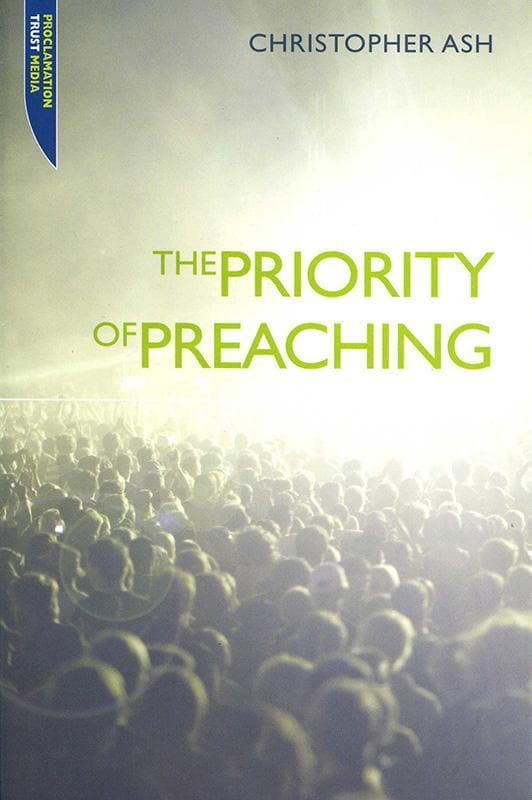
In this book, The Priority of Preaching, Christopher Ash highlights how preaching isn’t just about personal or individual growth but it is for shaping and growing community. He pushes back against the idea of faith as an individual journey, suggesting instead that preaching is a communal act that draws the church together under God’s Word. He’s already made the point that preaching is to have a sense of urgency. Here Ash argues that preaching isn’t to be a private conversation between the preacher and the individual listener; it’s an act that gathers and unites believers who are strengthened and encouraged together by His grace.
At one point Ash writes, “The church is not a collection of individuals who sometimes assemble; it is an assembly whose members may sometimes be dispersed.” This reflects his belief that the church isn’t defined by the scattering of believers during the week but by their gathering regally together to hear the Word preached. Therefore, preaching builds up the church as a whole. It is the reminder that all parts of the body make up the body, when one part is missing then it’s not the whole. This is similar to 1 Corinthians 12:12, “Just as a body, though one, has many parts, but all its many parts form one body, so it is with Christ.”
The communal nature of preaching can be traced back to the Israelites’ gatherings in the Old Testament. Ash points out that in Deuteronomy, the people didn’t gather as isolated individuals; they assembled as a covenant people, standing together to hear God’s Word (Deuteronomy 31:11-13). This gathering wasn’t just a formality; it was a formative experience where they were reminded of their identity and purpose as God’s people. Preaching today carries the same purpose: it’s an act that brings people together, grounding them in God’s promises and shaping their collective identity as a church.

What are the implications for today, then?
First, it challenges the modern day consumer mentality that can (or has) crept into churches, where people approach a service or gathering as a personal experience. While personal application may well be the outcome of the preaching of the Word, it goes beyond that toward fostering a communal identity and purpose grounded in the gospel. Similarly to Ephesians 4:12-13, where Paul describes the goal of ministry as “to equip his people for works of service, so that the body of Christ may be built up until we all reach unity in the faith.” preaching isn’t just about a message delivered; it’s about building up the church as the body in Christ.
Second, this focus on the communal aspect of preaching is a reminder that the church is firstly a gathering of people who are united in Christ. It’s not merely a place for individual self help but a community built on God’s Word. Preaching, then, serves as a regular reminder of who we are together as a church, connecting each believer’s personal faith to a larger identity and greater story of God’s people. This, hopefully, helps us reflect Christ’s love to the world, not as a scattered group but as a community.
Third, the reminder that preaching is communal highlights the role it has in culture. Ash suggests that preaching, when done with the gathered church in mind, becomes a point of difference between church and the world. This is not to say that preaching is an exercise in cultural critique, rather it should be for the whole of the church to respond to the whole world from a biblical worldview and gospel understanding. When preaching for community, instead of the individual, it enables gospel response and gospel conviction.
Fourth, this angle on preaching makes us think about the church as something a little more fluid because of the group aspect, rather than simple Sunday services, or select individuals with large voices or passions. It means making application points toward the group as a whole, not just individual self-help messages. For example, when preaching on forgiveness, this is not just about how individuals can forgive, but how we do that collectively in the church and as a church toward others.
In some ways, preaching as building community means the preacher needs to recognise the team or the body aspect of the church. In shaping the church culture the calling for action there becomes a clear ‘we’, rather than ‘you’ posture. It is to do what the people under Ezra and Nehemiah do, hear the Word of God, be attentive to the Word of God, and then turn to worship God under the Word of God (Nehemiah 8).
Christopher Ash’s vision of preaching as a communal building act causes us to move beyond thinking about the individual and realise its power in the collective gathering of God’s people. In doing so we are strengthened and bound more deeply together as followers of Jesus.



 Life + Faith – joncoombs.com