Tag: Luther

  • Luther’s Evening Prayer and The Practice of Written Prayers

    Luther’s Evening Prayer and The Practice of Written Prayers

    Reading written prayers of saints of the past, or writing our own prayers for specific events or days of the week can be beneficial for our walk with Jesus and life of prayer.

    In recent years I have sensed greater communion with God, and a more helpful and deeper practice, to be reading and writing written prayers. The more I have experienced prayer in my life, and the more I have read about the life of prayer others have, the more convinced I have become about the necessity of prayers that articulate what I can’t.

    We could say this is what the Psalms are written for, articulating what we can’t. And this is true. Like the Lord’s Prayer, it is helpful to be trained or train ourselves in praying these written prayers of the Bible. It’s also helpful to have others speak words to God that we want to speak but can’t conjure up ourselves.

    Recently, I came across Martin Luther’s evening prayer, written in his Small Catechism (circa 1529). I found it a prayer that encourages rest and solid sleep, recognising God’s hand and trusting his oversight and care in our lives.

    “I thank You, my heavenly Father, through Jesus Christ, Your dear Son, that You have graciously kept me this day; and I pray You to forgive me all my sins where I have done wrong, and graciously keep me this night. For into Your hands I commend myself, my body and soul, and all things. Let Your holy angel be with me, that the wicked foe may have no power over me. Amen.”

    Sleep well.

  • The Laughing Theologian

    It’s not often that the topic of humour is discussed in evangelical circles. I find, because I enjoy having a laugh and making others laugh, that I can be taken to be ‘anti-serious’. After reading this gem from Trueman I’m going to make sure I keep on laughing…!

    Tony Reinke's avatarTony Reinke

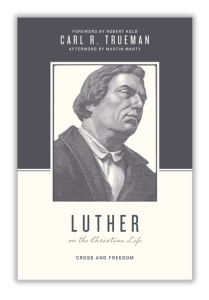
    truemanCarl Trueman, Luther on the Christian Life: Cross and Freedom (Crossway, 2015), 198–199:

    In general terms, of course, Protestant theologians have not been renowned for their wit, and Protestant theology has not been distinguished by its laughter. Yet Luther laughed all the time, whether poking fun at himself, at Katie, at his colleagues, or indeed at his countless and ever increasing number of enemies. Humor was a large part of what helped to make him so human and accessible. And in a world where everyone always seems to be “hurt” by something someone has said or offended by this or that, Luther’s robust mockery of pretension and pomposity is a remarkable theological contribution in and of itself.

    Humor, of course, has numerous functions. It is in part a survival mechanism. Mocking danger and laughing in the face of tragedy are proven ways of coping with hard and difficult situations. Undoubtedly…

    View original post 217 more words