Tag: Mark

  • King Jesus: The Calling of The Ordinary

    Today, the announcement of good news, of great news, of world transforming news would be shared virally across social media, it would make headlines on news websites, it would be part of the regular conversation down the street and with neighbours. So it should be a little surprising to us that the first place Jesus proclaims the good news of the gospel of God (Mark 1:14-15) is in a small town up in the north of the country of Israel, away from the power and influence of Jerusalem and its religious leaders. 

    Here in Melbourne, important political news comes from Spring St, and important AFL news comes from AFL House. These are the places where the power and influence of our city come from. However, here in Mark’s gospel this news of Jesus and the good news he has to share appears in an out of the way, quite backward place, among ordinary people going about their ordinary days. 
    And we read of this in Mark 1:16-20: 

    16 As Jesus walked beside the Sea of Galilee, he saw Simon and his brother Andrew casting a net into the lake, for they were fishermen. 17 “Come, follow me,” Jesus said, “and I will send you out to fish for people.” 18 At once they left their nets and followed him.

    19 When he had gone a little farther, he saw James son of Zebedee and his brother John in a boat, preparing their nets. 20 Without delay he called them, and they left their father Zebedee in the boat with the hired men and followed him.

    Jesus sees Simon (Peter) and Andrew at work, casting their nets. A little farther along he see these guys James and John preparing their nets. These fisherman are in the middle of their normal work day and Jesus comes along and calls them to follow him into a completely new direction and purpose. 

    Notice who Jesus doesn’t call. 

    He hasn’t gone to the highly ranked schools and universities. He hasn’t gone to find who is the smartest or brightest in the country. He doesn’t look for the leading academics and performers. He doesn’t start with the religious elite. 

    Who does he call? 

    The ordinary. Ordinary people doing ordinary things. Everyday people. People getting on with their jobs and responsibilities. 

    How encouraging is it to know that God’s kingdom isn’t built by the impressive, the influential, and the highly credentialed. Jesus calls those who have not made it in the eyes of the world. He doesn’t choose people because of their status or education or reputation. 

    Jesus calls ordinary people to follow him. 

    And what’s even more amazing is that Jesus is the one who takes the initiative. It was usually the other way around in the first century, a prospective student would approach a rabbi to be their disciple. Here, however, Jesus takes the initiative. He is the one who calls. He chose those who are to follow him. 

    This is a pattern throughout the Bible. God calls a people to himself. He takes the initiative and forms a people who belong to him and live under his rule. This same pattern is here in Mark 1, but in personal form. Jesus calls these men to come follow and become part of God’s mission in the world. 

    We are called in the same way today.

    Those of us who follow Jesus can say that God has taken the initiative toward us. He has called us to belong to him. 

    On one hand this is personal and individual, but on the other it’s not. Jesus calls these fishermen into a small group, a small community of followers who will become the early church as the New Testament unfolds.

    Following Jesus is personal, but it’s not isolated. We follow Jesus together and are shaped by him as we walk with others in faith. 

    When Jesus calls these fishermen he calls them into a life that will be changed and reshaped. One moment they are known locally for their trade, expertise, and work. In the next moment they are disciples of the Son of God, leaving behind all that is familiar to them.

    What a call we are part of! What a calling we have in Christ Jesus!
  • King Jesus: The Kingdom of God

    Have you ever received news or advice that changed your life?

    There are moments and events that reshape how we live and how we see the world. On a cultural level we might think of events like 9/11 or the COVID pandemic and how they altered patterns of work, travel, and security. On a personal level it could be a job promotion, a relationship breakdown, or the loss of someone close. These moments leave a mark.

    On a spiritual level, coming to Christ and trusting him as Lord and Saviour ought to have been life changing. As we walk with Jesus we might come through seasons, take a step of faith, or sit under the influence of a mentor that alters our life. I know that when I read a very basic biography of the missionary Jim Elliott I was never quite the same again. There are a few other moments like that I could name. 

    In Mark 1:14–15 we come to the beginning of Jesus’ public ministry. It begins with an announcement and a call. It is a moment that is life altering not only for those who first heard it, but ultimately for the world. We read, 

    After John was put in prison, Jesus went into Galilee, proclaiming the good news of God. “The time has come,” he said. “The kingdom of God has come near. Repent and believe the good news!”

    What do we notice? 

    First, Mark gives us the timing. Jesus begins his ministry after John the Baptist is imprisoned by Herod. The one who has prepared the way has completed his ministry, now it’s time for Jesus. 

    Second, Mark gives us the location. Jesus goes into Galilee. Technically he is already there because Nazareth is in that region, his home town. But the Sea of Galilee is around 30km away from there and this is where he shares this message. Note that this is not the religious centre of Israel or Jewish thought. This is a northern region, far away from the seats of power and influence. 

    Third, Mark tells us what Jesus is doing. He’s proclaiming the good news of God. He is announcing something that demands attention and response. He is bringing a life changing message. 

    In the Roman world, good news (or a gospel) would often be declared after a war victory, or at the birth or coronation of a ruler. There’s even an ancient inscription that speaks of “the beginning of the gospel of Caesar Augustus.” Mark deliberately uses this same kind of language, but now the good news is not about Caesar. It is about Jesus and the reign of God.

    Jesus says, “The time has come. The kingdom of God has come near.” 

    The long-awaited moment in God’s plan has arrived. What God has promised and prepared is now here.

    It’s hard to define the kingdom of God. One commentator I recently read had nine different angles on the kingdom of God from Mark alone! 

    At its most broad, the kingdom of God is God’s rule and reign over his creation. But in other places Jesus describes the kingdom using metaphors and objects in life. It’s like a mustard seed that grows into a large plant (Matthew 13:31-32; Luke 13:18-19). It is like yeast that when mixed with flour transforms everything it touches (Matthew 13:33; Luke 13:20-21). It’s like a pearl or a treasure that is so valuable that one sells everything to gain it (Matthew 13:44-46).

    In terms we might understand in our day and age, we might say the kingdom of God is like a washing machine. Dirty clothes go in and through the action of water and detergent they come out clean and renewed. Or perhaps it’s like the body when eating well and exercising, change is happening even if you do not see it on the scales each day. Or maybe it’s like a software update working in the background so that over time everything runs differently and hopefully better (!). 

    In Jesus the kingdom of God is not just an idea. It’s personified. The kingdom of God makes a personal appearance in Jesus. The rule and reign of God is revealed through the person and work of the Son of God. 

    When we enter this kingdom through Jesus, we are aware that it is not fully complete, either in us or in the cosmos. But as we step into it, and continue in it, we are asking Jesus to take his rightful place upon the throne of our heart and to establish God’s kingly rule over every dimension of our lives 

    This proclamation by Jesus then brings a call to action. To repent and believe. 

  • King Jesus: The Love of God the Father

    The baptism of Jesus, by John, is a key moment in the life of Jesus and his ministry. 

    In Mark 1:9-11 we read, 

    “At that time Jesus came from Nazareth in Galilee and was baptised by John in the Jordan. Just as Jesus was coming up out of the water, he saw heaven being torn open and the Spirit descending on him like a dove. And a voice came from heaven: ‘You are my Son, whom I love; with you I am well pleased.’”

    Jesus arrives from Nazareth and is baptised by John, who has been preparing the way for him to be received. Mark gives us a pretty simple description of what’s going on, but we can’t miss the vivid details either. Heaven is described as being torn open. The Spirit depends on Jesus like a dove. The voice of God the Father is heard. 

    This is the point of affirmation and anointing of Jesus. It establishes his identity. He is named as the Son, loved by the Father, and is pleasing to him. 

    We notice a particular closeness between Jesus the Son and his Father. This is unique in scripture. Throughout the Old Testament we know there are plenty who walk closely with God, think Noah, Abraham, Moses, David and others who are faithful followers and friends of God. But here it is the language of family. He is the Son. He is loved. God is pleased. The relationship described here is personal and direct. 

    As God the Father reveals the identity of Jesus the Son of God (Mark 1:1) it is also worth highlighting that this affirmation of identity and love occurs before he has done anything. This declaration occurs before Jesus has done any ministry at all. He hasn’t performed any miracles. He hasn’t taught any crowds. He hasn’t called any disciples to follow him. And quite obviously, he hasn’t gone to the cross or been raised from the dead. Yet, God the Father declares his love and pleasure in his Son. 

    I find this encouraging. 

    I find this a helpful reminder about God’s love and pleasure for us. 

    When someone you know tells you that they love you it lifts you. When someone says they are pleased with you or proud of you, then you are encouraged and stand a little taller. Here’s the Father speaking those kind of words over the Son. Love and pleasure is declared before achievement, not after it. 

    It’s the kind of reminder that helps us understand God’s love for us as we are, not in what we do. 

    God doesn’t love us because of what we are doing for him, how we are serving him, or whether we are becoming ‘better’ (whatever that might mean for us). No, God the Father loves us for who we are, as his child, as part of his family. God’s love and pleasure toward us comes before any sort of achievement we believe we are offering to him. 

    Remember John 3:16, “For God so loved the world that he gave his one and only Son…” This isn’t after we have proved ourselves. Nor is it after we’ve improved ourselves. This is out of love for us. 

    This is part of the deep comfort of the gospel. We come to a loving Father through a loved Son. 

  • King Jesus: The Messenger

    One of the few times Mark directly quotes the Old Testament comes at the beginning of his gospel. He writes:

    I will send my messenger ahead of you, who will prepare your way a voice of one calling in the wilderness, ‘Prepare the way for the Lord, make straight paths for him.’” (Mark 1:2–3)

    The Messenger

    These words point to a coming messenger. Someone sent ahead of the Lord to prepare people for his arrival, like the announcer before a basketball game who introduces the players from each team or the caller at a darts match who declares each score as it lands. The role is to get people ready and paying attention.

    Mark tells us that this messenger is John the Baptist.

    He appears in the wilderness, preaching a baptism of repentance for the forgiveness of sins. People from the Judean countryside and Jerusalem go out to him. They confess their sins and are baptised in the Jordan River.

    John is presented as a prophet in the mould of the Old Testament. His clothing of camel’s hair, leather belt, and wilderness lifestyle all point in that direction. He is especially reminiscent of Elijah. His role is to call people back to God and prepare them for what God is about to do next. In that sense, he stands as the last of the Old Testament style prophets, right on the edge of the new era that arrives with Jesus.

    The Message

    From this messenger comes a message that is clear and humble:

    “After me comes the one more powerful than I, the straps of whose sandals I am not worthy to stoop down and untie. I baptize you with water, but he will baptize you with the Holy Spirit.” (Mark 1:7–8)

    John knows exactly where he stands in relation to the one who is coming. He is faithful and bold, but he is not the King. He says he is not even worthy to untie his sandals.

    That image can slip past us today. We tie and untie shoes all the time without thinking about it. But in the first century, with open sandals, dirty roads, and poor sanitation, feet were filthy. Cleaning them was servant work. The lowest servant work. It was considered such a degrading task that even Jewish servants where warned against doing it.

    John says he is not worthy to perform even that lowly role for the one who is coming. That is how great he understands Jesus to be.

    Baptism

    Part of John’s ministry is baptism, and it is worth noting what his baptism means. Mark says it is a baptism of repentance for the forgiveness of sins. It is about turning back to God.

    Repentance is a change of direction. Like when you miss a turn while driving and need to do a U-turn. Repentance is that turning of the heart and life back toward God, with confession and humility.

    Christian baptism includes repentance too, but it also goes further. It is baptism into Christ. It speaks of forgiveness, new life, belonging to God’s family, and receiving the Holy Spirit. John’s baptism prepares the way. Jesus brings the fulfilment.

    John’s role is not to draw attention to himself but to point forward. Prepare the way. Straighten the path. Get ready for the King.

    Have you got a prepared heart ready to hear from the King?

  • King Jesus: The Beginning of The Good News

    Do you like a good action movie?

    A James Bond film, Mission Impossible, or one of the Bourne movies? The kind where things are moving from the opening scene and the story carries real momentum.

    If one of the gospels were turned into action flick, Mark would be the script. It moves quickly, has lots of movement, and gets straight to the point. There is no warmup, no stretching beforehand, no long preamble. It is like the starter’s gun at the beginning of a race and we are off.

    Mark begins like this:

    “The beginning of the good news about Jesus the Messiah, the Son of God.” (Mark 1:1)

    That single line acts as both introduction and purpose statement. It tells us what the whole book is about before anything else is said. Like the opening line of a great novel, it draws us in. Except this isn’t fiction. This is the announcement of a real person and the purpose for which he came.

    Mark doesn’t include genealogies, birth stories, or any post-resurrection events. His focus is clear and deliberate. He wants to announce and show that Jesus is the Messiah and the Son of God. The book is centred on who Jesus is, what he does, and what it means to follow him.

    The word gospel (euangelion in the Greek) means good news. In the first century, good news would be publicly proclaimed when there was a military victory or a royal announcement. You can picture the town crier calling out the news of the day in the streets. In that sense, Mark is like a paper boy standing on the corner calling out the headline,

    “Good news. Jesus Christ, the Messiah, the Son of God has arrived.”

    But this good news is greater than a victory in battle or the birthday of an emperor. This is the announcement of God’s King and the fulfilment of long-awaited expectation and hope.

    The good news is not merely an event. It is a person. Jesus himself.

    Notice the titles Mark gives him. Messiah. Christ. Son of God. These are not polite honourifics. They are identity claims. They tell us that Jesus is not simply another religious teacher or prophet. He is uniquely connected with God and shares in God’s own identity.

    From the first sentence, Mark wants us to know who stands at the centre of this story. Everything else in the book hangs from this opening declaration.

  • The Presence of God

    I’m once again attempting to read the whole Bible through in a year as part of my daily devotions. It’s a yearly goal. Sometimes it gets done, sometimes it doesn’t. This year I’ve been inspired by Melissa Kruger to take on this program which allows for the weekends off. If you’d like to join in it’s not too late!

    Today’s reading was from Genesis 28-29 and Mark 11. I found it interesting how they dovetailed each other.

    In Genesis 28 Jacob, on his way to find a wife, has a vision from the Lord while he is sleeping. This vision is essentially God promising Jacob that he will continue the line of Abraham. After this vision Jacob wakes up and realises that God is present. He wakes and says:

    “Surely the Lord is in this place, and I was not aware of it.” He was afraid and said, “How awesome is this place! This is none other than the house of God; this is the gate of heaven.”

    As a result Jacob builds a pillar of stone in honour of the Lord and makes a vow to Him.

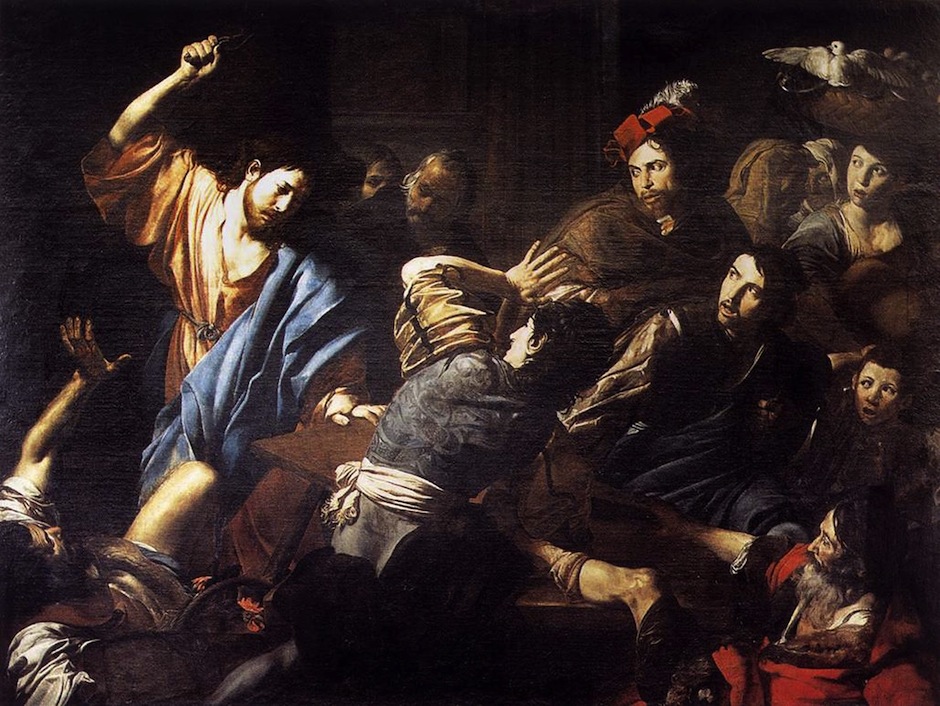
    In Mark 11 Jesus enters Jerusalem with much fanfare. He is praised and honoured and arrives on the back of a donkey. He makes his way around the city and heads to the Temple, the place where God is supposedly residing. Here he comes upon business activities that are unbecoming for a place of worship. He clears the Temple Courts and curses them.

    jesus-cleansing-temple.jpg

    As I read these two passages side by side this afternoon I was struck by the reality of God’s presence in the world. In one God comes through a vision to Jacob and by the time the first century rolls around there is a temple representing the presence of God among the people.

    But with the arrival of Jesus these things become redundant.

    We may still have visions and we may still have places of worship representing God’s presence but it is the presence of Jesus that brings the presence of God to us. For it is Jesus who is the True Presence, he is the one who is the reality of God in the world.

    We celebrate this every Christmas when we remember how God entered the world as a baby. We remember every Easter the sacrifice of Jesus on the cross so that we may know the presence of God in our lives. And we live each day knowing God is present with us through His Spirit.

    What a wonderful encouragement for us to know that the very presence of God is with us wherever we are in the world!