
Tag: Preaching

  • Jesus And My To-Do List

    tdlistWhy is it that I often walk out of church on a Sunday morning feeling more guilty and with more on my to-do list than I did walking in?

    I’ve had this occur numerous times over the last couple of years. I’m not sure if it says more about me or the church service and preacher. I can’t help wondering whether it’s my expectations of what it is to go to church and worship that leaves me wanting. Nevertheless, I occasionally walk out having that sense of needing to do more in the coming seven days.

    I’m a preacher myself, so I know I need to work hard on the application of my sermons. The explanation of the Bible and understanding of the passage can be worked through slowly or quickly but application needs to be there…somewhere. And it is within this application section that I need to know that the burdens I’ve been carrying for the last however long can be lifted. That my cares can be taken care of. That I can hope and know God is in control of all things.

    I need to be reassured that I don’t have to do anything more this week to have God love me more. 

    I know God. I know God because of my faith in Jesus and his work on the cross. Through that work he has enabled me to have my sin forgiven and be in a relationship with Him.

    I understand this will mean I will need to change. Following Jesus means growing as a disciple. This happens over time and with the Lord’s help.

    But when I am weary from a week where I know I’ve sinned throughout, where I didn’t read my Bible as much as I’d like, where things haven’t gone right, then I come to church seeking comfort, seeking encouragement, and to be reminded that God still loves me and is taking care of me.

    Of course, I may know this at a cognitive level. I may know this at an emotional level. But I need to know that this is the case again this week. Just as it was the last.

    This reminder may happen through the Scripture passage, or through the words of the preacher in explaining the text, or through the application part of the sermon.  Whatever way it may be it needs to occur in a way where the application doesn’t mean I walk out with more to-dos this week.

    Because guess what?

    When Jesus died he didn’t add a single to-do to my list. He took many, many, many to-dos away though. When Jesus died he didn’t add guilt to my burdens, he took them all and dealt with them.

    So, preacher (and I speak to myself as much as any other), preach Jesus. Preach Jesus in such a way as to articulate what he’s done without adding more to my week and my to-do list. Please.
  • 100 Sermons In


    I preached my 100th sermon the other day.

    I don’t consider myself a great preacher but there’s something about working at preaching that I find satisfaction in.


    SP11

    I have a spreadsheet which lists every sermon I’ve ever given. It tells me what number I’m up to, the date of delivery, what passage of scripture it’s from, what corny title I’ve given it, and where it was delivered. Due to my missions role there are a few double ups, having given the same sermon in different places.

    Some today argue that preaching is a waste of time. That sermons aren’t worth what we think they are. That there is a better way of communicating God’s truth, perhaps in small groups or through one-on-ones or in some form of creative dialogue. These ways of delivering God’s truth are great and there’s no denying there are different ways people receive the Word and understand it. It’s all a matter of communication theory I suppose.

    Yet, I still believe that Scripture not only gives us the words to communicate but also shows us the way God seeks his Word to go forth.

    The proclamation of scripture is an important aspect to the teaching and receiving of His Word. From the beginning to the end of scripture God speaks and uses preaching as a means of proclamation. These sermons and words are delivered by the person God has gifted in teaching or prophesy, such as, Moses or Ezra or the Prophets or Jesus or Paul or other apostles, just to name a few.

    Coming under His Word each week at a gathering of believers is important for my soul. I look forward to the opportunity to continue preaching His Word to anyone, anywhere.

  • Newton on Celebrity Preaching

    Perhaps a good word for those of us who follow and podcast the great preachers in this world…

    “A stated and regular attendance encourages the minister, affords a good example to the congregation; and a hearer is more likely to meet with what is directly suited to his own case, from a minister who knows him, and expects to see him, than he can be from one who is a stranger. Especially, I would not wish you to be absent for the sake of gratifying your curiosity, to hear some new preacher, who you have perhaps been told is a very extraordinary man; for in your way such occasions might possibly offer almost every week. What I have observed of many, who run about unseasonably after new preachers, has reminded me of Prov. 27:8: “As a bird that wandereth from her nest, so is the man that wandereth from his place.” Such unsettled hearers seldom thrive: they usually grow wise in their own conceits, have their heads filled with notions, acquire a dry, critical, and censorious spirit; and are more intent upon disputing who is the best preacher, than upon obtaining benefit to themselves from what they hear. If you could find a man, indeed, who had a power in himself of dispensing a blessing to your soul, you might follow him from place to place; but as the blessing is in the Lord’s hands, you will be more likely to receive it by waiting where his providence has placed you, and where he has met with you before.”

    From John Newton’s On Hearing Sermons.

  • 5 Ways George Whitefield’s Life Is Good For Your Soul

    As I was walking out the door to go on holiday I randomly threw the biography of George Whitefield by Arnold Dallimore in my bag. It is an extensive biography, a two-volume set, which outlines the life and times of the great preacher.

    Having finished the first volume I find myself reflecting on his life and ministry. Biographies teach us a great deal, not only about an individual life, but also about the value system, worldview, and passions the person held.

    5 Ways George Whitefield’s Life Is Good For Your Soul

    In thinking about Whitefield, I found five areas of his life that struck me as being central to the way he lived. Here are those five areas, and some brief reflections on each of them.

    First, he was a man passionate about Jesus and only Jesus.

    From his teenage years, but more so after his conversion, Whitefield was consumed with proclaiming and showing Jesus in everything he did.

    While at university in Oxford he was a member of what was known as the ‘Holy Club’, and made a conscious effort to always be upright in everything he did. As he grew in grace and a fuller understanding of the gospel he pursued a passion for God’s glory and supremacy over all things.

    Second, he was a man committed to preaching.

    Everywhere he went, from the age of 17 onward, he preached consistently.

    In certain seasons of his life Whitefield would would preach up to 15 times, or 50-60 hours, per week! His ability and gift in preaching was beyond the average person, but this still doesn’t negate the fact that he was always wanting to share the truth of the gospel everywhere he went.

    Whether he was in America or in Britain, Whitefield couldn’t help but preach and try to win souls for the Lord.

    Third, he was a man who instigated change.

    His preaching practices were unorthodox for his time.

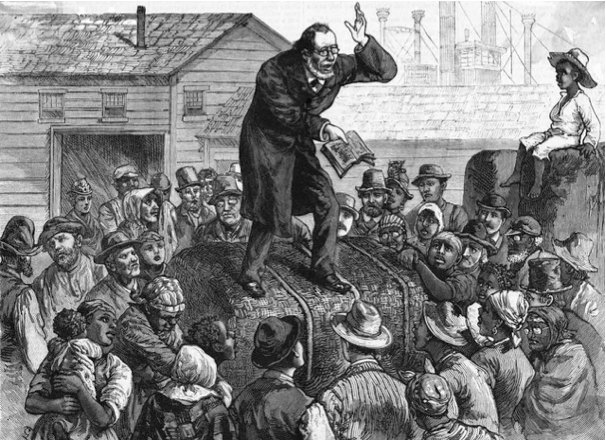
    He pushed the limits and received rejection for it. His actions of moving away from the church pulpit and begin preaching in the open air changed the face of his preaching ministry. When not allowed to preach in the local church, due to a decree from the local bishop or minister, he would simply began preaching outside–in the fields and parks of the city.

    Fourth, he was a man who had the courage to persevere in his ministry despite ridicule and rejection.

    Whitefield’s Calvinistic convictions, zeal for the Lord, and unorthodox preaching practices rubbed people up the wrong way.

    Fellow ministers, clergy, and other lay people developed a great dislike for Whitefield. Hundreds, if not thousands, of articles, journals, letters, and books were written against him and his beliefs. Throughout he continued to trust the Lord and pursue his ministry for the betterment of the Kingdom.

    While hurt by many of his detractors, Whitefield had the courage to stand and proclaim the gospel.

    Fifth, he was a man who sought unity rather than separation.

    At all times, particularly in his relationship with John Wesley, Whitefield sought to find common ground first rather than polarise people because of their belief or practice.

    In the end Whitefield had to separate from some relationships, but not after he had pursued unity, support, and friendship under the gospel. He was concerned for Christian unity while pursuing his single-minded goal of preaching the gospel.

    Whitefield’s biography, and some of his writings, is a terrific read. Dallimore portrays his life wonderfully well, exposing the godliness and character of the man. I would highly recommend reading this book, and even dipping into Whitefield’s other writings too.

    It will do wonders for your soul.