Tag: Priorities

  • Rest in the Rock – A Rest That Transforms

    Rest in the Rock – A Rest That Transforms

    In Part 1 of this series, we explored the idea of finding true rest in God alone. In Part 2, we looked at what it means to trust in God amid the pressures of life. Now, in this concluding post, we turn our attention to how resting in the Rock transforms us—not just offering relief but reshaping how we live, think, and step through the world.

    Psalm 62 doesn’t simply speak of rest as a static concept, like sitting on the couch after a long day. Instead, it invites us into a dynamic relationship with God—a rest that reshapes our priorities, grows resilience, and reframes how we engage with the world.

    A Rest That Reshapes Priorities

    It is written in Psalm 62:11-12:

    One thing God has spoken, two things I have heard:
    ‘Power belongs to you, God, and with you, Lord, is unfailing love’;
    and, ‘You reward everyone according to what they have done.’

    Here we see a contrast: God is mighty and loving. His strength speaks to his stability, while his love invites us into relationship. When we rest in God we see life differently. Our priorities shift. Power, wealth, and status lose its allure because we understand that only God will satisfy.  

    There has been told the story of a man who worked hard to climb the corporate ladder. He had everything—position, wealth, influence, power—but at the peak of his career, he found himself empty. One day, during an unplanned visit to a small country church, he heard the words of Matthew 16:26, “What good will it be for someone to gain the whole world, yet forfeit their soul?” 

    In that moment his heart was convicted. The words stopped him in his tracks. He realised those things he’d been striving for were fragile and fleeting. Change didn’t come overnight, but slowly he had a shift in focus. He spent more time with his family, he had a new depth of relationship with God. He began to serve others rather than himself. His soul found rest, not in what he achieved but in whom he trusted. 

    A Rest That Grows Resilience

    Rest in God isn’t passive; it is active and brings with it a sense of hope. In Jeremiah 17:7-8 we are given a picture of a tree planted by a stream. It says, 

    But blessed is the one who trusts in the Lord, whose confidence is in him. They will be like a tree planted by the water that sends out its roots by the stream. It does not fear when heat comes; its leaves are always green.

    The pressures of life, like uncertainty, grief, and stress, don’t suddenly disappear when we rest in God. Like that tree, however, we are given life and hope and nourishment that comes from a deep well. We are given greater resilience and allows us to face these challenges without breaking, snapping, or losing all hope.  

    When we rest in God we find that our we are refined like gold with fire. Instead of being unable to hope and unable to cope we are given deep resources by grace. His grace. For us. A grace that comes from resting in the Rock. 

    A Rest That Reframes Our Life

    So resting in this Rock doesn’t mean we will abandon all responsibilities and become monks or nuns. Instead, we approach these responsibilities of life with a different frame of mind. In Matthew 11:28-30, Jesus invites us to take his yoke upon us. Now, a yoke is a tool, not a device to help us lounge around, and it is to be used in partnership with another. When Jesus speaks of his yoke being easy and his burden light it is because he is the partner who carries the weight. Much of our baggage is not ours to carry, and so Jesus is there with us taking it upon himself. Just like he took our sins and burdens upon himself at the cross, so too he carries our daily worries and anxieties to help us rest. When we rest in Jesus, our life becomes less about proving ourselves and more about walking in step with him.

    As someone who enjoys ticking things off the to-do list, it’s easy to fall into the trap of measuring my worth by what I’ve done. When I take time to rest in God though, well, my life and perspective is different. I recognise it is by his grace, and I can say ‘no’ to certain things, and ‘yes’ to other things that seem to me to be right priorities. 

    Resting in God is not an escape from life but a way of being that transforms everything we do. It reshapes our priorities, grows our resilience, and reframes our lives. It’s not about doing less but about trusting more. And in that trust, we find a rest that satisfies our souls and empowers our lives.
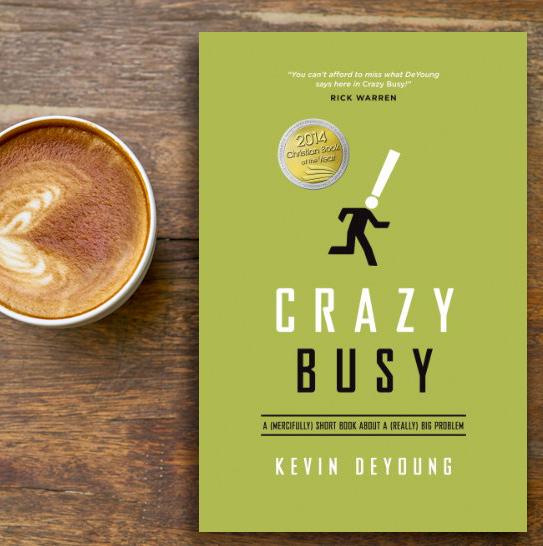
  • Crazy Busy: A (Mercifully) Short Book About A (Really) Big Problem by Kevin DeYoung

    Most people I know live busy lives.

    I live a busy life. I suspect you live a busy life.

    When people ask how I’m doing I try to avoid saying, “I’m busy”.

    Everyone is busy.

    Everyone says they’re busy.

    It’s part of life.

    I could have added ‘these days’ to the end of that last sentence but I don’t think we’re living in an especially busy era. People of every age have been busy, it’s just a different type of busy. And that’s humbling. To know we’re not alone in our busyness, either in this era or another, makes us no different to anyone else. We’re ordinary, ordinarily busy.

    In light of life’s busyness Kevin DeYoung has written another neat little book; this time describing his busyness journey while looking at this theme-at-large.

    Crazy_Busy_Kevin_DeYoung_

    In many ways he has written it for himself, and anyone else who will read it. It’s not a 10-point plan on how to get rid of busyness, but it is a 10-chapter book helping us understand more broadly why we’re busy and how to think about it.

    There was a period of time there where I’d be chasing the latest productivity tool or app that would make me more effective in life and work. I think that is similar to others I know. But really, when you consider all the time wasted in fiddling around with these tools you begin to wonder whether it’s worthwhile.

    I’ve found they’ve made me feel more busy that perhaps I really am.

    And that’s a problem.

    We sometimes believe we’re so busy when actually it is the case of having information overload and always being on the go. If we cut a couple of things out and didn’t input into our heads so much then we might find we’re not as busy as we thought.

    But it’s the things that need to be cut that are the issue.

    What do we prioritise? What’s important? What can’t go? What has to be prioritised?

    These questions, and many more, including the issue of sleep, are thought through by DeYoung.

    The final chapters really push home the point from a Christian perspective. The number one priority is our walk with the Lord.

    Using the story of Mary and Martha the author outlines the main point; resting in God and at the feet of Jesus is the priority and from there our work and busyness is to flow.

    He’s not being legalistic or prescriptive in how this is done. But, he certainly emphasises the good point that spending time with Jesus is important and has consequences now and in the future.

    I’d highly recommend this book, particularly to anyone who finds themselves feeling busy (read: everyone). Again, it’s not a book that outlines a plan for how to get out of your busyness. It gives a broad framework for thinking through and understanding the topic and some good wisdom for stepping into that. This is one of the best parts of the book, it leaves me to make my own decisions about how to avoid over-busyness.

    Here’s some quotes:

    “Busyness does not mean you are a faithful or fruitful Christian. It only means you are busy, just like everyone else.” (p32)

    “Jesus understood his mission. He was not driven by the needs of others, though he often stopped to help hurting people. He was not driven by the approval of others, though he cared deeply for the lost and the broken. Ultimately, Jesus was driven by the Spirit. He was driven by his God-given mission. He knew his priorities and did not let the many temptations of a busy life deter him from his task. For Jesus that meant itinerant preaching, with devoted times of prayer, on his way to the cross.” (p56)

    “The person who never sets priorities is the person who does not believe in his own finitude.” (p57)

    Peter Kreeft is right: “We want to complexify our lives. We don’t have to, we want to. We want to be harried and hassled and busy. Unconsciously, we want the very things we complain about. For if we had leisure, we would look at ourselves and listen to our hearts and see the great gaping hole in our hearts and be terrified, because that hole is so big that nothing but God can fill it.” (p83)

    “The antidote to busyness of soul is not sloth and indifference. The antidote is rest, rhythm, death to pride, acceptance of our own finitude, and trust in the providence of God.” (p102)