Tag: Suffering

  • Book Review: Spurgeon’s Sorrows – Realistic Hope for Those Who Suffer from Depression

    Would it surprise you to learn that one of the greatest preachers in Christian history, the so-called ‘Prince of Preachers’, struggled with depression throughout his life and ministry? 

    Charles Haddon Spurgeon, pastor of the Metropolitan Tabernacle in 19th-century London, preached to thousands weekly, wrote extensively, and continues to shape preachers today. Yet behind the sermons, quotes, and books was a man who often walked through deep fog and valleys of darkness.

    I have known for many years that Spurgeon battled various health concerns, and at least a little depression, but I hadn’t realised how pervasive it actually was. In reading Spurgeon’s Sorrows by Zack Eswine I gained a better picture of the man but also the depths to which his depression and anxiety impacted his life. The other surprising thing about this was how public and how often he spoke about it. This short little volume (just over 100 pages) really opens the reality of mental illness not just for believers but also for pastors. I know it’s not talked about often, if at all, and this book is so helpful and insightful for all saints and sufferers. 

    Our churches are full of people who are going through depression, anxiety, and all ranges of mental illness. We may not see it while interacting with them on a Sunday morning, but they sit there, often silently, battling the melancholy of the mind. Older people carrying the weight of loneliness, middle-aged adults questioning their position in life, young people navigating their identity and uncertain future. They may not look depressed but are sure to be there in the pews. 

    As Christians it is important to talk about this. The Psalms do. So does Job. So does Elijah. So does Paul. And so does Spurgeon. One reason I found this book helpful was the normalising of this conversation without reducing it to Christian cliches or simplistic solutions.

    To give you an idea of the depth of Spurgeon’s struggle he once said, 

    “The mind can descend far lower than the body, for in it there are bottomless pits. The flesh can bear only a certain number of wounds and no more, but the soul can bleed in ten thousand ways, and die over and over again each hour.”

    He knew the darkness that makes it hard to pray, to preach, to feel anything at all. That numbness that comes over us when walking through an unending fog. He writes about this kind of depression as something that comes uninvited and stays longer than is welcome. And yet, in all of this, he saw no contradiction between faith and depression. He writes elsewhere, “Depression of spirit is no index of declining grace”. 

    This is encouraging for us as believers. It’s comforting to hear this from someone who has lived faithfully under the weight of this burden. How often are we prone to think such a thought or such a condition may disqualify us of our belief? But it is not so!

    We walk with Christ in the valleys and on the mountaintops and everywhere in between. 

    Eswine writes with care and warmth. He doesn’t overreach. He lets Spurgeon speak and then offers reflections that feel more like a conversation. 

    In one part of the book Eswine lists various helps that Spurgeon would undertake to help him recover from these periods of flatness, which again was really helpful. But he goes on to talk about how, 

    “The melancholy life thrives when it runs marathons instead of sprints, or when it sprints often, only to rest often. You needn’t try to do “the most things” in “the fastest ways” anymore. To resist this is to have seasons of rest and nature forced upon us by breakdown.”

    This is helpful for all of us who find ourselves running too fast and living on the edge of our limits. Whether it’s burnout, exhaustion, or anxiety, there is the invitation to slow down and let go of that performance mentality. 

    At times Spurgeon himself described what it was like when the overwhelm was upon him.In a sermon called The Christian’s Heaviness and Rejoicing he preached these words:

    “I was lying upon my couch during this last week, and my spirits were sunken so low that I could weep by the hour like a child, and yet I knew not what I wept for…”

    How about that!? How raw. How open. How vulnerable and honest. It’s not the kind of thing we would hear out of a 21st-century preacher would we?

    The book, thankfully, doesn’t offer neat answers, tied up firmly like a shoelace. It doesn’t promise that darkness will lift, but what it does do is point to Christ. It points to Christ to declare that He is the one who truly understands what we may be going through. 

    I would recommend this book to anyone, it’s a must read. It’s five stars. If you’re a pastor it will do your own soul a truckload of good, and also help you walk with those who suffer from mental illness themselves. If you’re someone who experiences depression, or are in it now, then this book gives you a helpful and faithful voice to that which you struggle with. And if you walk with those who do walk the road of mental illness then this book might help you understand it a little more. 

    To close I can’t but leave you with one of my favourite quotes from Spurgeon about suffering and depression. While speaking about God providing all our needs from Philippians 4:19 he preaches,

    “Then comes our need in suffering, for many of us are called to take our turn in the Lord’s prison camp. Here we need patience under pain and hope under depression of spirit. Who is sufficient for furnace-work? Our God will supply us with those choice Graces and consolations which shall strengthen us to glorify His name even in the fires! He will either make the burden lighter, or the back stronger—He will diminish the need, or increase the supply.”

    Amazing. 

    How great that the Lord our God is with us through the troughs of life and will indeed supply us with everything we need. 
  • The Advance of the Gospel: In Joy

    The book of Job in the Old Testament presents the story of a man who, despite his righteousness, is subjected to immense suffering. Job’s friends, in their misguided attempts to provide comfort, suggest that his misfortune must be due to some hidden sin. Job, in defiance, is confident that God will ultimately vindicate him, that his trials will lead to deliverance.

    This ancient narrative finds a parallel in Paul’s letter to the Philippians. Paul draws on Job’s language of deliverance when he writes in 1:18-20 about the joy and confidence he derives from the support of the church and their prayers in the Spirit of Christ.

    Paul’s hope for deliverance is twofold: liberation from those who preach Christ with false motives and possible physical release from his imprisonment. Regardless of the specific form his deliverance might take, he is assured of his ultimate vindication.

    And so Paul is hopeful.

    His attitude hasn’t been dampened because of the circumstances he finds himself in. Rather, he is aware of what has ultimate value.

    He is not ashamed of being in chains, of being in prison. He is not ashamed of the sufferings and gossip of others. In fact, he expects to be given courage to face these challenges through Christ. Whether he is alive in body or not. Whatever situation he finds himself in he wishes to exalt Christ, to honour Christ, and in so doing the gospel will advance.

    It is an incredible conviction to have, an incredible attitude to have.

    How often might we find ourselves in hardship?

    There is tremendous hardship in our world. We read about it every week. We see images of it that scar our minds. We don’t have to live long to experience it ourselves or know of others who experience trauma, grief, sadness, loneliness, brokenness, and other sufferings . We are after all sinners, saints, and sufferers.

    And to be quite frank, everyone has a story.

    Everyone is going through something.

    Some things may cause our hearts to strain, to question the faithfulness of God, or bring to mind doubts in God’s goodness.

    And often there are no easy answers to those questions and doubts.

    We may be left in a place of not knowing, others times we are left to the mystery of providence.

    In Philippians we see that despite the circumstances Paul the message of Christ still advances.

    Christ is still exalted through such circumstances.

    And for this he rejoices, he rejoices in Christ.

    I wonder if we’ve ever thought that in amongst carrying that pain, brokenness, and heartache within that there is the opportunity to advance the gospel in there somewhere?

    Can our pain be used in God’s power to proclaim Christ?

    Would we be able to say, that what I really want you to know brothers and sisters is that the loss of my job has really served to advance the message of Christ?

    Would we be able to say, that what I really want you to know brothers and sisters is that the cancer or chronic health issue has actually served to advance Christ?

    Would we be able to say, that what I really want you to know brothers and sisters is that our miscarriage has actually served to advance Christ?

    Would we be able to say, that what I really want you to know brothers and sisters is that my wrestle with singleness has actually served to advance Christ?

    Would we be able to say, that what I really want you to know brothers and sisters is that the car accident has actually served to advance Christ?

    Would we be able to say, that what I really want you to know brothers and sisters is that the passing of a loved one has actually served to advance Christ?

    I just wonder. I just wonder that in the hardship of life we not only are able to find the comfort of Christ for our grief and lament, but that we also find Christ will be exalted and the gospel advancing.

    And so I wonder, despite it all, whether we can rejoice in Christ?


    This post is part of an ongoing series where we dive into the themes, messages, and lessons found throughout the book of Philippians. For earlier posts please see:

  • The Advance of the Gospel: In Suffering

    When baking, it’s often wise to follow a recipe, as it guides us to create the delicacy we envision. It instructs us on the ingredients to add, how to mix them together, and even specifies the right oven temperature to bake that perfect cake you’re dreaming of right now.

    In the grand scheme of Christian ministry, we often expect a similar recipe for success. We anticipate a clear path, a favourable environment, and the right mix of circumstances to see the advancement of the gospel. Yet, in the narrative of the Apostle Paul, as seen in his letter to the church in Philippi, we find a different kind of recipe. After affirming the friendship he has with the church in Philippi in v11, Paul goes on to describe his current situation in v12-26. He speaks about how his imprisonment, a circumstance that doesn’t look like a favourable environment, is actually helping spread the message of Christ in v12-14. It might not be the gospel recipe book we would imagine, but amidst suffering and persecution, even amidst selfishness and ego, the message of Christ is being proclaimed and advancing. And it is to these verses we turn now in our little series on Philippians.

    The Unexpected Catalyst: Paul’s Imprisonment

    In v12-14 Paul writes,

    12 Now I want you to know, brothers and sisters, that what has happened to me has actually served to advance the gospel. 13 As a result, it has become clear throughout the whole palace guard and to everyone else that I am in chains for Christ. 14 And because of my chains, most of the brothers and sisters have become confident in the Lord and dare all the more to proclaim the gospel without fear.

    Despite the dire circumstances Paul finds himself in, the gospel continues to advance. Almost unexpectedly, the message of Christ makes progress even while Paul is confined in prison.

    While in prison the guards and others in the palace find out why he is there. As the guards rotate through their shifts word gets out that Paul is imprisoned because he claims Jesus as Lord. This has religious connotations because of the Roman gods and idol worship. It also has political connotations because at this time the Roman Emperor was considered divine and a ‘son of god’. When Paul is publicly declaring Jesus as Lord, and as the Son of God, we can understand there might be a bit of push back. No one is to be considered Lord except the Caesar himself.

    It seems, however, that Paul’s imprisonment is an inspiration to the other believers with him or those in close contact. The gospel is advancing because Paul is suffering and locked away, and it is inspiring Christians in their boldness to share this message of Jesus with others too.

    Despite the less-than-ideal circumstances the gospel is at work inspiring faith.

    Inspiration from Unlikely Heroes: Stories of Faith Amidst Persecution

    Inspiration for our faith can come from a range of sources and through a range of people. I don’t know about you, but I’ve been deeply moved by the stories of other Christians and the significant impact their lives have had on others. Some of these have been missionaries and Christian workers of the past, like Jim Elliot, John Paton, Corrie Ten Boom, William Jay, JI Packer, Joni Eareckson Tada, to name a few. Others have been people I know, colleagues, family members, teachers, and people in churches I’ve been in. My faith is inspired by those who are living out their faith despite hard circumstances and situations. In fact, it is in hearing these stories, that often include hardship and suffering, I have found the gospel advancing in me, it is working in me through the life and times of others.

    That may well be a reason why Hebrews 11 and 12 are so powerful to me. Those chapters in Hebrews list saints of the past, saints of the Bible, who are an inspiration to our faith. Their stories are written to inspire our faith.

    There is the aspect of inspiration here, mixed with the persecution of Paul, locked away for his faith and proclaiming the gospel.

    Flourishing Faith in the Face of Hardship: The Unforeseen Advance of the Gospel

    Today we can search and read information about Christians around the world who are living out their faith despite the threat and reality of persecution, particularly in the majority world.

    In the 1950s missionaries were kicked out of China at the time of the revolution yet the gospel advanced to such a degree that there are now millions of believers living out their faith in less-than-ideal situations.

    In more recent times in Africa, Boko Haram are an extremist group who persecutes Christians in Nigeria on a regular basis. Yet as many are killed for their faith the Christians continue to live lives of faith under the most harrowing of pressures, instability, and concern for their lives.

    In Iraq, Christian families and churches face threats on a regular basis. Despite the constant pressure and threat, house church leaders continue to minister, and against all odds, the gospel continues its work, advancing the message of Christ.

    Knowing the stories of Christians past or present are inspiring. Their faith, their hustle, their confidence, and their trust in the Lord. Through their faith and faithfulness they display the ‘all surpassing value of Jesus Christ’ (Philippians 3:8).

    How does knowing about these stories impact your own faith? How might you live differently knowing that the gospel can advance in the most unexpected environments?

    Through suffering, through hardship, through difficulty the gospel advances. And for us today we can be inspired, encouraged, and given courage in our walk of faith. In what, from a human perspective, might be the least expected environments, the gospel can indeed flourish.


    This post is part of an ongoing series where we dive into the themes, messages, and lessons found throughout the book of Philippians. For earlier posts please see:

  • My Top Books of 2018

    At this stage of the year every pretentious writer worth their while comes out with the most arrogant of posts. Knowing they’ve read more than most of their friends they willingly share this information in a list, highlighting their favourites reads of the year just gone. Adding to this pretentiousness I offer my not-so-humble addition for the fifth year running (for previous years see: 201420152016, 2017 ).

    Without further ado, and in no particular order, here are my top books for 2018.

    Enjoy.

    My Top Books of 2018

    This is one of the books I used in preparation for preaching a series on Ruth. I think it is fantastic.

    It’s more of a devotional commentary and gives good insight into the book. It teaches the meta-narrative themes of Ruth and provides devotional material to personally ponder. It’s very helpful in understanding the book of Ruth, who God is, and the implications of the story. It’s also helpful in teaching how to read Old Testament scripture in narrative form.

    I preached through the book of Ruth in February and March. This was the main commentary I used, which was excellent.

    Ruth: The King Is Coming by Daniel Block is part of the Zondervan Exegetical Commentary on the Old Testament series. This particular commentary gives a good outline of all the textual, cultural, and literary issues of the book. It walks the reader through the text and its structure in a accessible way. It raises the theological issues and conclusions of the book too. It was very helpful in thinking through the book of Ruth and and a useful preaching tool.

    The writer, Jason Lloyd, has been an NBA beat journalist for years. He was the Cleveland beat writer during the time of LeBron’s coming, going, and return to the Cavs. He gives a fascinating insight into the way the club operated during this time and how the club dealt with the superstar.

    While there is biographical material of LeBron himself, the real insight of the book comes in the form of team strategy. That is, the management of an NBA team and what strategic moves the back office uses to build a winning team.

    This was a great book, worth reading, and some good sports writing.

    This is one of the best modern Christian books you’ll ever read.

    I rate it highly. So highly that I made it the first book in our church internship program.

    The Prodigal God is a short book that takes the reader through the parable of The Prodigal Son. Each chapter not only reveals the content of the parable in a fresh way but is powerfully mind-blowing and heart-convicting for your soul.

    If you’re looking for a great read and something that will encourage you in your Christian faith then this is well worth getting your hands on. It’s short too.

    I re-read this book this year and found it helpful again. This is 25 chapters of leadership thinking by the President of the Southern Baptist Theological Seminary. The cover of the book is pretty crass, like any leadership book with the authors picture on the front. But inside it’s worth a look and a read. I find Mohler particularly clear and insightful when it comes to wrestling with leadership as a Christian and as a Christian leader.

    I hadn’t read anything by the late RC Sproul until I read this book. I know he’s been around for many many years and very highly regarded. I was blown away by the content in this book, now over 30 years old. From start to finish Sproul outlines the holiness of God. He moves from creation to mystery, from the Old Testament to the New. He shows just how large an impact God’s holiness has in the relationship he has with his creatures, and just how patient, gracious, and merciful he is.

    For a more comprehensive review you can go here.

    I have no way near the experience of suffering as Cole or other friends of mine have. Yet, as a pastor, and someone who is now reaching the stage of life where hearing of death and divorce has become more regular, I have found this book quite amazing. It is so comprehensive in understanding the pain of suffering and grief and so deep and rich in biblical truth. This is a pastoral book, an encouraging book, and a helpful book for anyone who is, has, and will suffer in this life (read: all of us). No wonder it won World Magazine’s Accessible Theology Book of the Year.

    Thanks for reading along, hope you find something in there to read in the coming 12 months. If you’d like to read more about what I’ve read you can do so here.

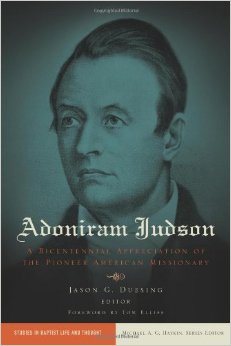
  • Book Review: Adoniram Judson by Jason G. Duesing

    Judson bookThe last book I can remember reading that had such an impact on me was in my later university years. I read a young adult version of the biography of Jim Elliot, a missionary martyr to Ecuador. His life and faith were an inspiration as I worked out my faith during my university years and spurred me into the world of missions.

    That was over 10 years ago now.

    So it seems very few books I read spur me into greater action and reflection. Most books invite me into the story and may give good information about a particular person or period. But I can’t think of more than a handful of books I’ve read that spur me into action and greater obedience to God.

    But the book Adoniram Judson: A Bicentennial Appreciation of The Pioneer American Missionary by Jason G. Duesing, is one of those books.

    This book isn’t written by one author. We could say it’s a collection of essays combined to give an excellent picture of Judson’s life and ministry. The book goes deep into his early life, his Christian life, his missionary life, his married life, and the influential life he led.

    It is a wonder as to why I hadn’t previously read a book about Judson. He is highly esteemed, particularly by those in America and the missions world. He is recognised as the father of American missions. The little I previously knew was from John Piper’s biographical message on the man from 2003. Yet in this written volume, with references to his and his wives’ journals and letters, there is a terrific account of this “mighty man”.

    Three main areas I saw highlighted in the book were Judson’s faith in the sovereignty of God, endurance through suffering, and commitment to long-term missions service.

    Sovereignty
    The faith Judson and his wives’ had in God is simply an inspiration.

    I say wives because Judson ended up having three. Ann and Sarah, his first two, died during his lifetime and Emily passed away only a few years after Judson himself died. I feel this needs to be clarified so there is no miscommunication. 🙂

    But all four individuals were wholeheartedly followers of Jesus Christ and sought to be obedient to His call, wherever that led. This begins with the conversion of Adoniram Judson soon after hearing one of his good friends from university die in the room next to him. He literally heard this man passing away during the night and upon finding out who it was the next morning was thrown into turmoil about his own soul.

    Judson sees the light and the graciousness of God through his Son and clings to the cross for forgiveness and salvation. He realises that it is only the cross that can bring true salvation. The trust he has in God at this early stage is evident. The way God’s hand guided him from being the son of a Congregationalist minister into atheism through university and then into a living, vibrant, and heartfelt faith when he was 20 years old is clearly seen. God’s sovereignty is at work.

    With this as the banner of his life he pursues a life that will count. He seeks to see others come to know God through his Son, so that they too may see salvation through the cross.

    He trusts God in his studies, as he heads to theological college without an active faith. Over the course of his studies he converts and has an unrivaled desire to be a missionary is Asia. He trusts God as he seeks a wife and proposes to Ann Hasseltine, loving her and trusting she will be willing to come with him to Burma and the East. In a letter to her parents, seeking to begin a relationship with her, he very early on describes his intentions for life and what that will mean for them and their daughter. In July, 1810, he writes,

    I have now to ask, whether you can consent to part with your daughter early next Spring, to see her no more in this world; whether you can consent to her departure, and her subjection to the hardships and sufferings of missionary life; whether you can consent to her exposure to the dangers of the ocean; to the fatal influence of the climate of India; to every kind of want and distress; to degradation, insult, persecution, and perhaps a violent death. Can you consent to all this, for the sake of him who left his heavenly home and died for fer and for you; for the sake of perishing immortal souls; for the sake of Zion, and the glory of God?

    As they travel he trusts God’s plans as they make the controversial but convicted decision to become Baptists after studying the scriptures. In the four months from leaving the American shores he and his wife Ann see the truth in Believer’s Baptism and are baptised themselves by colleagues of William Carey in India.

    In his first marriage with Ann, and consequently the ones following, the sovereignty of God is central to their faith and obedience.

    Suffering
    Judson and his wives’ suffered immensely. He saw the death of two wives, the death of over five children, and the death of colleagues in the mission work. He was imprisoned for nearly two years by the brutal regime in Burma at the time. When he lost his firstborn son he wrote:

    Our little Roger died last Saturday morning. We looked at him through the day, and on the approach of night we laid him in the grave. This is the fourth day, and we just begin [sic] to think, What can we do for the heathen? But yet it seems hard to forget little Roger so soon, to force off our thoughts from the attractive, painful subject, and to return to our usual employments. O may we not suffer in vain! May this bereavement be sanctified to our souls! and for this I hope we have your prayers. (p88)

    Ann experienced the same difficulty. In a letter to her parents, she expressed her confidence in God’s sovereign goodness, even in the death of her child:

    We do not feel a disposition to murmur, or inquire of our Sovereign why he has done this. We wish rather to sit down submissively under the rod and bear the smart, till the end for which the affliction was sent shall be accomplished. Our hearts were bound up in this child; we felt he was our earthly all, our only source of innocent recreation in this heathen land. But God saw it was necessary to remind us of our error and strip us of our little all. Oh may it not be in vain that he has done it. May we so improve that he will stay his hand and say, ‘It is enough’. (p88)

    What inspiration and trust in the Lord!

    Added to this is the ridicule he received from the local Burmese. It took seven years into the work before the Judson’s saw a convert. The constant health issues and lack of ‘success’ in the conversion of the people he sought to reach, and the death and disease he saw drove him to leave the main town he was living in and live by himself, in the jungle, sitting and staring into a shallow grave he had dug.

    Thankfully it was the years after this that Judson saw the fruit of his work but the suffering had an effect, as one could expect.

    Service
    The commitment of Judson and his wives’ have had a lasting impact on the lives and ministry of those who have gone after him. Their service of nearly 40 years, with one furlough back to America, is something to behold in the modern day. I understand that this was a different era, but the long lasting commitment of Judson and his wives attest to the fruit from long-term service.

    As mentioned, they didn’t see a convert for seven years. They experienced great suffering in their own lives and also saw it among the people they served. Yet, they continued to work in building relationships and translating the Bible into the native tongue of the Burmese. To this end Judson had a commitment to being contextual in everything and learn the culture well.

    The Judson’s immediately set about learning the Burmese language. Understanding Burmese was crucial for personal evangelism and Bible translation, both of which were necessary if the gospel was to gain a foothold in Burma. It was not enough to learn the language; the Judsons also had to learn how to live and minister in a Burmese context. Phyllis Rodgerson Pleasants describes the centrality of this learning for the Judsons’ mission:

    “The Judsons recognised that they had to be learners before they would be able to teach anything. They were persistent in learning from the Burmese [sic], their entire lives in order to communicate the gospel authentically in ways natural to the Burmese instead of trying to make the Burmese American so they could understand the gospel. More than learning the language from their teachers, the Judsons learned what it meant to be Burmese.”

    Learning the Burmese language and being immersed in Burman culture were critical components in providing a contextually appropriate Christian witness. The Judsons eventually excelled at both. (p81)

    This led Judson to be a communicator in word and deed. Alongside the work of translation was the contextual approach to being a witness for Christ.

    We agree in the opinion that our sole object on earth is to introduce the Religion of Jesus Christ into the empire of Burmah; and that the means by which we hope to effect this are translating, printing, and distributing the Holy Scriptures, preaching the Gospel, circulating religious tracts, and promoting the instruction of native children.

    Cross-cultural communication of the gospel was the Judsons’ heartbeat.

    Jusdon understood that translation work could commence more quickly in Burma that in some settings because, as Wayland surmised from Judson’s letters, “The Burmans are reading people. They have their religious books, and possess the teachings of Gaudama in their own language.’ However, Judson prioritised proclamation, “The press can never supplant the pulpit’.

    Language acquisition came gradually with parallel cultural knowledge, giving them the ability to interpret nuanced Burmese meanings, and worldview complexes of belief and practice. One of Judson’s first forays in adapting his technique to the culture was to stop building a zayat, a speaking point at the end of his house where passersby would stop to inquire this foreigner and his teaching. Eventually it became a place to hold public worship. Even though he borrowed the zayat idea from Buddhist priests, he clearly distinguished his zayat from theirs. His diary described the design and function of the building and recorded that it ‘is whitewashed, to distinguish it from the other zayats around us’. (p139)

    Conclusion

    Much more could be said. The book is well worth a read and some days spent in reflection of it. It was an inspiring read and one that made me think about my commitment to Christ and the way in which missions is currently done.