Author: Jon

  • Psalm 103: Praise The Lord

    It is certainly difficult to go through this Psalm without recognising the call to praise. The beginning and the ending couch this Psalm in words to encourage praise.

    Note how personal the writer King David is as he expresses himself.

    “Praise the Lord, my soul; all my inmost being, praise his holy name. Praise the Lord, my soul, and forget not all his benefits” in v1-2.

    And in v20-22,

    “Praise the Lord, you his angels, you mighty ones who do his bidding, who obey his word. Praise the Lord, all his heavenly hosts, you his servants who do his will. Praise the Lord, all his works everywhere in his dominion. Praise the Lord, my soul.”

    This is something deeply personal, something coming deep from within here. It is like David is willing himself to praise.

    There are times, aren’t there, when we have to will ourselves to do something. Whether it is chores around the house to trying to work through our emotions in a lockdown due to a global pandemic. Here David sounds like he is willing himself to praise. Like the marathon runner willing herself to get to the finish line so too David is willing himself to praise.

    Often praise, encouragement and thanks don’t come easy. Often we can be so consumed with our own self and all the problems we have to deal with that we soon forget or fall out of habit of praise, of thankfulness, of gratitude. Here we get the sense of David, writing in reflection from years of experience, willing himself to praise God for who he is and what he has done.

    For David realises all of what God has done. Not only for him personally, but also for the whole of humanity. He remembers God and all his deeds and dwells on the action of his compassionate God, which in turn draws him to praise.

    As we close this three-part series on Psalm 103 I encourage you to remember, dwell, and praise God this week.

    It has been a tough 12 months.

    You may have taken the opportunity to sit with God and spend more time with him this year. But, in the conversations I’m having with people I suspect the majority have not. And so I wonder whether this might be a good time to spend some time with the Lord.

    If you’re one who is in a habit of doing so, I encourage you to keep going.

    But, if you’re one who hasn’t sat with God, opened his scriptures, read and thought of the things of God in a while then I encourage you to do so this week.

    Take 30-60 minutes. Open a Psalm, maybe even this one. Write down a few things that strike you as you read it. Pray about what is on your heart. Express those fears and worries and anxieties to God. And dwell for a period of time, something we’re not used to, on your compassionate God who is slow to anger and abounding in love.

    Because when you do, experience tells me that the Lord will meet you where you are at and will draw you toward praise just as David is here.

    It will do your soul and your life much benefit.


    This is the third of a three-part series on Psalm 103. The first post, ‘Remember The Lord’, can be found here. And the second, ‘Dwell on The Lord’, is here.

  • Psalm 103: Dwell On The Lord

    In recent months there have been numerous articles suggesting more Australians have been thinking about aspects of faith and spirituality. COVID seems to have had an impact, not only in the way we think about health and operate as such, but also in matters of faith, priorities in life, and the dwelling on eternity. Something about this past year has driven people to think about these things!

    On one hand this is great. This should be the case due to what the world has experienced this year–coming to terms with our lack of control, the limits on our own capacity, and the realities of living in a broken world. Further, the personal reactions we’ve had due to the circumstances we’ve been through have led many to question and reflect on life. This year has been a reminder that there are greater things going on in the world than you or me.

    But on the other hand this has been such an exhausting year for many that the capacity to contemplate and dwell on aspects of faith, and dwell on the Lord and his goodness specifically, has diminished. The impetus, the motivation, the inclination to sit with God is hard at the best of times, but add in the fear, stress, worry of 2020 and we find ourselves hindered in doing so.

    Here in Psalm 103 we find, I believe, a passage of scripture to dwell on as we enter somewhat of a new year. In the earlier verses of this psalm we are encouraged to remember the Lord, and we are given plenty of examples. But to take it a step further, we are also given scriptures here to dwell on.

    You see, the writer David continues in v5-12 by dwelling on who God is and what he has done. In turn he helps us to dwell upon God, naming the character of God alongside the benefits of God.

    There is the reminder of God’s work in bringing his people out of Egypt through Moses, which leads to statements of truth about God’s character. David speaks of God’s compassion and grace, his slowness in becoming angry, and his abounding love in v8. This verse, v8, is such a significant refrain in the whole of the OT.

    It is referred to in Exodus 34:6; Nehemiah 9:17; Psalm 86:15; 145:8; Joel 2:13; and Jonah 4:2. If you ever want or need a short and succinct answer to the question of who God is, this is the answer, “The Lord is compassionate and gracious, slow to anger, abounding in love.”

    This is God’s covenantal love; his marriage promise to his people encapsulated in one verse.

    God’s commitment to his people of the Old Testament and his continued commitment to his people in the New Testament through Christ.

    We are reminded here of the incarnation, God coming in the form of a man for the rescue of the world. God has such compassionate love for humanity that he came to be part of our lives. In physical terms this occurred through Jesus of the first century, in spiritual terms this comes to us today through his Spirit. And so when we place our faith in him, recognising our need for God and having that need met through faith in Christ, then we are receiving his compassionate love, his covenantal love, his promised love.

    As we walk through 2021 may we dwell on this compassionate love of God knowing the truth of v9-12. Knowing he does not accuse us, he does not hold his anger toward us, he does not treat us as we deserve, he does not repay us for the sins we commit, and nor is he vengeful toward us.

    9 He will not always accuse,
    nor will he harbor his anger forever;
    10 he does not treat us as our sins deserve
    or repay us according to our iniquities.
    11 For as high as the heavens are above the earth,
    so great is his love for those who fear him;
    12 as far as the east is from the west,
    so far has he removed our transgressions from us.

    Instead, the Lord’s love is as far as the east is from the west, displayed through our Lord Jesus Christ.


    This is the second of a three part series on Psalm 103. The first post, ‘Remember The Lord’, can be found here.

  • Psalm 103: Remember The Lord

    In Psalm 103 we come to a psalm of thanksgiving, perhaps better described as a hymn of gratitude, as the writer, King David, moves from heartfelt personal praise to inviting all of Israel and all of God’s people to remember the Lord, dwell on what he has done, and give him praise. 

    In v2 we read, “Praise the Lord, my soul, and forget not all his benefits…”

    I’m not sure about you but it’s very easy to forget things. I would’ve forgotten more of my life than remembered it. I’m sure you are the same. 

    I mean, we all like to think we’ve got good memories and can remember a lot, which of course our amazing brains can. But we’re also not all blessed, or perhaps cursed, with a photographic memory. And so we remember many things we’ve done, sights we’ve seen, and words we’ve listened to. But the reality is that we forget more than we remember. Which to me seems like one of the Lord’s graces toward us. 

    Who wants to remember those really embarrassing comments we’ve made to colleagues or others we don’t know so well? Who wants to remember that embarrassing experience we had in high school or going through those years of puberty? Who wants to remember the acute grief we experience when a loved one passes away? There is actually plenty in life that we don’t want to remember.

    But, there is also the negative side to forgetting things. We find ourselves forgetting names, numbers, faces, people, dates and times. And as we get older this can have repercussions on our quality of life. 

    But David’s point in this Psalm is not a negative one, it’s a positive one. It’s the encouragement to remember what the Lord has done, to remember the benefits that come with knowing God. For there are plenty of benefits that the Lord has given us and when we remember these things we are led to praise and gratitude for them and for him. 

    This whole Psalm seems to list the benefits available to us, but in v1-6 we read specific benefits of: 

    • The forgiveness of sin
    • The healing of disease
    • The redemption of life from pit
    • The crowning of love and compassion upon us
    • The satisfaction of our desires
    • The righteousness and justice of God

    In the busyness of life it is easy to forget the benefits that come with being crowned a child of God. And these are incredible benefits! Even David, considered to be a ‘man after God’s own heart’(Acts 13:22) evidently needs to be reminded of these things. 

    And all these benefits we see fulfilled through our Lord Jesus. This baby Jesus we remember at Christmas, this God-child we read of through the Prophets and writings of scripture, this Son of God born to a teenager in a derelict town, is the one who fulfils all these benefits and provides us with all these benefits through his life and death on a cross. 

    And so who would want to forget these things?

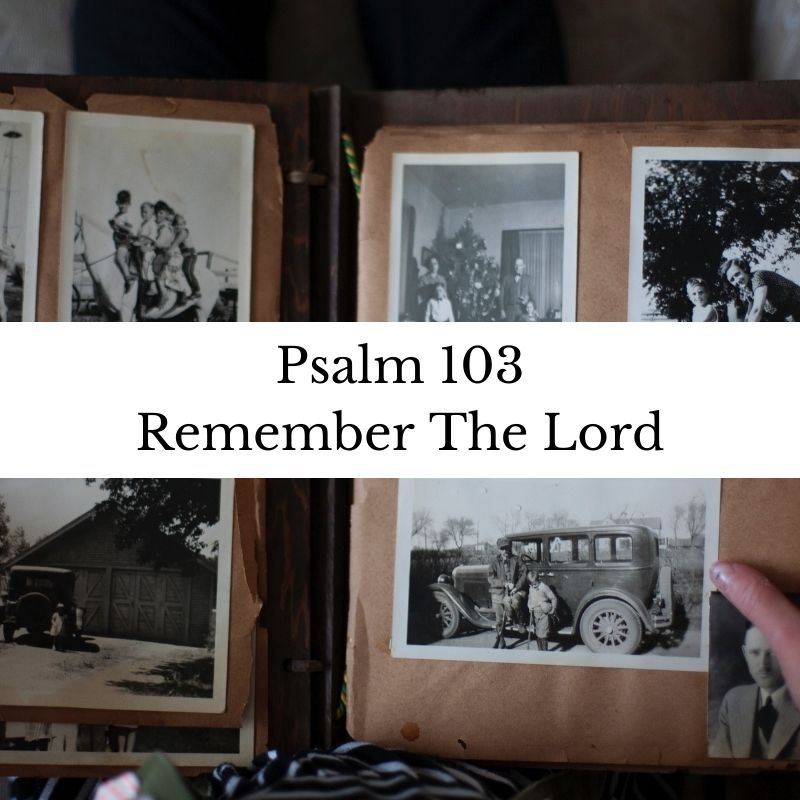
    We take photos to remember the experiences we’ve had and the places we’ve been to. When we look back on photos we’ve taken, our memories take us back to what we’ve done and experienced. We don’t want to forget that sunrise, or that waterfall, or that animal we got up close to. We don’t want to forget that party with friends, or that dinner with family, or that person we met. And so we take a photo as a keepsake, to help us remember. 

    This list here is a reminder for us, a keepsake, as is all of scripture, which helps us remember God for who he is and what he has done. 

  • Deliver Us From The Evil One

    What comes to mind most often when I think of deliverance are horror movies that depict the spiritual exorcism of a child or young person. For some reason the narrative always includes a wayward young person who requires a priest to come and exorcise their perceived demons, mostly at the instigation of their parents! The priest comes along with their wooden cross, their garlic, and their special oil seeking to deliver this young person from their wrongful behaviour. And while it might be a good movie, and sadly a reflection on what happens in real life in some places, the truth is this isn’t what Jesus is teaching his disciples in the final line of the Lord’s Prayer.

    However, there is something apt in concluding this prayer by asking God for deliverance, for deliverance from the evil one is something we all need. The only way we are delivered from evil is through the Lord. For he has not only provided a way out of the clutches of the evil one, but a person who has compassion and cares deeply for us. Through the power of his Son Jesus the Lord shows his heart for his people. Like a father toward his children he seeks their good. And one aspect of this good is deliverance from the evil one.

    As mentioned in my previous post this phrase ‘Deliver us from the evil one’ is strongly linked with the prayer of help in temptation. Temptation and the evil one go hand in hand and we are in need of God’s help for us to remain apart from both.

    Deliverance is often associated with something ultra-spiritual or cult like. The movie example is one aspect to that. But the reality is there is a spiritual battle going on that we are often quite unaware of. In our comfortable Western cities and societies we choose to ignore anything that isn’t tangible, that isn’t something we can smell, taste, touch, or feel; physically or emotionally. Even though it isn’t something we think about This, however, doesn’t excuse the reality of the spiritual battle taking place.

    Paul the Apostle wrote about this reality in Ephesians 6:12. He writes, “For our struggle is not against flesh and blood, but against the rulers, against the authorities, against the powers of this dark world and against the spiritual forces of evil in the heavenly realms.” And so the reality we live in involves the reality of the spiritual realm, a world unseen to our human eyes and only known through the reality of our soul. It is a reality that requires deliverance from the evil one.

    When Jesus encourages us to pray this prayer, and remember he is the one who is teaching us to pray here, he highlights the need for us to pray for deliverance. When we are tempted, when we are fearful, when we are in need of comfort, when we sin, then we are able to pray for deliverance. In regard to temptation, when Jesus was tempted in the wilderness in Matthew 4 by the evil one he relied on the Word of God to rebuff such approaches. So too, when we are tempted one helpful way for us to find deliverance from such temptation is to remember and rely on the Word of God. This is also the case when we are fearful, need comfort, or require the reminder of Jesus as our great Saviour from sin. While we may follow the evils of the world this prayer shows our need for God is great, and especially in the battle against the spiritual forces of the evil one.

    In his commentary on this particular verse (Matthew 6:13), D.A. Carson writes,

    “This petition is a hefty reminder that, just as we ought consciously to depend on God for physical sustenance, so also ought we to sense our dependence on him for moral triumph and spiritual victory. Indeed, to fail in this regard is already to have fallen, for it is part of that ugly effort at independence which refuses to recognise our position as creatures before God. As Christians grow in holy living, they sense their own inherent moral weakness and rejoice that whatever virtue they possess flourishes as the fruit of the Spirit. More and more they recognise the deceptive subtleties of their own hearts, and the malicious cunning of the evil one, and fervently request of the heavenly Father, ‘Lead us not into temptation, but deliver us from evil.’”

    And perhaps that is an apt ending to not only this clause within this verse, but of the whole prayer itself.


    This concludes our series in the Lord’s Prayer. All the posts in this series can be found at the following:

  • My Top Posts for 2020

    After three years of significant growth the last 12 months has seen a little dip on my blog. I’ve certainly had less capacity for writing, and have slowed down my posting and focus. This has had an impact. But then, hasn’t everyone slowed down and felt unfocussed in some form or another at times this year?

    I have certainly written less in the past 12 months, less that I have in the last five years. Both my public and private writing has suffered, and as a result I feel like I’ve suffered because of it too. This is not to be dramatic, but it is a result of decreasing in a habit that I find great joy and satisfaction in. Since writing less I have found myself to be less reflective, and in turn less reflective on my heart and soul. You see, there is something about writing that causes us to slow down, to reflect, to take stock, to gather thoughts, and to be precise about what we think and say. Writing enables better thought-processes–all things I have had little capacity for these past 12 months and wish to get into once again.

    Having said this, while posting less may have meant less people have wandered over to my part of the internet I am still very thankful that people do read what I’ve written. It surprises me how many people wish to read something I’ve written, and who may even post a comment about it on my social channels. And so I’m very grateful that I get to share something of my life and faith through this site.

    Aside from the statistics there is a particular satisfaction I have in writing and publishing posts. Reading posts I wrote a number of years ago is like going back and looking at sermons you’ve written, a harrowing and embarrassing experience. To see the quality of my writing increase in these last few years has been pleasing. And this is reflected in the top posts for the year 2020, which you can read below.

    Like any pursuit, creative or otherwise, there is a certain satisfaction in finishing a post and seeing it ‘out there’ on the inter-webs. It is an accomplishment and and encouragement at the same time. As with life and faith, which this blog is all about, writing and blogging require me to plod along. The quality of these things are built on small steps and increases in habits each day, week, month, and year.

    So, here’s to another year of writing, hopefully a bit more consistently, and with something that might be of value to you!

    Top Posts for 2020:

    1. The Grieving of the (Non) Gathering of God’s People (published 2020)
    2. Your Will Be Done (published 2020)
    3. Make The Bible Project Your Bible Reading Plan for 2018
    4. Martin Luther on Complete Forgiveness In Christ
    5. God’s Love Expressed: Through The Cross

    [Top posts for 2019, 2018, 2017, 2016, 2015]