Author: Jon

  • On Unity

    The following post is something I had published in The Witness, the monthly Victorian Baptist magazine, published by the Baptist Union of Victoria, in 2009.

    Unity seems to be something which is hard to find in the church today. Well, maybe it’s always been hard to find, church history seems to suggest so too. It’s surprising isn’t it; one would think that the church would be the one place that is united.

    If we look outside the church there are plenty of things that unite people. Football unites supporters like nothing else here in Melbourne, but sport in general does that in almost every nation. Community events show a united people, look no further than Black Saturday and the out-pouring of unity that came from that. But we could also think of book clubs, favourite cafes, the RSL, the local lawn bowls club, and the like. Being part of a community, being part of a family, brings unity and commonality.

    In recent months I have been pondering unity within the church.

    It’s been hard to nail, and hard to find.

    If we are honest with ourselves we must recognise that there is a wealth of disagreement that occurs within the church. These may be things like where the pulpit should be placed when one is preaching, to the ways in which we reach our community with the Gospel, to the various theological positions church members have. Differences occur, they are bound to, but quite often they cause disunity rather than mutual encouragement and respect.

    While on holiday a couple of months ago I read volume one of Arnold Dallimore’s biography of George Whitefield. Whitefield was a preacher who spread the Gospel throughout the UK and America in the 18th century. He was one of the first to preach outdoors, outside the church building, and for his day this was radical. Instead of avoiding such “corner preaching” like the plague, which we tend to do, Whitefield was able to preach to tens of thousands at a time. What impressed me most about his character was the way in which he tried to be unified with other believers. Wherever he went he would first stop by the local church or parish, and in his theological disputes with John Wesley he continued to pray and hold him up as a brother in Christ.

    Whitefield modelled, what I believe many in the church today miss, unity.

    Paul speaks no better about unity than in 1 Corinthians 12 and 13. Beginning with the illustration of the church being one body with many parts he moves on to the most crucial point regarding unity–love. While one may be particularly enamoured by the passage regarding love in 1 Corinthians 13 it actually stems out of Paul’s thinking regarding unity and the body of Christ.

    It is love which is most central to unity, it is love which is most central to Paul, and it is love which is most central to our faith. It is the “more excellent way” (1 Corinthians 12:31). Christians are to be marked by love and to be unified by love.

    That love is best expressed when we head to the cross. That sacrificial, God-exalting, sinner-redeeming love is most clearly seen through Jesus’ death and unifies all believers to love others rather than themselves.

    Why is it that churches split, that conflict occurs, that disunity abounds?

    It is because there is no Christ-like love.

    Why does a supporter of a footy team actively go to all the matches and buy the team scarf? Why does a community rally in the face of adversity? Why does unity occur?

    It is because there is love.

    “Unity through diversity” seems to be a current catch-cry but perhaps “unity through love” might be a better way to put it.

    Through the cross of Christ and the love of Christ unity is at its peak.

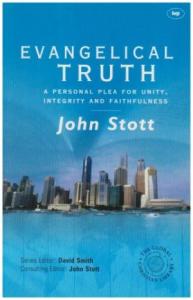
  • Evangelical Truth by John Stott

    evangelicaltruth stottJohn Stott and his ministry is well known and well respected throughout the world. He has written numerous books and articles, and up until his death in 2011 he was considered a worldwide Christian leader.

    In this little book of 149 pages Stott explains the essentials of the Christian faith and makes a strong plea for unity. Here, toward the end of his life, Stott continues to write with great insight, making you think about the primary and secondary issues within the Christian faith. There is constant debate between Christians, now more than ever it seems, over all sorts of theological and social issues. Stott believes these issues should be discussed, but at times there is a need to lessen the vigour and closed-handedness of these debates.

    Evangelical Truth has five chapters, including the introduction and conclusion. The three main chapters cover the following areas: the revelation of God, the cross of Christ, and the ministry of the Holy Spirit.

    In the introduction Stott gives a brief rundown of his definition of evangelicalism. He pitches this definition against that of fundamentalism and liberalism. Within this chapter he also gives information about evangelicalism has evolved and its main historical turning points within the church.

    The chapter on revelation, as expected, is based on the revelation of God through the bible. Stott speaks of general and specific revelation, progressive and personal revelation, inspiration, authorship, biblical authority. He touches on the debate between the sufficiency of scripture and also the inerrancy of scripture. Here Stott makes his stand against using the term ‘inerrancy’.

    Chapter three is essentially the gospel. It is the message of the cross well explained. He gives a helpful explanation of ‘justification by faith’, and grapples with what disciples and mission are. It is the shortest chapter in the book but also the most concise and straight-forward. It was good to hear the gospel again.

    A final chapter on the ministry of the Holy Spirit makes Evangelical Truth truly trinitarian. The topics of assurance, holiness, purity, community, mission, and hope are all covered. Stott is really telling the reading of how the Holy Spirit works; in the New Testament and his continuing work today. This is a good chapter and well explained.

    To conclude, Stott summarises his point and pleads with the reader to be united with Christian brothers and sisters around the globe. He calls for Christians to endure hardship and wants to be an encouraging voice within that. You can really see in the writing that Stott has a wealth of experience and knowledge of the gospel, is passionate about the things of God, and wants Christians around the world to be united under the gospel. He encourages all believers to lead with humility and to love one-another with Christian love.

    A great primer of the Christian faith. Get on it.

    John Stott, Evangelical Truth: A Personal Plea For Unity, Integrity and Faithfulness (149 pages; Leicester, UK: Inter-Varsity Press), 2003.

  • Power Through Prayer by EM Bounds

    EM Bounds is known as a prolific prayer-warrior, mainly because of his many and various books on the topic. While they were written many, many, years ago they are still greatly relevant for our soul today.

    “Power Through Prayer” is a book written particularly for ministers, that’s certainly the impression you get from reading it. Bounds encourages everyone, but particularly those who preach, to come back to prayer, to fight for prayer, and to do all things with and through prayer. Bounds stresses the power that comes through prayer, and through close communion with God in prayer you soul will be lifted high unto the heavens.

    Bounds tells tales and stories of people of the past who have spent many hours on their knees fighting for their congregation, the people they minister to. Throughout the book there are various quotes about prayer from famous churchmen in Christian history, including a special affection for David Brainerd, the young American preacher and Indian missionary of the 18th century. They are very inspiring and perfect for an Instquote if one could be bothered. In fact, much of the book is quotable as he wrestles the reader to the ground, urging them to take up a prayer ministry. There is constant encouragement to spend time in prayer, praying for the sermon, and the souls of men and women.

    An example of this would be:

    “What the Church needs to-day is not more machinery or better, not new organizations or more and novel methods, but men whom the Holy Ghost can use — men of prayer, men mighty in prayer. The Holy Ghost does not flow through methods, but through men. He does not come on machinery, but on men. He does not anoint plans, but men — men of prayer.”

    Even though the book is only 128 pages it is an inspirational book. It will shake you up and help you understand the power of prayer in the Christian life. I would highly recommend it to anyone who is wondering about prayer and its importance. It is an excellent book, and you can even download a free PDF of it here.

    E. M. Bounds, Power Through Prayer (128 pages; London, UK: Marshall, Morgan & Scott).

  • Richard Baxter On The Pastor and Recreation

    Richard Baxter on recreation for the minister:

    “Recreation to a minister must be as whetting is with the mower – that is, to be used only so far as is necessary for his work. May a physician in plague-time take any more relaxation or recreation than is necessary for his life, when so many are expecting his help in a case of life and death? Will you stand by and see sinners gasping under the pangs of death, and say : “Go, doth not require me to make myself a drudge to save them?” Is this the voice of ministerial or Christian compassion or rather of sensual laziness and diabolical cruelty?”

  • George Whitefield (Vol 1) by Arnold Dallimore

    This great volume comprehensively describes the life and times of George Whitefield.

    Starting with his early years right through to the age of 26, Arnold Dallimore describes the wanderings and impact of this young man. Using previous biographies, and the more important journals of the man himself, Dallimore outlines Whitefield’s contribution to the spiritual state of Britain and America during the 18th century.

    This book is brilliantly illustrated with stories of his time at home and at school. There is detailed analysis of his time at university, where he became a true convert of Christ and became firm in his understanding of the doctrines of grace.

    GeorgeWhitefieldv1and2

    His travels throughout Britain and America take up considerable pages, but these are very much the guts of his ministry. The book ends with Whitefield about to face more trials as he returns to England for the second time.

    As I’ve written previously, there are a number of things to take away from this work. His preaching ministry is a powerful manifestation of the Spirit, and his courage in the face of adversity is something to behold. He began preaching while in his teens, and soon began speaking to crowds upwards of 20-30,000 people. Such was the power of his preaching.  Furthermore, there is a sense of his overwhelming love for his fellow brethren, wanting to be united with the many ministers and other preachers.

    This is only book one of a two volume set, and there is much depth and content to be gleaned about the man. It’s worth the read.

    Arnold Dallimore, George Whitefield: The Life And Times Of The Great Evangelist Of The 18th Century Revival (vol. 1, 590 pages, London: Banner of Truth Trust), 1970.