Hey, I’m Jon.
And this is where I write about life and faith, no niche included. Just an honest attempt to be faithful and fruitful for Jesus. If that’s something you want more of, subscribe.


  • Newton on Celebrity Preaching

    Perhaps a good word for those of us who follow and podcast the great preachers in this world…

    “A stated and regular attendance encourages the minister, affords a good example to the congregation; and a hearer is more likely to meet with what is directly suited to his own case, from a minister who knows him, and expects to see him, than he can be from one who is a stranger. Especially, I would not wish you to be absent for the sake of gratifying your curiosity, to hear some new preacher, who you have perhaps been told is a very extraordinary man; for in your way such occasions might possibly offer almost every week. What I have observed of many, who run about unseasonably after new preachers, has reminded me of Prov. 27:8: “As a bird that wandereth from her nest, so is the man that wandereth from his place.” Such unsettled hearers seldom thrive: they usually grow wise in their own conceits, have their heads filled with notions, acquire a dry, critical, and censorious spirit; and are more intent upon disputing who is the best preacher, than upon obtaining benefit to themselves from what they hear. If you could find a man, indeed, who had a power in himself of dispensing a blessing to your soul, you might follow him from place to place; but as the blessing is in the Lord’s hands, you will be more likely to receive it by waiting where his providence has placed you, and where he has met with you before.”

    From John Newton’s On Hearing Sermons.

  • 10 Simple Steps To Making A Godly Decision

    I recently preached on God’s Guidance. Toward the end I provided some practical steps in how to go about making a biblically wise decision. The steps are outlined below and have been adapted from Kevin De Young’s book, Just Do Something: A Liberating Approach To Finding God’s Will.

    20140129-122213.jpg

    1. God has called us to himself. He has enabled us to know him through his Son Jesus and given us forgiveness and hope.
    2. The Spirit is at work to grow us into holiness and Christlikeness. We are a work in progress. It’s OK. We won’t be made perfect until Christ comes again. Our decision making is going to be flawed at times, let’s keep ourselves in perspective; it may save us from regret.
    3. We are to love God and love others. The first and most important command, this should be relevant to us as we seek guidance and make decisions.
    4. We are to search scripture and keep ourselves in line with the commands and guidance that God gives through his Word.
    5. We are to pray. Just sit down and pray about it to God. Whether it’s once, or it’s every day for the next 10 years. God seeks to hear from us but it may also change us.
    6. We are to talk to people with biblically wise people. In our churches and communities, and our wider Christian networks, who can help you think through issues and make decisions?
    7. We are to know ourselves. By knowing our gifts, abilities, skills, passions, attitudes and desires we can begin to see alignment between them and what God is perhaps calling us to. The question of are we a ‘good fit’ is a good one?
    8. We are to know other Christians. Discernment and guidance doesn’t take place in your own head. It is a communal exercise. Are their close friends who resonate with what you’re suggesting or doing? Does the church give its backing to your decisions and pursuits?
    9. We are to think through the opportunity. On one hand God’s ‘open door’ policy can be good. There is a door open and you can step through it, then you can look back and think of God opening the door for you. On the other hand, the ‘open door’ can be deceptive. The opportunity that comes along may take you away from other possibilities. However, if you’ve done the above then I would hope you’re right.
    10. We are to make a decision. The ball is in your court. Make a call, commit and follow through with it.

    As a final summary to his book DeYoung concludes with these great words on God’s will, guidance, and making decisions:

    “So the end of the matter is this: Love for God. Obey the scriptures. Think of others before yourself. Be Holy. Love Jesus. And as you do these things, do whatever else you like, with whomever you like, wherever you like, and you’ll be walking in the will of God.”

  • The Glenn McGrath Bible Reading Plan

    Glenn McgrathSo by now you should be a week into your New Year’s resolution of reading the bible this year. Well, if you’re a Christian of some description anyway.

    How’s it going? Have you managed to work your way through the chapters you planned to? Did you choose one of those plans that makes you jump between different books of the Bible? Perhaps reading some Old Testament chapters, some New Testament and then a Psalm. Or, maybe you’re working through the Old Testament and so you’d be stuck in the middle of Genesis or thereabouts right now.

    Every year for the last seven or eight years I reckon I’ve attempted to read the whole Bible through. I’ve managed it twice in that time. It was probably the first couple of years too where I completed the goal.

    One year I was silly enough to choose a plan that required reading 10 chapters per day and took you to almost every part of the bible. Yeah, I managed about two weeks and gave up. It was like reading a short novel every single day. I like reading, but perhaps not that much.

    The thing with bible reading plans is that at the start of the year it starts off well but then you realise you’ve got to work your way through Chronicles and 150 Psalms and some prophets, which can be depressing at times. Sometimes it’s the same story over and over again, sometimes it’s just the same genre of writing that can get a bit tiresome.

    Don’t get me wrong, I think bible reading plans are good. I think that having a plan or a goal in your bible reading is important. And, if you don’t, what’s that saying about how seriously you’re taking your faith and wanting to hear from God? Hmmm, one to ponder there I think.

    So while I hold them up as good there does need to be a sense of reality about what type of plan you’re going to do. At the start of the year we tend to think we can achieve more than perhaps is possible. What’s important in any reading plan, whether it’s the bible or other books, is to break it down into consistent chunks that are achievable. Like with anything – fitness training, writing, art – it requires discipline.

    This is where I’ve come up with the very basic idea of The Glenn McGrath Bible Reading Plan.

    If you at least follow a little cricket I would hope you know who Glenn McGrath is. If you don’t, shame on you. Glenn McGrath is the great Australian fast bowler who holds the record of most wickets by a fast bowler for Australia, possibly even the world. Throughout his career McGrath bowled line and length. That is, he bowled the ball just short of a good length and in line with the off-stump or just outside. He aimed for the same spot each delivery and made it very difficult for the batsmen. By doing this he was disciplined in not wavering from his plan, he was consistent in his pace and placement of the ball on the pitch, and it just got people out. It was terrific fast bowling, could be considered pretty boring too, but it worked.

    And this is the thing with The Glenn McGrath Bible Reading Plan.

    The key is consistency, the same process every day.

    The bible has 1189 chapters. The year has 365 days. That means 3.25 chapters per day will have you finishing the book of Revelation on New Year’s Eve. You will have read the whole bible through in a year. 3.25 chapters isn’t much is it? That’s like 15 minutes max. Maybe more for the day you’re reading Psalm 119, but I digress.

    It’s actually not much per day when you put it in those terms. It’s achievable and even more so when you’ve got your phone and you’re on your way to work or you wake up and it’s right next to you.

    This year I’ve planned to read four chapters per day and am simply ticking off what I’ve done. I’ve started at Matthew because most years I’ve started at Genesis and it’s gotten tiring. To make it a habit I’d rather read from Matthew first. If I continue to go with four chapters per day I’ll have finished the bible by September or October I think. After January I could pull it back to three chapters per day and we’d be right for the rest of the year. I’ll make that call later. The important thing is that it’s happening and beginning to become a habit.

    How about you? Have you started a plan this year? How’s it going?

  • ‘From Five Barley Loaves’ – An Interview with Ken Manley

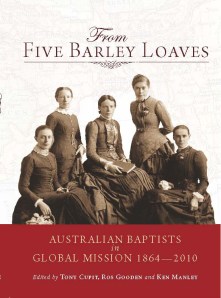
    From Five Barley Loaves CoverThis year Global Interaction, the Australian Baptist cross-cultural mission agency, celebrates 100 years since federation and 149 years of involvement in global mission. As part of these celebrations a book has been released highlighting the involvement of Australian Baptists in cross-cultural mission since 1860.

    The first five Baptist missionaries sent from Australia were female. At their commissioning service the pastor, Silas Mead, preached from the text referring to Jesus feeding the five thousand in John 6. Drawing on this story Mead made reference to the five barley loaves supplied by the child, the implication being that the work these five women were about to undertake in Bengal would be one where they were few among many. It is from this beginning that the title of the book From Five Barley Loaves gets its name.

    Ken Manley, Australian Baptist pastor, historian, and former Whitley College principal, was one of three main editors of this work. He has been kind enough to answer a few questions about the book and let us in on some of the significant points of his research and writing. I’d like to publicly thank Ken for agreeing to share his thoughts, it’s much appreciated.

    1. What interested you in being involved in writing this book?

    I was asked to act as a consultant to a small group from Global Interaction who were planning the project. There was no expectation or commitment that I would do any writing. I was quite supportive of the book for several reasons. When writing my history of Australian Baptists I had included one chapter on our foreign mission work and realised how inadequate this was. I knew there was a great need for a carefully researched history of the Mission. I also believed that the work of the Mission was the most unifying ministry of Australian Baptists nationally and wanted to see the full story told. My friend Gerald Ball had written a fine thesis on early Australian Baptist work in India and had been asked to write a major history of ABMS (as our mission was then called). I really wanted to help him and was sorry when his health meant that a much wider group of writers had to work on the history. Also, I had always been a supporter of the Mission and had served in minor ways across the years and so was delighted to be asked to help as an advisor. In the end I wrote the chapters on home leadership and mission policy as well as the conclusion.

    2. In your mind, what were the most significant findings in researching the book?

    This is hard to say in the sense that in broad terms the story was well known. As a group we shared a belief that mission history generally and our story in particular should itself have a strong missiological purpose. As we wrote the history we were constantly seized with the way in which the Mission was led by God and sustained especially in the most difficult times. The way in which various national groups responded to the gospel is itself inspiring and a reminder that all missionary work is in the deepest sense simply telling what God is doing in the world. The depth of the commitment to the work by such a wide range of people right across our churches was confirmed by the details of our research.

    3. As Australian Baptists why is it important to know our mission history?

    It is a major part of who we are as a people. We did not want to produce a naive devotional narrative that depicted missionary heroes as flawless saints. We wished to avoid any sense of triumphalism or promote a cultural imperialism. The growth of faith and mission among those people with whom the missionaries shared has been a significant and central part of our story, not as a justification or vindication of ‘our’ work but as testimony to the unfailing work of God in mission in the world. That God used ordinary people just like us is a call and challenge for us to serve in our day.

    4. Was there anything that surprised you about our mission history? If so, what?

    I am not sure that ‘surprised’ is the right word. In broad outline the story was known. Yet the very fact of bringing it all together was itself an inspiration. Here was ‘just’ another story about part of the global phenomenon that is Christian mission. Here was a tale about this small part of the Christian world family seeking to share the truths of the gospel to people of different cultures. Here was the story of both failures and successes, of a slow but steady growth in awareness of the challenges of cross-cultural mission and of experiments in outreach to different cultures in times of dramatic changes in the world. We believe that there is inspiration and challenge in the story but we have not felt it necessary to gloss over mistakes and struggles. A couple of the saddest parts to record were about differences and failures but that was necessary too.

    5. How can we be encouraged in our faith through reading this book?

    Archbishop Rowan Williams has written, ‘We are always likely to forget that Jesus is different from the Church, not the Church’s possession’. So with this Mission. We were once inspired with the vision of taking the gospel to the ‘lost heathen of the world’. We do not mock the motivation, the sincerity and the passion with which that mission was undertaken. But our Mission’s story affirms that Jesus was never the Mission’s possession to be given from an imagined superiority to the poor benighted people of distant foreign places. Today we clearly affirm that we are partners not propagandists with a vision to ‘empower communities to develop their own distinctive ways of following Jesus’.

    Indeed, as the one eventually charged to write about the work of successive leaders, to analyse home support and reflect on the missiological policies of the Mission, I was deeply impressed with several aspects and found my own faith in missions increased. I was, for example, inspired by the way in which during successive periods dedicated workers grappled with challenging problems. Frank Marsh who led the Mission for 23 years summarised his term as a series of crises that ‘add up to a story of repeated deliverance and convincing evidence of Divine care’. His successors echoed this sentiment. I discovered a willingness to change, to follow fresh insights and to adopt compelling mission goals even if this involved risks of misunderstanding by supporters. Most especially, I came to understand more clearly the immense depths of support given by a myriad of loyal, mostly unknown Baptists, whose unfailing interest, incredible generosity, faithful prayers and sacrificial efforts seemed to grow in times of desperate need and which lay behind every advance on the fields. This is the story of such ordinary Baptists at home as well as the hundreds who served as missionaries in diverse locations.

    6. And for those tossing up whether to read this history or not, what would you say to them?

    It is a long book and you may choose to read it in chunks. It is great value! Every church should have a copy in the church library or available for all to read. The story in each country is found in separate chapters. Reading it will reward you as an individual believer and as a church you will be challenged to extend your commitment to global mission in our generation. Here is our story, not only from the past by right up to date. If you care about the spread of the gospel throughout our world today you will need to read and be challenged!

    Any further comments?

    One Anglican reader and historian of missions, Professor Stuart Piggin has written about our history: ‘A really quite astonishing record of an astonishing part of the church family which says to the rest of us, “Go and do thou likewise”’.

  • Silence

    9373122847_55bf20db8d_b
    Cristiana Gasparotto

    In the early 400s a hermit named Agathon was said to have spent three years with a stone in his mouth to encourage him in his practice of refraining from speech.

    Ignoring the fact that Agathon is a cool name and sounds like he should be a character in Lord of The Rings, he was evidently a man committed to silence.

    I read this little anecdote in a book I’ve just finished titled, Silence: A Christian History by Diarmaid MacCulloch, the Professor of the History of the Church at Oxford University. As the title implies, it’s a book detailing the theme of silence through Christian history.

    Since reading this book I’ve found myself pondering silence.

    Silence seems to be elusive in our society, it’s not something we’re generally comfortable with.

    After all, most of us, I dare suggest, prefer noise over silence.

    As I sit writing this I’m well aware of the noise around me. I’m in a cafe where the customer and the owner are talking quite loudly about what they got up to on the weekend. There is a group of Christians (they look Presbyterian) praying in the corner, some of which I can hear. There are people getting up from the table and scraping their chairs on the wooden floor, and there’s the noise from the kitchen, dishes clanging and chef’s directing.

    That’s just the noise from where I sit. It’s a comfortable place to be.

    But think of the noise we choose to have in our own lives. This isn’t just the busyness that pervades our diaries, this is the actual noise we have ringing in our ears as we fall asleep, as we commute to work, as we do exercise. In each of these cases we may have the radio or the iPod attached as we seek to multitask and be efficient.

    So, how do we bring silence into our lives?

    If we go back to the example of Agathon we see his commitment to his cause. It’s radical, it’s extreme. I don’t imagine I could do it.

    I think I prefer noise because it helps keep me distracted. It helps me avoid silence.

    Silence can be threatening.

    When there’s no one around and no distractions it’s only me and my own mind. I can get caught up in my own thoughts. Some good, some not so good. Silence means it’s just me. No one else.

    From a young age I’ve enjoyed watching the detective series, Cadfael. Cadfael is a monk who was part of the crusades upon the Middle East but then turns to the cloister in search of a simpler life. In doing so he is portrayed as the worldly monk, competent in medicinal practices and helpful at solving the extraordinary number of murders that occur in and around the Abbey.

    The monk life enabled regular time for silence, worship, and reflection on God. Silence was structured into the day. Over the course of a 24 hour period there are eight designated times of prayer and worship, while outside of this is space for the individual to be silent.

    I’m not suggesting we need to join the monk life, but I am suggesting silence might help us cope with our busy lives. Silence provides a space for reflection, for thinking, for clarity. It enables us to have time to ourselves, to recalibrate our bearings. How long has it been since you recalibrated those rusty bearings?

    Recently I’ve found myself enjoying even 5-10 minutes of silence every few days. It’s bought a sense of refreshment and the ability to persevere with whatever is next. For me, incorporating silence into my weekly rhythm will help give me the energy to deal with the week’s busyness.

    What about you? Is silence something you avoid? Do you include silence in your weekly rhythm?

    Challenge: Spend 10 minutes in your car with the radio off, how do you react?