Tag: Youthmin

  • Day 14 – You Are Relational

    “They devoted themselves to the apostles’ teaching, to the fellowship, to the breaking of bread, and to prayer. Everyone was filled with awe, and many wonders and signs were being performed through the apostles. Now all the believers were together and held all things in common. They sold their possessions and property and distributed the proceeds to all, as any had need. Every day they devoted themselves to meeting together in the temple, and broke bread from house to house. They ate their food with joyful and sincere hearts, praising God and enjoying the favour of all the people. Every day the Lord added to their number those who were being saved.” (Acts 2:42-47)

    The God we worship is a relational God.

    He could’ve done anything he liked and what he chose to do was create humanity in order to have a relationship with him. We see in the first book of the Bible that he not only creates the world and everything in it, but there is a particular emphasis on him creating humanity as the pinnacle of his creation. We as his creatures reflect the image of God. We carry within us, and possibly outside of us, aspects of God himself. In recognising this we find we are image bearers of God. We bear the image of God as we walk and talk, as we connect and commune with others.

    God, being a relational God and creating us to be in relationship with him, therefore, puts into us something of that relational characteristic that he has.

    We reflect God’s relational character in our lives.

    Therefore, we find we have a yearning for relationships.

    We seek after relationships with others, we seek their company, friendship, acceptance and love.

    You're More Than A Number - You Are Relational

    The explosion of social media in recent years highlights the fact that we want to tell others about ourselves, and probably highlights our voyeuristic tendency to want to see what others are up to as well. But, it seems that we want to be in relationship with others, and seek that relationship in a variety of places. Whether it is face-to-face or online there is a yearning and desire for relationship in our lives. Some find these fulfilling relationships in positive places, others fall into the arms of harm and pain, suffering as they seek to find the relationship they desire.

    This creation narrative in the opening chapter of the bible (Genesis 1:26-28) reminds us we are not accidents and that we are made for one-another. Not all relationships need to be physical or sexual, but they do need to be person to person, seeking to love one-another because that is what we are created to so. This kind of relationship is not simply between one person to another either. It is relationship with groups of people, with a community.

    Thankfully, God in his infinite wisdom provides a community for believers that is to meet aspects of this relational need.

    God has designed a community in the form of his people, the Church.

    When we think of church we may not have great things to say about it. We may think of it as only a meeting place for singing songs, praying prayers, and hearing someone speak to us. Church is meant to be much more than a place to gather for 90 minutes on a Sunday. The church is to be a place where we find God-fashioned community.

    In Acts 2:42-47 we see the early church, those who had contact with Jesus in his lifetime and witnessed his presence in physical form, came together with other believers in community. As part of that coming together they had meals together, prayed together, heard teaching together, and simply hung out with one-another. This was the germinating church, the church in its infancy as believers came together, bonded together, and were in community.

    This is God’s people living together as God’s people.

    In today’s Western society we can look around and see that our churches and communities of faith are not expressing themselves in the same way. Due to cultural and societal factors this doesn’t occur as it did in first-century Palestine. But as God has designed it we are made to commune with one-another on a regular basis, as an expression of our love for God and love for one-another.

    In the book of Hebrews 10:24-25 we are encouraged to not stop meeting together but continue to do so in love and worship.

    “…let us watch out for one another to provoke love and good works, not neglecting to gather together, as some are in the habit of doing, but encouraging each other…”

    This is not only an expression of church but an expression of worship through community.

    Just as we are made for relationship with God and with each other we are also made to express our relationships through community. Together with a group of people we play an important role in helping people know they are loved by God and others.

    FOR REFLECTION

    • What relationships are most important to you?
    • How does knowing you were made for relationship and community affect your view of others?
    • In what ways can you contribute to a local church so that others know the love of God?

    This is part of a devotional series called You’re More Than A Number. To understand the purpose of these posts then please read the series introduction. If you’d like these delivered to your inbox, please sign up to follow this blog or my FB page.

    1. You Are Created
    2. You Are Sinful
    3. You Are Forgiven
    4. You Are Called
    5. You Are Redeemed
    6. You Are Loved
    7. You Are Saved
    8. You Are Free
    9. You Are Chosen
    10. You Are A Child of God
    11. You Are A Slave
    12. You Are Made For Good Works
    13. You Are A Follower
  • Day 13 – You Are A Follower

    “Come, follow me…” (Matthew 4:19)

    A disciple is someone who follows another.

    When Jesus was hanging around earth in human form he collected 12 disciples. Each one he called to follow him, and as they travelled with him they got to know him more and more. This was typical of the day. Rabbi’s, Jewish teachers of the Law and Prophets, would have a group of followers, a group of disciples, who they would teach. In the case of Jesus, he choose people who weren’t typically considered disciple material. Lacking in education, and not well versed in the scriptures, Jesus’s disciples would not be people normally associated with a Rabbi. Yet, Jesus doesn’t do things that people would expect, does he?

    Today, we are expected to lead from the front. You may even hear the term ‘self-leadership’. This means that we are to take responsibility for our own learning, growth, and decisions, and lead ourselves. We’re not people who are to follow others but are to follow our own dreams, passions, and feelings.

    You're More Than A Number - You Are A Follower

    From a young age we’re told we can do whatever we want. We can do anything in life, whether that be career, study, or sport. We’re constantly told that the most central and important person in the world is us. And with that comes the expectation we are to forge our own path in life.

    For some this comes in the form of not following the advice and desire of parents. The rebellious nature of adolescence, pressures of school and family too, can bring about feelings of resentment. Instead, some decide to follow their own path out of spite, in direct opposition to what their parents would believe is the best for them or approve of.

    Others recognise they have a particular passion and gifting in an area and seek to pursue that until they have reached a level of success others around them will never attain. The pressure of popularity, being better than others, and comparison, can drive people to work hard at following their passions and desires.

    And then, of course, there is the chase of wealth. The pursuit of money and riches is easily one of the defining pressures of our day. Wealth and perceived success is a certain driver for many decisions and career choices.

    When we look at Jesus we see he chose people who were ordinary. He didn’t choose those who were the best at their craft or artistry. He didn’t choose them because of their wealth or potential success. No, Jesus chose some average and ordinary men to come and follow him.

    In Melbourne we support our football teams with passion. We’ve all seen those supporters who go the extra mile. They buy the membership and all the gear–the jumper, the scarf, the hat, the badges. They have their seat at the ground. And they follow the players and team constantly.

    In some ways these kinds of supporters put many believers to shame. Why don’t we follow Jesus with the same passion and support as these football supporters? Often we find ourselves dragged down by what life throws at us. But considering we know what Jesus has done for us through the cross shouldn’t we be the ones who are passionately and actively following him?

    Following Jesus isn’t always easy. That was never the deal when we committed our lives to following Jesus. Following Jesus may bring with it a fair bit of struggle. People may not like us, we may not be popular, we may have to sacrifice wealthy opportunities, but within all that surely we should be passionate about following the one true and almighty God!

    As Dietrich Bonhoeffer says in his book, The Cost of Discipleship,

    “When Christ calls a man, he bids him come and die.”

    This means that he calls us to follow him with our all. He calls us to follow him with everything. He calls us to follow him with our lives. Not just part of our lives, or on a particular day of the week. All.

    It’s a gripping and scary thought.

    But for those of us who believe it resonates and resonates strongly – That we are followers of a great and holy God who through his Son has enabled us to have hope now and for the future.

    When we say “yes” to God we are saying we are willing to become a follower.

    FOR REFLECTION

    • Do you consider yourself a follower of Jesus?
    • Are there areas in your life that you aren’t following Jesus in?
    • That quote by Bonhoeffer, how do you react to that? Are you letting Jesus lead in your life?

    This is part of a devotional series called You’re More Than A Number. To understand the purpose of these posts then please read the series introduction. If you’d like these delivered to your inbox, please sign up to follow this blog or my FB page.

    1. You Are Created
    2. You Are Sinful
    3. You Are Forgiven
    4. You Are Called
    5. You Are Redeemed
    6. You Are Loved
    7. You Are Saved
    8. You Are Free
    9. You Are Chosen
    10. You Are A Child of God
    11. You Are A Slave
    12. You Are Made For Good Works
  • Day 12 – You Are Made For Good Works

    “As for you, you were dead in your transgressions and sins, in which you used to live when you followed the ways of this world and of the ruler of the kingdom of the air, the spirit who is now at work in those who are disobedient. All of us also lived among them at one time, gratifying the cravings of our flesh and following its desires and thoughts. Like the rest, we were by nature deserving of wrath. But because of his great love for us, God, who is rich in mercy, made us alive with Christ even when we were dead in transgressions—it is by grace you have been saved. And God raised us up with Christ and seated us with him in the heavenly realms in Christ Jesus, in order that in the coming ages he might show the incomparable riches of his grace, expressed in his kindness to us in Christ Jesus. For it is by grace you have been saved, through faith—and this is not from yourselves, it is the gift of God—not by works, so that no one can boast. For we are God’s handiwork, created in Christ Jesus to do good works, which God prepared in advance for us to do.” (Ephesians 2:1-10)

    Can you think of something you’ve done this week which you would categorise as ‘good’?

    Perhaps you behaved well in class. Perhaps you went to church. Perhaps you ate well. Perhaps you opened the door for someone. Perhaps you didn’t swear when you got angry. Perhaps gave someone a birthday present. Perhaps you sent a loving text.

    What did you do this week that was good?

    Often we find ourselves thinking in terms of good or bad. Am I a good Christian? Have I done something good with my life? Have I achieved the good I want to this week or month? Have I got good marks?

    Well, the bible speaks of believers being good. That is, that we have been created for good works. Did you know that?

    You're More Than A Number - You Are Made For Good Works

    It is very easy for us to believe that the good we do will help our standing before God. In reality this isn’t the case. Our good works don’t improve of lessen our standing before God in any way. His love for us in unchanging. To be right with God is not because of these ‘good works’ but because of what Jesus has done on the cross. God accepts us because of what He has done through Jesus, not from our good actions, behaviours, or thoughts.

    It’s a radical gift.

    It’s why the song ‘Amazing Grace’ came into being. It’s amazing because we haven’t done anything to deserve this gift. It is grace because it is a free gift from God to us.

    And out of this radical gift of grace we find ourselves bursting forth with thanks, joy, and hope for life.

    Off the back of this great news we recognise that God has created us to do good works. Because of the gift we’ve been given we seek to gift others by helping, loving, and serving others.

    Listen to what Paul, the writer of a letter to the Ephesian church, says:

    For it is by grace you have been saved, through faith—and this is not from yourselves, it is the gift of God—not by works, so that no one can boast. For we are God’s handiwork, created in Christ Jesus to do good works, which God prepared in advance for us to do. (Ephesians 2:8-10)

    God has shown his incredible riches, grace, and kindness through Jesus. And out of this amazing grace from God we find ourselves created to do good works. As we follow Jesus and put our trust in him we have a joy in doing good works for others. Our hearts are now turned to help and love others, we desire the best for others and so seek to help them through the good works we do.

    God’s hands are all over this as he has moved in us to accept this grace, and continues to move us to desire the best for others. As we continue in our relationship with God we continue to be made more and more like His Son. In this we desire to seek and serve those around us, learning how to do the good works that he has prepared for us to do.

    Incredible.

    FOR REFLECTION

    • Do you realise how much grace God has given you through the person and work of his Son Jesus?
    • Out of this truth, what is the response you have?
    • What opportunities do you have to do good works for others this week?

    This is part of a devotional series called You’re More Than A Number. To understand the purpose of these posts then please read the series introduction. If you’d like these delivered to your inbox, please sign up to follow this blog or my FB page.

    1. You Are Created
    2. You Are Sinful
    3. You Are Forgiven
    4. You Are Called
    5. You Are Redeemed
    6. You Are Loved
    7. You Are Saved
    8. You Are Free
    9. You Are Chosen
    10. You Are A Child of God
    11. You Are A Slave
  • The Forgotten Leader

    In chapter 40 of Genesis we read of Joseph in prison.

    He’s in prison because he’s been falsely accused of sleeping with the wife of Egypt’s 2IC (second in charge). But chapter 40 tells the story of Pharaoh’s cupbearer and baker, who are also in prison with Joseph, having dreams that need to be interpreted.

    Joseph seems to have risen to prominence, even within the prison walls, as he is tasked with looking after these two men. Having shared their dreams with him the cupbearer and baker ask Joseph to interpret them, which he does. When Joseph interprets positively for the cupbearer he asks him to remember him and speak highly of him to the Pharaoh. When these things happen the cupbearer is released and finds himself back in favour with Pharaoh.

    The final verse of the chapter reads,

    “Yet the chief cupbearer did not remember Joseph; he forgot him.”

    This sparked a thought about how we often forget those who play a significant role in our lives.

    The Forgotten Leader Post

    We all tell ourselves a certain narrative of the way things are, of what has happened in our lives. We are able to remember significant things, turning points, and people in our lives. But then, there are all those people we have forgotten, people who may have only had a small part in our lives at some point.

    When we think about our own walk with Jesus we often have key people who are part of that journey. We might remember a youth pastor, or a youth leader that connected with us regularly, or maybe someone older in the church who asked how we were every now and then. Sometimes though we forget those other people who were around and part of the ministry; they don’t seem to play a role in our narrative.

    This is often what it is to be a youth leader. It is often the case that we can be forgotten.

    We become a forgotten leader. 

    The forgotten leader isn’t any less significant. I often think it is better to be the forgotten leader than the one who goes down in a blaze of glory, remembered for all the wrong things they did.

    The forgotten leader is someone who serves without expecting to be needed in years to come. They serve in the youth ministry (or any other for that matter) week in and week out. They continue to grow in their relationship with God, and students come and go through the programs with the forgotten leader faithfully serving.

    This kind of leadership is certainly not what our culture expects. We want youth leaders that are flashy, that are bold, that are magnetic. But often these kinds of leaders don’t last long. Soon enough they’ve had their fill and move on to another place where a new set of people will attach themselves to them.

    A forgotten leader is someone who is counter-cultural and at their heart a servant. They get on with the job of connecting with God and connecting with students, doing the task they have been given for that season. Their work often goes unseen, they help with setup and are often packing up well after the parents have picked up their children.

    A forgotten leader is a servant leader; doing the one-percenters make the ministry work and being faithful to do what God has asked them to do. In this way the forgotten leader lowers themselves, not seeking first place, but highlights others before themselves.

    When Joseph is forgotten by the cupbearer he was performing the task that God had asked him. The issue isn’t that he was forgotten, it’s about how he was faithful to God.

    May you be a forgotten-faithful leader this year.

  • 3 Ways The Beach Helps Youth Ministry

    The beach is great.

    If it was a choice between a warm beach location or say a cold snowy type location, the beach wins every time.

    And so with summer holidays and hot days comes the annual visit to the beach. A few days spent relaxing, reading, and having a rollicking time with the family. Last year I spent hours making an awesome sandcastle with my daughter, this year it seems we’re more adventurous and have ventured into the cooler waters and waves.

    Oddly enough, the beach had me thinking about youth ministry. Perhaps it was the salt water, the days off, or too much cricket watching (can that ever be the case?). Nevertheless, using the beach as an illustration for youth ministry it reminded me of three things we youth leaders need to have in mind coming into the 2018 youthmin year.

    First, we need perspective. 

    Sitting on the beach gives you a view of the large expanse of water in front of you. It gives you a view of stretches of sand, to your left and right. It reminds you that there is something bigger than your small self going on in this world. As one person sitting on a small patch of sand, millions of grains within arms reach, you are given perspective on life, faith, and ministry.

    As Psalm 139:7-10 reminds us, God is huge. He is everywhere.

    “Where shall I go from your Spirit? Or where shall I flee from your presence? If I ascend to heaven, you are there! If I make my bed in Sheol, you are there! If I take the wings of the morning and dwell in the uttermost parts of the sea, even there your hand shall lead me, and your right hand shall hold me.”

    In youth ministry we often need perspective. It’s not about the next event, the next catch-up, the next Bible study, the next service, the next hard conversation. It is about God, and declaring that he has come, and is with us through his Son and his Spirit. He will lead and hold us, as the Psalmist has written.

    Second, we need grit. 

    Generally sand is quite gritty. On some beaches it really does give your feet a good workout.

    Youth ministry is the same. It is a hard work. It is constant work. It requires grit. It is the type of work that will give you a good workout, physically, emotionally, and spiritually.

    Paul knows this from experience and writes in 2 Corinthians 6:3-10:

    “We are not giving anyone an occasion for offense, so that the ministry will not be blamed. Instead, as God’s ministers, we commend ourselves in everything: by great endurance, by afflictions, by hardships, by difficulties, by beatings, by imprisonments, by riots, by labors, by sleepless nights, by times of hunger, by purity, by knowledge, by patience, by kindness, by the Holy Spirit, by sincere love, by the word of truth, by the power of God; through weapons of righteousness for the right hand and the left, through glory and dishonor, through slander and good report; regarded as deceivers, yet true; as unknown, yet recognized; as dying, yet see—we live; as being disciplined, yet not killed; as grieving, yet always rejoicing; as poor, yet enriching many; as having nothing, yet possessing everything.”

    It might be a different context but Paul’s words speak of the kind of grit needed for ministry. The physical persecution is not generally associated with Western youth ministry, but that doesn’t discount the challenges it brings.

    All this requires grit. It’s goes without saying that this grit will come more easily when we are walking closely with Jesus. As we work with students and their families we seek to serve them and the church out of our enjoyment of God.

    Third, we need to be fluid. 

    At the beach you can sit on the sand and watch the waves come time and time again. You can also go for a swim and enjoy the cool water on a hot day. Stating the obvious, the water is fluid and can cope with what is going on in it and around it.

    When working with students (and adults too) we need to be flexible, fluid. Often things won’t go to plan, people won’t turn up, or the weather might not be what we’d hoped for our program. In working with people, and in youth ministry, we need to be flexible in our plans and ideas. It’s helpful to know and be sure in what we think is the best way to operate, but sometimes others might actually provide better ways.

    So whether it’s events or people, holding things losely, having planned to our best ability is something worth evaluating for ourselves coming into the new youthmin year.

    At any time, not just at the start of the year, it is worth taking a few moments to gain perspective, grow in grit, and assess what we hold tightly. I can recommend the beach as a good place to do that.

  • My Top Books of 2017

    The end of another year is the perfect time for pretentious bloggers to write their list of top reads for the year. Armed with the arrogance of knowing they’ve read more books than most of their friends, and willing to share that information publicly, puts them in a category everyone despises. Nevertheless, I’ve done it for the last three years (2014, 2015, 2016) so why not continue to reveal my own pride and let you all know what I’ve read and how much.

    Here goes.

    My Top Books of 2017

    Because any reader worth their salt is signed up to Goodreads, which enables readers to reveal and recommend books to their friends, there is an automatic graphic created to show just what I’ve read. If you’re interested in that then feel free to have a look. The following is a list of books I’ve rated 5 out of 5 from the 27 I’ve read this year. They are in no particular order.

    I couldn’t have kicked off the year with a better book. It was all about how we relate to God. Since reading the book I have found it hard to explain his idea of being ‘with’ God but it was very true and very life giving. It’s pretty much the idea that we aren’t relating to God through Christ in a way which means we are ‘over’ God, or ‘under’ God, per se. It is really trying to say that through our lives we are walking with Jesus, we are WITH God and God is WITH us. There’s a relationship thing going on. It’s a brilliant book and I’d highly recommend it. It’s become a main text for my apprenticeship program next year, it’s that good.

    Peterson writes really well. Everything I’ve read of his has been great. This is no exception. Here Peterson articulates the story of his life and ministry. He doesn’t do it all in a chronological and normative fashion. However, there is much in here to listen to and chew on.

    I’ve written previously about this book and have found it very stimulating. It’s mainly about how the church can be the church in a post-modern, post-Christian, post-everything culture. And, how Christians can be Christians in a post-everything culture. From the other books I’ve read of his I’ve found this to be his best one. This books has also made it into the hands of a few at church, which is pleasing. But as I’ve commented to them, it’s constantly full of ideas and points one wants to discuss with others. It’s really good.

    I took my time reading this but was very impressed with how Keller holds social justice and his evangelical convictions so well. I’m not sure why I’m surprised through, evangelical Christians have been doing good works for centuries. Anyway, Keller articulates the biblical mandate of justice and uses the odd example to show how this might work out in a church context. He elevates this well and by the end you know this is a no-brainer. Big tick.

    Just as the Australia plebiscite was in full swing I read this book. It was brilliant. I’m not even sure it matters that the writer is gay. He articulates a terrific theology of friendship, elevating the need for friendship into a status close to marriage. There is the thought of commitment ceremonies for friends, and not in a gay marriage kind of way, but in a way that highlights the need for friends to commit to one-another. It is a book that makes you think about how your church helps singles, couples, and marrieds be better friends to one-another. It’s certainly worth the read. I wrote a few more words about it here.

    This is a small yet powerful book. For Christians it should be obvious that discipling others is part of what it is to be a believer. Here Dever outlines a terrific way in how to do that in the Western church and is something I believe strongly in. As I’ve written previously:

    “The obvious case for making disciples is made and then the ‘how-to’s’ are provided. Because I’ve read a lot of Dever, and this kind of discipleship, then I understand how to go about it. For those who are unsure this is a good primer and will provide the foundations and the practical. It’s really as easy as meeting with someone, opening the bible with them, and simply talking and listening to one-another. This should really be a standard text for anyone wishing to disciple/mentor/coach or whatever you want to call it. If I was running an internship or ministry apprenticeship this would be on my reading list.”

    I wrote a review of this book separately and outlined how many of Roos’ leadership principles relate to youth ministry. Read that for more worthwhile content.

    This book follows Paul Roos’ playing days, and particularly his successful coaching career. It’s a great read if you like sports biography, AFL, or leadership.

    • Lion by Saroo Brierley

    This is the true story of Saroo, who at the age of five is separated from his family in India. After jumping on a train, believing it will take him back to his family, he is lost in one of the largest and busiest cities in the world. The story is amazing, and I won’t spoil the ending. But, it’s the book made into a movie a couple of years ago. Great story. Inspiring stuff.

    I finished this book a couple of weeks ago and there is much to recommend about it. It’s all about youth ministry, which isn’t a surprise given its title. But, it goes into depth about the ins and out of what youth ministry is about. It talks about the culture of youth ministries and how churches are always looking for the short-term, quick fix. Instead, the author is advocating for long-term, strategic and sustainable youth ministries focussed with intention and structure. DeVries has had many years of experience in youth ministry, mainly at one church but then with an organisation that consults to other youth ministries and churches. I found it one of the better youth ministry books I’ve read. It probably makes my top 5 (youth ministry books). I have some quotes from this book in a previous post. Excellent.

  • Sustainable Youth Ministry, Quotes

    I’m currently reading Sustainable Youth Ministry by Mark DeVries. It’s a book published in 2008 and I can’t actually believe I haven’t read it yet. Anyway, while it’s been resting on my shelf since last Christmas I thought it worth bringing it out at years end. At the 70 page mark I can certainly tell it’s a zinger, with a number of challenging quotes and comments. Here are three that have stood out to me thus far.

    From page 13:

    “The short-term, high-number, razzle-dazzle, success of your current youth ministry might blind you to the fact that success in youth ministry is measured in decades, not in year-to-date comparisons with last year’s mediocre youth staffer who, quite honestly, just didn’t have your gifts.”

    From Thomas G. Bandy quoted on page 16:

    “The declining church always assumes that the solution to youth ministry is programmatic. If only they could get a good leader! If only they could find a great curriculum! If only they could renovate a room in the building for youth meetings! They fail to recognise that the solutions to youth ministry, like the solution to decline in general, is systematic.”

    Quoting Roland Martinson on page 29:

    “The history of primary calling inexperienced and inadequately trained young people to do youth ministry reflects the myth that youth ministry is a beginner’s job that doesn’t require much education, experience or skill. Nothing could be farther from the truth. Youth ministry is one of the most demanding ministries–so demanding and frustrating that many pastors and congregational leaders don’t know what to do.”

  • Published: What are the Top 5 Books of The Bible You Want Your Students to Read?

    So, I’m in a few Facebook groups full of youth pastors and youth ministry practitioners. Someone asked this question of the group and numerous responses came through. I thought about it for a few minutes and jumped in myself. I then made a blog post out of it. It was then published on Rooted Ministry.

    “Keep in mind, these aren’t necessarily my five favourite books of the bible. These are what I see as the most helpful pieces of scripture for my students, when it comes to communicating the gospel. It’s an interesting question. You may love Jeremiah, and Amos, and Revelation. Great. Are they in the top five for helping your students understand more of the grace of God and seeking to love and follow Him? Maybe they are.

    Of course, no answer is a right answer, but let me outline why I think these are the top five for my students.”

    You can read the whole post here.

  • The Sparkle of a Youth Ministry First-timer

    To help transition grade six students into youth ministry I find it helpful to invite them along to our Term 4 program.

    I don’t think this is an earth-shattering idea.

    But behind this idea is intentionality. There is intention in inviting graduating primary students and their parents to begin attending the youth ministry prior high school beginning.

    In the life of the family the graduation of primary school is significant, particularly if it is their first child. It’s an exciting time for the family as they celebrate all that their child has achieved throughout their primary school life. It is also a daunting time, because in a couple of months their child will enter high school, where they start on the bottom rung of the school ladder and desire to find new friends and community.

    So, while celebrating the final term of primary school and transitioning to high school, it becomes a good idea to transition students earlier than later. The amount of change going on in the family unit at the start of a new year, particularly when high school is a new step, doesn’t need to be heightened by throwing youth group into the mix. Instead, allowing students to attend early and get an idea of what it means to be part of the youth ministry helps alleviate stress come the new year.

    I also believe this helps the parents of the student. Finishing off primary school can be stressful, and this is mixed with various information nights and transition days for high school. With all this going on parents seem pleased for their child to be invited to youth group, and it helps them get a taste for what could be part of the family calendar the following year. Being able to meet leaders, see the program themselves, and watch how their child is adapting to a group of high school students helps in their parenting, and the expectations for their child when they begin high school.

    And finally, it is always great to have new people come along to any youth ministry. Inviting new people in Term 4 brings an energy to finish off the year. It lifts everyone to be intentional about their leadership, welcoming, and community-building. And, it’s always terrific to see the sparkle in the eyes of a first-timer.

    Perhaps you haven’t thought much about transitioning students between primary and high school? It is worth doing so, and putting into place at least some invitation and communication about this.

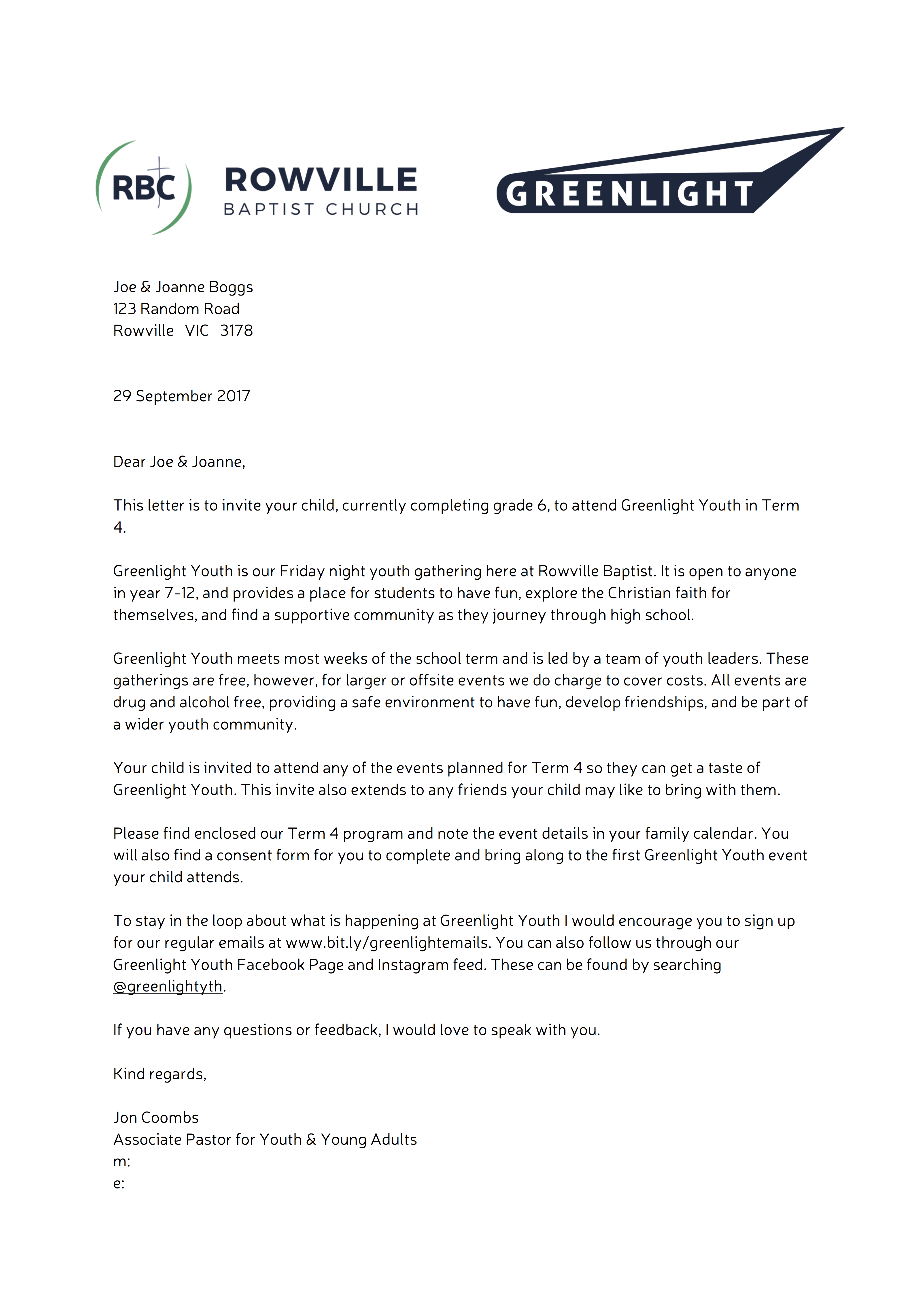
    Because of this, I have copied my welcome letter to grade six students and their parents, which is sent to them at the end of Term 3. Feel free to use as you like. I trust it will be helpful.

    170830 Letter to Parents - G6 Invite Letter - Blog Example

  • Recently Read: October 2017

    I’ve ploughed through a few books recently. I was hoping to write more detailed reflections on them, but alas, I’ll have to do with these summaries for the moment.

    Recently Read - Oct 2017

    Spiritual Friendship: Finding Love In The Church As A Celibate Gay Christian by Wesley Hill

    This is an excellent book. It really outlines a clear and attractive theology of Christian friendship. Friendship, true Christian friendship, and what that means and looks like, is not often talked about in church. This book does a great job describing a vision for friendship that is separate to small talk and serving together in some form of ministry. It is about hospitality, love for the other, and the elevating of friendship to a similar level as we evangelicals enjoy elevating marriage. It really is a profound book with plenty of ideas about how we can be better friends and provide opportunities for friendship in the life of the Christian. Unfortunately, some readers will be put off by the author being gay, celibate, or Christian. In some respects it doesn’t matter how he labels himself, he gives a good treatise on friendship and is a valuable read.

    Here I would love to include a couple of quotes, as I underlined heaps of the book, but it was so good that I gave the book away to a close friend. Ironic.

    Disappearing Church by Mark Sayers

    This seems to be the best I’ve read from Sayers. He pinpoints culture, analyses the way churches have sought to be relevant to culture, and then calls for a coming back to Word and prayer for the Christian and the Christian church. It is excellent in its cultural analysis and provides plenty of food for thought in how to live in a post-Christian, secular society. His main point is that we should be seeking to have a resilient faith, built upon understanding the Word and seeking God in prayer. You can read a more detailed reflection on Disappearing Church here.

    The Glue: Relationship As The Connection For Effective Youth Ministry by Mike Stevens

    Read this post for a fuller reflection on the book.

    As I wrote in an endorsement for the book:

    “Whether you are leading a youth ministry in a small or large church The Glue is worth reading and reflecting on. Mike helps you understand the bigger picture of relational discipleship as well as providing detailed ideas to help your youth ministry move forward. This balance is fleshed out further through focussed questions at the end of each chapter, which were certainly helpful for me in processing what I was reading. The Glue is definitely worth reading.”

    Discipleship by Mark Dever

    Here’s a little book that helps anyone wishing to improve their discipling of others. The obvious case for making disciples is made and then the ‘how-to’s’ are provided. Because I’ve read a lot of Dever, and this kind of discipleship, then I understand how to go about it. For those who are unsure this is a good primer and will provide the foundations and the practical. It’s really as easy as meeting with someone, opening the bible with them, and simply talking and listening to one-another. This should really be a standard text for anyone wishing to disciple/mentor/coach or whatever you want to call it. If I was running an internship or ministry apprenticeship this would be on my reading list.

    Here It Is: Coaching, Leadership and Life by Paul Roos

    This was a fantastic biography by Paul Roos and gives insight into his coaching and leadership principles as an AFL coach. The fact that I enjoy sport and listening to Roosy on the radio helped me to buy the book in the first place. I kept seeing clear applications to youth ministry in much of his approach so I wrote a little something on that too. Go there for further details about the book.

    The Hate Race by Maxine Beneba Clarke

    I made it through to the 100 page mark and called it quits. It is a well regarded memoir, highlighting the racism and casual racism of Australians in the 1980s to today. I’ve got no criticism of the book, I just didn’t enjoy it and wondered where it was heading.

    Strange Days: Life In The Spirit by Mark Sayers

    This was full of cultural analysis, as per usual from Sayers. Strange Days is more about living in the tension of the world but seeking to be set apart from the world as a believer. The book examines the biblical text of what it means to live in exile, what it looks like to live in the world today, and then how to think as a Christian in these tension-heightened days. Like Disappearing Church, which I preferred, it is full of ideas, analysis, and application.

    Lion by Saroo Brierley

    What a memoir! This is the story of Saroo, who became separated from his mother at five years of age. He became lost in Calcutta and was eventually adopted by an Australia couple in Hobart. The story is just phenomenal. It’s an emotional rollercoaster at times, but written in a very positive and encouraging way. It’s a must read. You may have already seen the movie. I haven’t.

    What have you read recently?