Category: On Church

  • The Grass Isn’t Greener

    We are constantly comparing ourselves to others.

    From our material goods to our leadership skills to our parenting, we are always comparing ourselves to others. There is something about our fallen humanness that leads us to measure our uniqueness with the uniqueness of others.

    This also happens in the church, and in youth ministry.

    img_6518
    We are enticed into dreaming about the bigger, and supposedly better, youth ministry down the road. Our mind drifts to consider what it would be like to be in a position at that church, or under this leader. What would it be like to have that role, live in that place, and have those facilities? For some reason we believe that the person leading that youth ministry or the role in that church will be better than the current position we find ourselves.

    I think this is natural.

    I hope it’s natural.

    I know it’s not helpful.

    Part of this thought is solidified by social media. Those glorious pictures of friends on holiday, travelling to exotic places, and experiencing amazing things compound our thought life. We tell ourselves that life is not like that, but we can’t help wonder whether our life is matching up to what we see around us. The same is true when we follow other youth group accounts, meet with other Youth Pastors, and hear of stories of what God is doing in other youth ministries. The pics portray a false reality that leads our thinking and dreaming into unhelpful areas. We begin to judge ourselves with the bigger church down the road, the one which has more money, better facilities, and the opportunity for seemingly more influence.

    Instead of praising God for the work he is doing we sit there comparing ourselves, turning the work of youth ministry into an exercise in self-centredness.

    But the truth is, the grass in not greener on the other side (or in another church).

    The issues, challenges, hard work, conflict, and all those frustrating and negative things we are dealing with now are still there in the ‘bigger and better’ church down the road. It might not look that way from the stories or the pictures or the conversations, but despite a change in place or position those pastoral and youth ministry related challenges will still be there.

    As I wrote in my original post, “It’s easy to let your mind drift to the church down the road and begin to think of how good it must be there. It’s not. It’s just not. They are having the same issues as you. They are having the same struggles. They are having the same problems. The same goes with going into a different ministry role or a role at a para-church organisation. The grass isn’t greener. It’s work. It’s hard.”

    So, instead of dreaming and spending time unhelpfully thinking about the church next door why not do some of the following things to help gain some perspective. What we do now, in the place and position we are currently in, is important. We are called to be faithful to it and work hard in the youth ministry we are involved in now.

    Abide In Him

    In John 15 Jesus talks of abiding in him. Jesus makes the connection between fruit and abiding in him. If we are to be fruitful we need to be faithful to Jesus. Through remaining in Christ, walking closely with him, and realigning our thinking with his, we will find ourselves in a better frame of mind about our current position.

    Pray

    Once we realise we are not living with Jesus as well as we should be we do need to admit that to him. Through prayer we can lift our thoughts to God and ask for forgiveness. We can then ask God to help us understand what he has for us now. While our life with Jesus is a major part of our drifting into unhelpful thinking it may also be tiredness, weariness, and demotivation for a period of time. Pray for the ministry and your rhythms in all of this.

    Vision Over Task

    With the never-ending to-do-list we can get stuck in the task. Remember the vision for youth ministry you have. Spend some time mapping out the broader vision for the youth ministry, and do some brainstorming about future ideas and possibilities. When we are stuck on task we can get bogged down. Lift your eyes to the heavens and dream about the big-hairy-audacious goals. It’s usually pretty inspirational.

    Write A List

    Have the list of everyone involved in the youth ministry at your church. Make specific comments on what you appreciate about them. Write them a note or a card referencing those specific appreciations.

    Look At Your Calendar

    Hopefully you have a calendar. Look over the last 3 months, writing down everything you’ve been involved in – the people you’ve seen, the meetings you’ve attended, the teaching you’ve presented, the events you’ve been to. Everything. Look at how much you’ve accomplished.

    Call A Friend

    Either a mentor or a close ministry friend. Give them a call. Verbally vomit on them about how you’re feeling and the frustration you’re going though. Tell them about the unhelpful thinking. Let them help you process what’s happening right now. Let them slap you around (metaphorically, of course).

    It’s often not admitted, but we know it’s there. Perhaps it’s time to let go of the belief that it’s better somewhere else. God has us where we are for a reason, we are to be faithful to him in that.

    And remember, the grass isn’t greener.


    A while ago I wrote a post about what I wished I knew when entering youth ministry. This is part five of a series dedicated to elaborating each of those eleven points. You can read part onepart twopart three, and part four here.


    11 Things: A Youth Ministry Series
    Beginning As A Youth Pastor
    Part 1: Life With Jesus
    Part 2: The Senior Pastor-Youth Pastor Relationship
    Part 3: Church Health > Youth Ministry
    Part 4: Friends For The Journey And Friends For The Road
    Part 5: The Grass Isn’t Greener (this post)
    Part 6: Nothing Else Matters
    Part 7: Temptation And Holiness
    Part 8: Church Culture And Politics
    Part 9: Fixing People vs God’s Grace
    Part 10: Working Better
    Part 11: The Privilege Of Youth Ministry

  • Friends For The Journey And Friends For The Road

    If there is one thing Pilgrim’s Progress makes clear it is that you need friends to help carry you and be there for you. Christian faces trials and challenges to faith numerous times as he seeks the Celestial City. It is Jesus who carries him through, but the means by which this carrying occurs is through the friends he has along the way.

    Friends are important. We know this ourselves. Socialisation and relationships are something we learn from a young age, or hopefully learn at least. The need for relationship and friendship and companionship is vital to living. This is why we begin making friends in playgroup and kindergarten, seek to be included when we’re in high school, find community in hanging out with university friends or work colleagues on a Friday night, and why recent widows or widowers marry again soon after the passing of their spouse.

    Relationship drives much of what we do. 

    In youth ministry we are surrounded by people, but this doesn’t mean we have close friends. In fact, it is probably less likely for us to feel like we have solid friendships with others because we may only be at a church for a short period of time before moving on to another congregation. This is not to say that we don’t care about those people we cared for previously. Due to a new role and a new church, new relationships need to be made.

    Another point to consider is that sometimes our friend card can be full. If we’ve had some really close friends from high school and that’s continued for a number of years, picked up a few more through church and other areas of life, then our social and relational needs may be met. When we get to a new church we may not need to be friends with people because of the friends we already carry. This is not always the case but worth recognising as a reality.

    With this said there are two types of friendships we might come across in youth ministry. The first I call friends for the journey, and the second I call friends for the road.

    Friends For The Journey

    The word ‘journey’ has got to be the most overused Christianese I have heard. Ever. It’s probably lessened in recent time, overtaken but that word ‘space’. However, it is good to use the word to describe this situation.

    Friends for the journey are those friends who are only around for a short period of time but they are with you through your ministry tenure at your church.

    For example, this could be a member in the congregation or in the small group you connect with really well. They are genuine friends with you and you with them. The relationship grows and grows but when you leave then the relationship pretty much stops. There is the recognition that this relationship was only for a certain period of time because of the situation you find yourself in. It could well be that you rarely speak to a former colleague after leaving for another ministry placement. That’s OK. It’s going to happen. But while you were there it was a great friendship. When you meet up again it’ll be as if no time has passed at all. But, don’t be surprised if the friendship moves on and new friends are made from both sides when this occurs.

    Friends For The Road

    These friends are those friends who you’ll be 83 years-old with and still kicking around like you’re 23. These are the friends who stick with you, you may not see much of each other during certain seasons in life, they may not even go to church or be Christian. But, the relationship and friendship was formed years ago and over time it is just natural to continue that friendship. They know more about you than most other people will ever know, and they can speak into your life or come along and support you at anytime. You could pick up the phone, call them, and they’d take it.

    This kind of friendship is needed in youth ministry as they will be there when there are challenges and tough times. They will be there in the joys and fun of the ministry. They will also see you grow and mature and become the pastor and leader you are. These are great friendships and are important to have as you lead and minister to others.

    Friends and relationships are important in every sphere of life. Sadly, there are many who don’t have friends. But in ministry it is important to have people who walk with you closely for a period of time and then there are people who are needed over the long-term, those lifelong friends.

    Do you have such friends? Is it time to give someone a call or shoot them a text? 


    A while ago I wrote a post about what I wished I knew when entering youth ministry. This is part four of a series dedicated to elaborating each of those eleven points. You can read part onepart two, and part three here.


    11 Things: A Youth Ministry Series
    Beginning As A Youth Pastor
    Part 1: Life With Jesus
    Part 2: The Senior Pastor-Youth Pastor Relationship
    Part 3: Church Health > Youth Ministry
    Part 4: Friends For The Journey And Friends For The Road (this post)
    Part 5: The Grass Isn’t Greener
    Part 6: Nothing Else Matters
    Part 7: Temptation And Holiness
    Part 8: Church Culture And Politics
    Part 9: Fixing People vs God’s Grace
    Part 10: Working Better
    Part 11: The Privilege Of Youth Ministry

  • Church Health > Youth Ministry

    Would it surprise you that there are churches out there that are unhealthy? That there are churches full of sinners, led by sinners, where the health of the church is compromised?

    I’d hate to burst your bubble but it’s true.

    There are churches that aren’t as healthy as they should be or could be. This is a shame, of course, because a healthy church can do wonders for the glory of Christ and the people who go to it. Unfortunately, not all churches are perfect. But, as the saying goes, if you find the perfect church make sure you go somewhere else as you’ll be the one to stuff it up. 😉

    I open referring to unhealthy churches because the reality is that the state of the youth ministry you lead or are part of (as a student, volunteer, or parent) is only as healthy as the overall church.

    It is important to reflect a little on this idea of health. There are a number of ways to think about it. Is the church healthy theologically? Is the church healthy in its structures and processes? Is the church healthy in its interpersonal relationships? Is the church healthy in its leadership? There are different angles to explore this issue of a healthy church. Nevertheless, if there is some part of the church that is unhealthy then it will, consciously or not, affect the whole church. When I get a cold my main issues are the throat and sinuses but it affects the way my whole body operates. It’s the same with the church.

    For you as a Youth Pastor, or someone involved in youth ministry, this could look different. This unhealthiness could show up in different ways.

    For some churches there is a clear disparity between the youth ministry and the rest of the church. The youth and young adults have their own things going on and the adults have other programs happening and never the twain shall meet. This is sad. It means there isn’t any inter-generational interaction and growth occurring, resulting in the ‘silo effect’. When people of generations aren’t able to get to know each other it is easy to forget “we’re all one in Christ Jesus” and that our church is a local expression of the body of Christ, from child through to octogenarian.

    Other churches may have a great Youth Pastor, have a terrific leadership group, run an awesome program, build solid relationships with parents and students, and see people coming to Christ. However, if things at the top of the church leadership structure aren’t great then things will go awry. The health of the leadership of the church is vital in providing a sustainable base for the youth ministry to grow and thrive. In Baptistland, where I find myself residing, there is always the temptation of church leaders to seek power and control and the status of being on the ‘diaconate’ or ‘council’. If the point of being on such a group isn’t service, and a looking out for the whole of the church and its ministries, then it will soon collapse.

    So, what are some ways those in youth ministry do despite un-health?

    • Pray for the church. Pray for the whole church, for its pastors, for its leaders, for its volunteers, and for its health.
    • Encourage membership. In the Baptist tradition the base of power is held with its members. Therefore, encourage those who meet the membership requirements of your church to become members. This enables those within the youth and young adult ministry to have a more formal voice in the church’s decision-making process.
    • Be aware of what is going on in the wider life of the church. The worst thing is to become a person or ministry that is disconnected to the whole church. Be someone, or a ministry, that seeks strong relationships with others in the church. In doing so you may find yourself recognising that you’re part of a bigger picture.

    A while ago I wrote a post about what I wished I knew when entering youth ministry. This is part three of a series dedicated to elaborating each of those eleven points. You can read part one and part two here.


    11 Things: A Youth Ministry Series
    Beginning As A Youth Pastor
    Part 1: Life With Jesus
    Part 2: The Senior Pastor-Youth Pastor Relationship
    Part 3: Church Health > Youth Ministry (this post)
    Part 4: Friends For The Journey And Friends For The Road
    Part 5: The Grass Isn’t Greener
    Part 6: Nothing Else Matters
    Part 7: Temptation And Holiness
    Part 8: Church Culture And Politics
    Part 9: Fixing People vs God’s Grace
    Part 10: Working Better
    Part 11: The Privilege Of Youth Ministry

  • Para-Church Triage In Youth Ministry

    It could be the regular emails sent by various para-church organisations. It could be actual snail mail arriving through the church office. It could be the phone calls from representatives seeking your ear.

    In church ministry there is the constant demand from people in Christian organisations around the country who would love to ‘partner’ with you. They email, post, call or seek coffee with you regularly enough that a whole day of your week could be filled with meeting people para-church organisations.

    So, what do you do?

    On one hand, it seems rude to palm people off and not hear what they have to say about their organisation and what they’re doing. On the other, there is only a certain amount of time, money, and space you can give to various organisations.

    How do you prioritise which organisations you will closely ‘partner’ with?

    I’ve come to see the answer to this question as para-church triage.

    If there is some form of health crisis and you need to go to hospital for help you usually head straight to the emergency department. If you’ve ever been to the emergency department you’ll know that the first person you see is the ‘triage nurse’. The triage nurse is someone who takes your details, assesses your condition, and then places you in the appropriate spot in the queue to see the doctor. This assessment and placement is known as triage. The nurse is evaluating where you should be placed on the priority list, whether you’ll be seen quickly or whether you’ll need to sit a while. If the triage nurse is making the right assessments someone with a drug overdose should be seen quickly while you wait with your basketball-induced sprained ankle.

    It’s the same with para-church triage.

    As a youth pastor, or any type of pastor I suspect, you need to do a little triage. That is, you need to decide where in the priority queue the various para-church organisations are placed. Some organisations might be at the front of that metaphorical queue and have a strong relationship with you, others might find themselves having to wait a while or work on the relationship, and then there are others who probably need to move queues.

    What kind of system is useful in order to perform this triage?

    I’ve come up with a framework that helps me think through what to prioritise. I understand that it will have flaws, but it might be helpful for some.

    Para-Church Triage Framework

    Priority 1: A relationship of openness, trust, and engagement

    • The organisation already has an ongoing relationship with the church.
    • The organisation is given financial support through the annual church budget.
    • The organisation employs members of the church.
    • The organisation is aligned theologically with the church.
    • The organisation can helpfully contribute to the vision and mission of the church.

    Priority 2: A relationship that is cautiously open

    • The organisation is known to you and you affirm their work.
    • The organisation has connection with people who attend the church.
    • The organisation has been recommended to you by people you respect.
    • The organisation helps train and develop disciples through people, events, and resources.
    • The organisation reaches out, wanting to improve its partnership with the church.

    Priority 3: A relationship of little or no connection

    • The organisation is not known to you and there is no relationship with them.
    • The organisation doesn’t fit with the vision and mission of the church.
    • The organisation doesn’t align theologically or philosophically.
    • The organisation pushes for financial support over relationship.

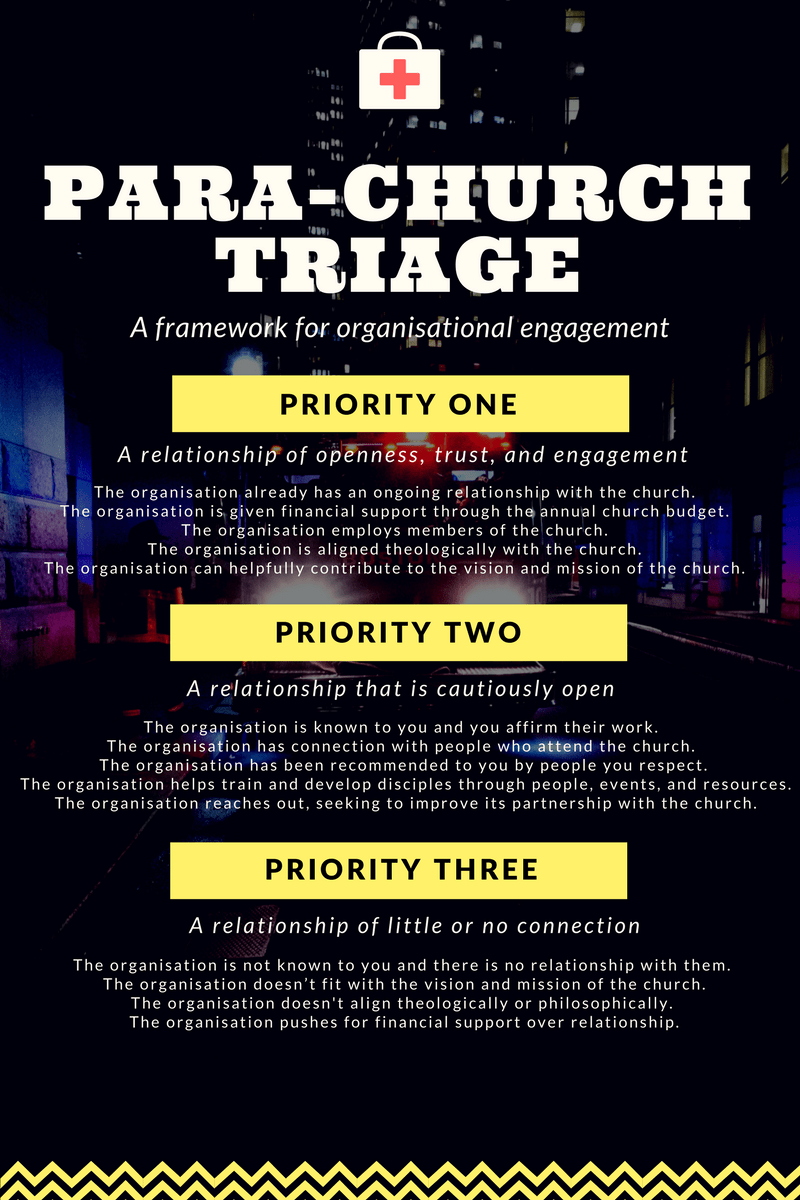
    That’s the framework, and one that I hope helps you think through this issue. It’s not an issue that’s overly appealing so I’ve created a graphic to go with this to make it that little bit more sexy.

    para-church-triage-graphic

  • Growing Young – Growing Young In Your Context

    This is post eight in a series of reflections on the book Growing Young: Six Essential Strategies To Help Young People Discover And Love Your Church. For an introduction to the series please read part one and continue reading the reflections in part two, three , fourfivesix and seven.


    The final chapter!

    To conclude Growing Young the authors provide a chapter designed to help churches, pastors, parents, families, and anyone interested apply the research to their own context.

    Having made my way through the chapters it’s become clear that different churches will apply this in different ways. Every church I know of would agree that they seek to grow young people in faith and number. The decline in young adults continuing on in the faith has been dramatic over the past 20 years and many churches are grasping at straws, willing to try anything to hold on to the young people they have. Yet, if anyone reading this work comes to the conclusion that it’s an easy task then they haven’t understood the research or church culture. The process to reverse this trend and begin growing faithful young adults will require years of constancy and faithfulness.

    Growing-Young-Book-3D-Transparent.png

    In this final chapter Growing Young gives a broad process to help you or your church work improve its engagement of young people. There are five steps, outlined below:

    First, listen.

    Start conversations with everyone in the church. Listen. Listen to the kids, the young people, the leaders, the families, the parents, the young adults, the older people, the community, the whole congregation. Everyone. Go ask questions about how the church should or could engage with young people. You might see the problem clearly, others might not. You might understand the need and urgency, others might not. You might believe there is a massive problem, others might not. Begin with conversation.

    Second, tell stories of future hope.

    There will be no movement without a vision for the future. After listening and conversing with others the problem and challenge of growing young will appear. With this in the forefront of people’s mind it will be time to form a way forward. Begin by telling stories of what could be. Begin dreaming. Begin by white-boarding ideas. Let these dreams, ideas, and possibilities form into stories for the future. All good stories have a moment where there is a problem to overcome. Pitch the problem, pitch the solution. Tell stories of the future hope that could be.

    Third, list the challenges.

    There are going to be heaps of challenges. There is the problem that the church you’re in may not be growing young but the bigger challenges will come when you begin to move forward in seeking cultural change. The challenges that will occur will be to do with worship style, lack of interest, lack of volunteers and leaders, a large generation gap, and a lack of resources. These and more will make the task a tough one. But it is patience and persistence, all part of the journey itself, which will help to bring about change.

    Fourth, experiment at the margins.

    Someone once said, “To love is to risk not being loved in return. To hope is to risk pain. To try is to risk failure, but risk must be taken because the greatest hazard in life is to risk nothing.” Churches are often risk adverse. In order to grow young as a congregation risk will need to be taken. The place and way to start this is with those on the margins of the church. Those ministries and programs not seen as the backbone of the church is where the possibilities begin. Is there a ministry that could use a little bit of risk-taking? Is there something that young people could takeover or drive themselves? In the listening phase was there something found that the young people could be directing?

    Fifth, be patient.

    I was at an event last week with some experienced pastors and church leaders from around the state. During my conversation with one elder statesman of the Victorian church I asked how long he thought a certain cultural change might take to implement in a local church. He responded with the sides of his mouth upturned and a glint in his eye, “Oh, you’ll probably see fruit at around the 20-year mark”. And that’s what it seems to take in the church of God. It is long-haul ministry and long-term thinking that will bring about faithful expressions of discipleship and maturity of faith. Pray hard, preach hard, and be patient, realising it is God doing the growth.


    Here are the links to the series of reflections on the book:

    1. Growing Young
    2. Growing Young – Keychain Leadership
    3. Growing Young – Empathise With Today’s Young People
    4. Growing Young – Take Jesus’ Message Seriously
    5. Growing Young – Fuel A Warm Community
    6. Growing Young – Prioritise Young People (And Families) Everywhere
    7. Growing Young – Be The Best Neighbours
    8. Growing Young – Growing Young In Your Context
    9. Growing Young – Final Reflections