Category: On Ministry

  • Para-Church Triage In Youth Ministry

    It could be the regular emails sent by various para-church organisations. It could be actual snail mail arriving through the church office. It could be the phone calls from representatives seeking your ear.

    In church ministry there is the constant demand from people in Christian organisations around the country who would love to ‘partner’ with you. They email, post, call or seek coffee with you regularly enough that a whole day of your week could be filled with meeting people para-church organisations.

    So, what do you do?

    On one hand, it seems rude to palm people off and not hear what they have to say about their organisation and what they’re doing. On the other, there is only a certain amount of time, money, and space you can give to various organisations.

    How do you prioritise which organisations you will closely ‘partner’ with?

    I’ve come to see the answer to this question as para-church triage.

    If there is some form of health crisis and you need to go to hospital for help you usually head straight to the emergency department. If you’ve ever been to the emergency department you’ll know that the first person you see is the ‘triage nurse’. The triage nurse is someone who takes your details, assesses your condition, and then places you in the appropriate spot in the queue to see the doctor. This assessment and placement is known as triage. The nurse is evaluating where you should be placed on the priority list, whether you’ll be seen quickly or whether you’ll need to sit a while. If the triage nurse is making the right assessments someone with a drug overdose should be seen quickly while you wait with your basketball-induced sprained ankle.

    It’s the same with para-church triage.

    As a youth pastor, or any type of pastor I suspect, you need to do a little triage. That is, you need to decide where in the priority queue the various para-church organisations are placed. Some organisations might be at the front of that metaphorical queue and have a strong relationship with you, others might find themselves having to wait a while or work on the relationship, and then there are others who probably need to move queues.

    What kind of system is useful in order to perform this triage?

    I’ve come up with a framework that helps me think through what to prioritise. I understand that it will have flaws, but it might be helpful for some.

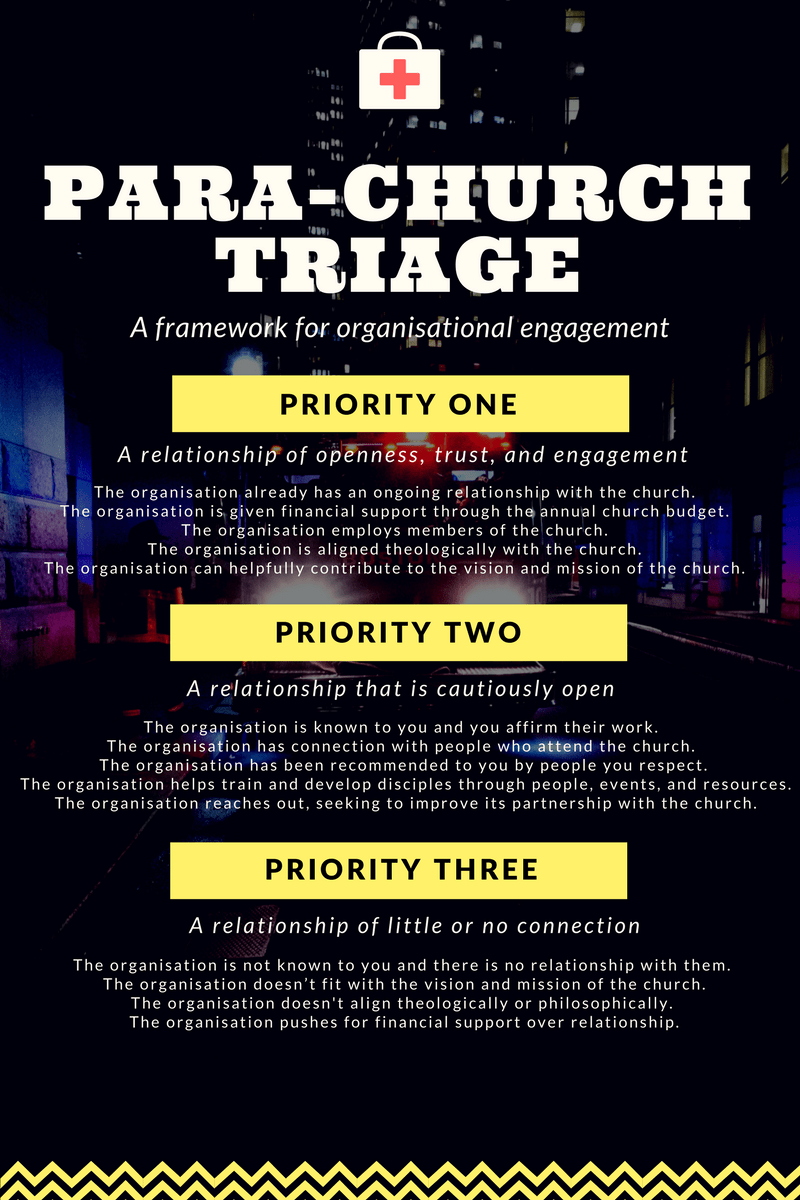
    Para-Church Triage Framework

    Priority 1: A relationship of openness, trust, and engagement

    • The organisation already has an ongoing relationship with the church.
    • The organisation is given financial support through the annual church budget.
    • The organisation employs members of the church.
    • The organisation is aligned theologically with the church.
    • The organisation can helpfully contribute to the vision and mission of the church.

    Priority 2: A relationship that is cautiously open

    • The organisation is known to you and you affirm their work.
    • The organisation has connection with people who attend the church.
    • The organisation has been recommended to you by people you respect.
    • The organisation helps train and develop disciples through people, events, and resources.
    • The organisation reaches out, wanting to improve its partnership with the church.

    Priority 3: A relationship of little or no connection

    • The organisation is not known to you and there is no relationship with them.
    • The organisation doesn’t fit with the vision and mission of the church.
    • The organisation doesn’t align theologically or philosophically.
    • The organisation pushes for financial support over relationship.

    That’s the framework, and one that I hope helps you think through this issue. It’s not an issue that’s overly appealing so I’ve created a graphic to go with this to make it that little bit more sexy.
    para-church-triage-graphic

  • Beginning As A Youth Pastor

    I was asked to speak at a gathering with other Youth and Young Adult Pastors a few months ago. This was in a session on ‘Winning In The First 3 Years of Ministry’. I shared 10 points from the perspective of what I wish I had known going in to youth and young adult ministry. Here are those 10 points, plus an extra.

    beginning-as-a-youth-pastor-11-things-i-wished-i-knew

    1. I wish I knew that an active and exciting relationship with Jesus would be so hard to foster.
    It’s easy to look at the Youth Pastor when we’re in youth group, or volunteering as a leader, and think they’re really spiritual and full-on for Jesus. If they are then that’s great, but in my experience it is really hard to find a rhythm in order to foster an active and growing relationship with Jesus. Sure, I’ve grown and have made Jesus the centre of my being since I was in high school, but being surrounded by teaching materials, going through Bible College, leading Bible studies, and preaching regularly, aren’t a substitute for personal spiritual disciplines. Make sure you carve out time for Scripture, prayer, reading, music, reflection and solitude.

    2. I wish I knew that my relationship with my Senior Pastor was the most important in the church.
    I feel like I’ve had great relationships with my Senior Pastors but I’m surprised at how crucial they’ve been for the week-by-week, month-by-month, year-by-year ministry. They are the closest relationship I have in the church because of my proximity to them and the regularity in which I see them. It is the relationship that keeps me energised and willing to stick around for the long haul. When Youth Pastors leave it is most likely because their relationship with the Senior Pastor has broken down. I’ve seen it, over and over again. I don’t want it to be me.

    3. I wish I knew that the health of the youth ministry is only as healthy as the church.
    Youth and young adult ministry is not happening within a vacuum, it is set in the context of the wider church. When you are sick the whole body is sick, not simply one particular part. So it is with youth and young adult ministry. In my first year as a paid Youth Pastor there was significant disharmony in my church that saw a number of significant and influential people leave. This had a trickle down effect. The evening service went from averaging 60-70 people each week to 20-30. The loss of young adults, the loss of youth leaders, the loss of high school students. It just went bang. This highlights the importance of making sure we are aware of what is going on in the wider church. Getting to know people across all ages and stages is important. An understanding of the history of the church is also critical when thinking through the church’s health.

    4. I wish I knew that there would be friends for the road and friends for the journey.
    Some friends stick around. They stick with you through thick and thin, when you move church, and are generally lifelong friends. These are friends for the road of life. Other people will simply be friends for the journey. They’ll be with you for the time you’re at their church or in their life. But, when you move they won’t continue to catch up with you or check in with you. It’s taken time for me to realise this, more so in the last 12 months. Friends and colleagues that I thought would continue to have an interest in my life, as I do theirs, don’t. It’s important to gather around you 3-4 friends who’ll be with you for the road, ministry or not.

    5. I wish I knew that the grass was not greener in another church, in another ministry role, or in another para-church organisation.
    It’s easy to let your mind drift to the church down the road and begin to think of how good it must be there. It’s not. It’s just not. They are having the same issues as you. They are having the same struggles. They are having the same problems. The same goes with going into a different ministry role or a role at a para-church organisation. The grass isn’t greener. It’s work. It’s hard.

    6. I wish I knew that what I have done in the past doesn’t really mean much to others.
    I’m proud of what I’ve done in my life. There are of course some stupid things I’ve done, but generally, I’m pretty proud of some of the things I’ve achieved in life – relationships, study, work, ministry. Guess what? No one cares. Except perhaps for that job interview or the search committee coming up. Other than that, no one cares. I mean, most people have a decent sized ego and so we’d like to think that our achievements matter. X number of years at this church, volunteer years put in at that other church, the secular work we’ve done in the past, the degrees we’ve studied for, the service opportunities we’ve been involved in, et cetera. et cetera. You know, it all builds us up to think that we’ve got some awesome job experience to be an awesome pastor, even before we walk into the role. Nup. That parent of the 14-year-old kid who is annoying each Friday night doesn’t care, they just want to know if you can look after their kid for a couple of hours while they go on a date with their spouse. That deacon doesn’t really care either, they just want to let you know that you can’t park your car at the front of the church because that’s reserved for more significant members of your church.

    O how humbling ministry is.

    7. I wish I knew that the sin that so easily entangles will entangle you with more force in ministry.
    Yep, those things we fear, those habits we slipped into years ago, those things we listen to and watch, those temptations to click. These things will continue. The devil will attempt to strike, and strike with more and more force. I figured it would be easier to let go of those things because of the important and significant work I would be doing in the life of the church. How little did I know! You’ve had a porn habit, watch the devil seek to strike you there. You’re overly insecure, watch the devil play with you. You’re too conscious of your appearance or what people think of you, bang. You’re seeking intimacy and relationships, boom. Sin doesn’t stop. It carries on. And it’s usually coming at you with a force you’ve never seen before.

    8. I wish I knew the extent of which church politics would take up headspace and suck my emotional energy. 
    There is a lot to be said about getting to know your wider church and being involved in the high level discussions and conversations at your church. Yet, it is also the place where church politics is most clearly seen and can just suck you dry if you let it. This is closely connected to point 3 about church health, but it is surprising at how deeply it can affect us. Some, and perhaps all of it, may not be about the ministries we are involved in. It might be to do with the budget, or with the way the flowers are arranged on Sunday mornings, or how the coffee and tea is served at morning tea. It might have nothing to do with your ministry at all, yet something small and insignificant can get us down and consume the rest of the day if we let it.

    9. I wish I knew that people don’t need me to tell them what to do, they need the grace of God applied.
    I remember the first few months of going to church after I’d finished up on staff at a previous church. I took the opportunity to visit various churches and also went back to our home church. What I distinctly remember was that every time I walked out I felt like I had more burdens than when I arrived. I felt like I’d been given a good sermon and good teaching, but when it came to application I’d be lumped with more and more things to do. My week was already busy. I’m house-hunting, I’m waiting for a newborn to arrive, I’m feeling overwhelmed with my own sense of sinfulness, I’m trying to study hard, I’m looking for a new job. I don’t need application that leaves me feeling like I’ve got to do more in order to get my life back on track. No. What I need is grace. I need the grace of God shown to me. I need the grace of God to make me realise that he is the one my burdens are to go to. All those significant things in life will be before him, given to him, and dealt with by him. I would encourage you to give people grace – kid, parent, young adult, oldie, pastor, ministry volunteer, anyone. When you’re teaching, give them grace. Apply grace.

    10. I wish I knew how to work better.
    I had been in the health and fitness industry for a couple of years before I moved into ministry. A few more years and I took up my first position in a church. I am an organised and systematic person naturally, but it still took me a number of years to work out a decent workflow system. Things like getting your emails down to zero, planning your calendar, working out how long things would take, making to-do-lists, dealing with budgets, how to think through a project like a camp or one-off event. The non-people work side of stuff. What is that? Administration. For this I’d recommend Tim Challies’ “Do More Better“, which only came out a little while ago. It covers what you’d need. And I’m sure you’ll be surprised at how much administration you find yourself doing.

    ***While I shared the above there was a glaring omission from the list, one which every Youth Pastor needs to know.***

    11. I wish I knew it was such a privilege
    Not until I left my first church did I realise how much of a privilege it is to be such an influence in the lives of young people and students. The trust, affection, openness, and vulnerability people have toward you is simply amazing at times. The position you have and the places you find yourself in as you disciple young people is phenomenal. While it can be long, frustrating, and messy work there is the privilege of guiding people in life decisions, applying the Gospel to people’s lives, and celebrating their growth as people and disciples.

    What a wonderful work it is. 


    11 Things: A Youth Ministry Series
    Beginning As A Youth Pastor (this post)
    Part 1: Life With Jesus
    Part 2: The Senior Pastor-Youth Pastor Relationship
    Part 3: Church Health > Youth Ministry
    Part 4: Friends For The Journey And Friends For The Road
    Part 5: The Grass Isn’t Greener
    Part 6: Nothing Else Matters
    Part 7: Temptation And Holiness
    Part 8: Church Culture And Politics
    Part 9: Fixing People vs God’s Grace
    Part 10: Working Better
    Part 11: The Privilege Of Youth Ministry

  • What Building Sandcastles Teaches You About Youth Ministry

    On holidays our family has been hitting up the beach. With the beach comes sand. And while I know a number of people who aren’t big fans of such creation there are awesome sandcastles to be made with it. Yesterday was our opportunity to achieve such heights of awesomeness. 

    Our daughter was sick of the beach after only 30 minutes. Considering the effort it took to get there we weren’t leaving anytime soon. So to help entertain her we began making sandcastles together. The conditions were perfect with the right balance of dry and wet sand. And after picking our spot we created a fairly sizeable sandcastle city with roads, tunnels, bridges, hills, castles and village houses.


    Post-sandcastle fun I’ve thought about how this activity can teach those of us in youth ministry a thing or two. So, here are five ways building sandcastles can teach you (and me) about youth ministry. 

    (1) You need a team

    This was a great activity for my daughter and I to do together. The wife also joined in at times, while our young son looked on. But the experience of building this sandcastle city was made better by doing it together. I could’ve made the thing on my own but this wouldn’t have been as fun, nor would there have been as many ideas about what to build, and the shared experience of doing this together would be non-existent. 

    Youth ministry is the same. 

    Doing it by yourself can work but it won’t be nearly as good. Youth ministry is great fun together as a team, the ideas coming from each unique person involved is essential in growing faith and community. Furthermore, the shared experience of being on a youth ministry team, serving one another and the church, is something you hold dear for years and years. 

    (2) You get dirty 

    It’s sand. Sand gets in places you’d never think it could get to. It isn’t the most pleasant flooring to kneel on. It gets in your eyes with every gust of wind. And in my case, it cakes on to my thick matte of leg hair. Building sandcastles means you need to be all in and be ready to get dirty. 

    Youth ministry is the same. 

    The obvious link here is to refer to the classic youth group night of “messy games”. Of course, you’re going to get messy when playing games involving eggs, tomato sauce, and cooked spaghetti. Messy games are part of any good youth ministry repertoire. 

    At a deeper level, getting dirty refers to being involved in the lives of young people and their families. It is physically and emotionally taxing to be helping people with their mental health, sexuality, drugs, alcohol, relationships, family crisis, death, school stress, and other growing pains. It’s a dirty work in this sense. 

    (3) You need patience

    Building something from scratch, even something as small as a two square metre sandcastle, can take time. 

    Youth ministry is the same. 

    People take time to grow in life and faith. Being in a ministry that deals with young people who are 11-18 years-old means patience is required. You’re not going to see results in six months. It takes years for the seeds of youth ministry to sprout fruit. 

    It’s been said to me by a number of long-term Youth Pastors that they felt most effective after six years. Six years! It is quite rare in the Australian context to find a Youth Pastor who sticks around for more than three years in one church, let alone six. More Youth Pastors need to stay, and recognise that patience in the ministry is required. 

    This isn’t all about young Youth Pastors though. Long-term youth ministry volunteers are needed too. It’s the volunteers who more often than not have greater influence long-term than any fly-by-the-night Youth Pastor. 

    (4) You make mistakes

    At one point in our sandcastle building my daughter and I were digging tunnels under roads and castles. In a couple of areas we hadn’t evaluated the wetness of the sand and soon found the tunnels collapsing, the whole thing folding in on itself. When we tried to make a river flow, in order to create a moat, a group of village houses were taken away in a flood. We made a few mistakes as we build this little sand city. 

    Youth ministry is the same. 

    Mistakes are bound to be made when you serve in youth ministry. In fact, if you don’t make mistakes you’re probably not trying hard enough.

    But mistakes can happen at a variety of levels. Not having enough balls for a game of dodgeball is one thing, writing an angry late night email to a parent is another. Hiring an expensive bus and not having enough kids to cover the costs is one thing, undermining your senior pastor in front of others is another. Not turning up on time to meet one of the young adults is one thing, choosing a person who hasn’t got the character to join the leadership team is another. 

    The level and variety of mistakes vary in youth ministry. Some will be of little impact. Others, however, could derail an event, program or the whole ministry.

    (5) You will find delight

    There was little more satisfying than spending time with my daughter building sandcastles yesterday. It was a delight to play with her and talk with her about what we were doing. We searched for pieces of driftwood to build bridges, and joined hands in tunnels we made. It was a delightful experience. 

    Youth ministry is the same. 

    While youth ministry may have a number of challenges there is a certain delight that comes with it.

    First, seeing young people grow in faith, connecting in with a community of people who accept them, and serving others together as a group, all these bring personal delight. Looking back after a number of years and seeing how young men and women have grown always blows my mind. Being able to help them and their families as they struggle with whatever life might bring is a privilege. There is a personal satisfaction and delight in being involved in such a work. 

    Second, ultimately it is not youth ministry that needs delighting in. 

    It is Jesus. 

    It isn’t the ministry that’s important for young people, it’s the person who they follow. This person isn’t the Youth Pastor, or is it the Youth Leader, or the mentor, or the parent, or the friend. 

    The person is Jesus. 

    If young people find their delight in Christ then the inward delight will come to anyone involved in youth ministry. But may it be that they delight in their Creator as He delights in them. 

  • Growing Young – Be The Best Neighbours

    This is post seven in a series of reflections on the book Growing Young: Six Essential Strategies To Help Young People Discover And Love Your Church. For an introduction to the series please read part one and continue reading the reflections in part two, three , fourfive and six.


    In these first few months of being involved in the life and ministry of Rowville Baptist Church I’ve been blown away at the commitment to the local community. Part of the culture of the church is to serve the local community through its time, money, facilities, and people resources. The more I’ve seen the various programs and people in action the more I’ve seen the body of Christ neighbouring well.

    So far I’ve seen a fortnightly dinner put on for those in the community that need a feed, a week-long school holiday program, a drop-in centre for those who need to chat and some pantry supplies, and a twice weekly breakfast served at a local school. In coming months there will be a Christmas Day lunch held at the church for those with no place to go and a nearly weeklong service ‘camp’ that sees young people lead and serve the local community in practical ways.

    This culture, this DNA, is what the final chapter summarising the Growing Young findings is all about.

    It seems that those churches who are good neighbours to their local community are more likely to ‘grow young’ than those who aren’t. 

    photo-1472653816316-3ad6f10a6592.jpeg

    Growing Young suggests it is this kind of culture that keeps young people at church. On one hand there is the good teaching that comes from taking Jesus’ message seriously. On the other hand there is the fact that young people seek to be involved in practically serving others together.

    “…churches that grow young recognize the careful dance that values both fidelity to Scripture’s commands for holiness and knowing and graciously loving their neighbors. This dance affects how they serve, pursue social justice, help teenagers and emerging adults find their calling, interact with popular culture, and respond to heated cultural issues. Much more than developing detailed policies or releasing theological position papers, these churches train and infuse their young people with an integrated discipleship that enables them to thrive in our complex world.”

    Reading this chapter didn’t feel like I had to take sides in some kind of evangelism versus social justice debate. No, this chapter brought together the first and second commandments – to love God and love others – in a way that upheld the proclamation of the Gospel and good works. Yet, it did highlight the fact that young people are attracted to that which deals with the physical and practical needs of people and communities.

    A second area this chapter highlighted was the ability for growing young churches to converse well with the tough topics. You know, sexuality and gender, refugees and immigration, alcohol and drugs, marriage, relationships and divorce, suicide and mental health, death and grieving, calling and vocation. These topics can be challenging for any person to converse about, let alone a church. But what Growing Young has found is that those churches willing to converse about such topics go a long way in helping young people grow and stick at faith. It is often the process and the discussion about these topics that is more helpful than the answers themselves.

    How then does this chapter help in thinking through youth and young adult ministry? 

    First, recognise young people are action-orientated and want to be part of something that helps the local community and beyond.

    Second, provide time and people to walk alongside young people as they explore answers to the deeper questions of life and society.

    Third, ask questions of the young people already connected to your church and of the local community to understand their culture and passions.

    Fourth, teach and show a gospel-ethic providing a balanced diet of Biblical teaching and good works.

    Fifth, spend a period of time actually serving your neighbours well, meeting some needs they have.

    May your light shine before others so that they see your good deeds and glorify your Father in heaven (Matt 5:16).


    Here are the links to the series of reflections on the book:

    1. Growing Young
    2. Growing Young – Keychain Leadership
    3. Growing Young – Empathise With Today’s Young People
    4. Growing Young – Take Jesus’ Message Seriously
    5. Growing Young – Fuel A Warm Community
    6. Growing Young – Prioritise Young People (And Families) Everywhere
    7. Growing Young – Be The Best Neighbours
    8. Growing Young – Growing Young In Your Context
    9. Growing Young – Final Reflections
  • Growing Young – Prioritize Young People (and Families) Everywhere

    This is post six in a series of reflections on the book Growing Young: Six Essential Strategies To Help Young People Discover And Love Your Church. For an introduction to the series please read part one and continue reading the reflections in part two, three , four and five.


    A church that confines the involvement of young people to their youth group won’t be a church that young people or emerging adults hang around too long. The whole church needs to be a place where young people and their families can participate.

    This chapter in Growing Young makes the case for churches to focus on young people and their families in everything they do. Whether it be the Sunday service, the children’s ministry, the working bee, the missions team, or the cleaning roster. In every area of church life the question to be asked is: How can young people participate? 

    yja2so4srtmdlfrskd5t_moulin-fisk

    This is not just a superficial or patronising question. Well, it’s not meant to be. It’s a question that needs to be asked by churches and ministry leaders not so more young people come to the program or event but so that young people have active involvement in leading and shaping it.

    This question becomes a church culture question: How is the church thinking about the participation of young people and families in the life of the church? 

    “How do churches that grow young make youth and emerging adults a greater priority? When they think about budget, strategy, worship planning, programming, community life, theology, and all other aspects of church life, they think about young people. They intentionally pay attention.”

    One of the most significant comments in this chapter is about the role of parents in a young person’s faith. It has been and continues to be found that “…parents still carry the most important weight in their kids’ faith development.”

    This begs the question: What are we as Pastors and churches doing to encourage the parents to discuss faith within the home? 

    Only three days ago I was in a conversation about how churches have a big focus on children’s and youth ministries, as well as a support focus with older people, but those going through the middle season of life, the parents and adults, are basically left to there lonesome.

    “Research continues to affirm that the best predictor of a young person’s faith is the faith of their parents. That means the role of ministry leaders who care about kids also must include the care, equipping, and formation of parents and families…According to pastoral leaders, when parents are intentional about faith building outside of church, overall faith maturity and vibrancy within the congregation rises even more.”

    It’s a no brainer for those in children’s, youth and family ministry to begin focusing more on the parents than the kids themselves. Continue to work and have programs in these areas but begin the culture shift through encouraging and engaging parents in their role as faith-builders.

    So what could this look like in the life of a youth ministry?

    • Send an email or message that talks about what aspect of faith the youth ministry is focussing on at the moment.
    • Give parents a few questions to help them initiate faith conversations in the home.
    • Suggest a reading plan for the family to do together.
    • Run an afternoon tea where all the parents are in the room and they get to chat and find support with others in the same situation.
    • Start talking about how you are a church or ministry that partners with parents.

    In regard to the other parts of this chapter, seeking to prioritise young people and families in the church. It might be a good time to review the ministry structure and evaluate where young people are involved and where they are not and what needs to be changed.

    I have to say that this mind-shift is something that can take a bit of time. It is a cultural shift for a church focussed on a programmatic approach to children’s and youth ministry with little engagement of parents.


    Here are the links to the series of reflections on the book:

    1. Growing Young
    2. Growing Young – Keychain Leadership
    3. Growing Young – Empathise With Today’s Young People
    4. Growing Young – Take Jesus’ Message Seriously
    5. Growing Young – Fuel A Warm Community
    6. Growing Young – Prioritise Young People (And Families) Everywhere
    7. Growing Young – Be The Best Neighbours
    8. Growing Young – Growing Young In Your Context
    9. Growing Young – Final Reflections