Category: On Reading

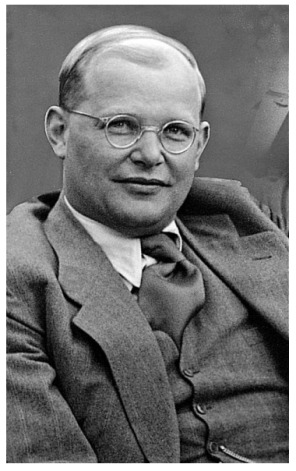
  • Who Am I? by Dietrich Bonhoeffer

    Dietrich Bonhoefferby Dietrich Bonhoeffer.

    Who Am I?

    Who am I? They often tell me
    I stepped from my cell’s confinement
    Calmly, cheerfully, firmly,
    Like a Squire from his country house.

    Who am I? They often tell me
    I used to speak to my warders
    Freely and friendly and clearly,
    As thought it were mine to command.

    Who am I? They also tell me
    I bore the days of misfortune
    Equably, smilingly, proudly,
    like one accustomed to win.

    Am I then really that which other men tell of?
    Or am I only what I myself know of myself?
    Restless and longing and sick, like a bird in a cage,
    Struggling for breath, as though hands were compressing my throat,
    Yearning for colors, for flowers, for the voices of birds,
    Thirsting for words of kindness, for neighborliness,
    Tossing in expectations of great events,
    Powerlessly trembling for friends at an infinite distance,
    Weary and empty at praying, at thinking, at making,
    Faint, and ready to say farewell to it all.

    Who am I? This or the Other?
    Am I one person today and tomorrow another?
    Am I both at once? A hypocrite before others,
    And before myself a contemptible woebegone weakling?
    Or is something within me still like a beaten army
    Fleeing in disorder from victory already achieved?

    Who am I? They mock me, these lonely questions of mine.
    Whoever I am, Thou knowest, O God, I am thine!

  • Newton on Celebrity Preaching

    Perhaps a good word for those of us who follow and podcast the great preachers in this world…

    “A stated and regular attendance encourages the minister, affords a good example to the congregation; and a hearer is more likely to meet with what is directly suited to his own case, from a minister who knows him, and expects to see him, than he can be from one who is a stranger. Especially, I would not wish you to be absent for the sake of gratifying your curiosity, to hear some new preacher, who you have perhaps been told is a very extraordinary man; for in your way such occasions might possibly offer almost every week. What I have observed of many, who run about unseasonably after new preachers, has reminded me of Prov. 27:8: “As a bird that wandereth from her nest, so is the man that wandereth from his place.” Such unsettled hearers seldom thrive: they usually grow wise in their own conceits, have their heads filled with notions, acquire a dry, critical, and censorious spirit; and are more intent upon disputing who is the best preacher, than upon obtaining benefit to themselves from what they hear. If you could find a man, indeed, who had a power in himself of dispensing a blessing to your soul, you might follow him from place to place; but as the blessing is in the Lord’s hands, you will be more likely to receive it by waiting where his providence has placed you, and where he has met with you before.”

    From John Newton’s On Hearing Sermons.

  • The Glenn McGrath Bible Reading Plan

    Glenn McgrathSo by now you should be a week into your New Year’s resolution of reading the bible this year. Well, if you’re a Christian of some description anyway.

    How’s it going? Have you managed to work your way through the chapters you planned to? Did you choose one of those plans that makes you jump between different books of the Bible? Perhaps reading some Old Testament chapters, some New Testament and then a Psalm. Or, maybe you’re working through the Old Testament and so you’d be stuck in the middle of Genesis or thereabouts right now.

    Every year for the last seven or eight years I reckon I’ve attempted to read the whole Bible through. I’ve managed it twice in that time. It was probably the first couple of years too where I completed the goal.

    One year I was silly enough to choose a plan that required reading 10 chapters per day and took you to almost every part of the bible. Yeah, I managed about two weeks and gave up. It was like reading a short novel every single day. I like reading, but perhaps not that much.

    The thing with bible reading plans is that at the start of the year it starts off well but then you realise you’ve got to work your way through Chronicles and 150 Psalms and some prophets, which can be depressing at times. Sometimes it’s the same story over and over again, sometimes it’s just the same genre of writing that can get a bit tiresome.

    Don’t get me wrong, I think bible reading plans are good. I think that having a plan or a goal in your bible reading is important. And, if you don’t, what’s that saying about how seriously you’re taking your faith and wanting to hear from God? Hmmm, one to ponder there I think.

    So while I hold them up as good there does need to be a sense of reality about what type of plan you’re going to do. At the start of the year we tend to think we can achieve more than perhaps is possible. What’s important in any reading plan, whether it’s the bible or other books, is to break it down into consistent chunks that are achievable. Like with anything – fitness training, writing, art – it requires discipline.

    This is where I’ve come up with the very basic idea of The Glenn McGrath Bible Reading Plan.

    If you at least follow a little cricket I would hope you know who Glenn McGrath is. If you don’t, shame on you. Glenn McGrath is the great Australian fast bowler who holds the record of most wickets by a fast bowler for Australia, possibly even the world. Throughout his career McGrath bowled line and length. That is, he bowled the ball just short of a good length and in line with the off-stump or just outside. He aimed for the same spot each delivery and made it very difficult for the batsmen. By doing this he was disciplined in not wavering from his plan, he was consistent in his pace and placement of the ball on the pitch, and it just got people out. It was terrific fast bowling, could be considered pretty boring too, but it worked.

    And this is the thing with The Glenn McGrath Bible Reading Plan.

    The key is consistency, the same process every day.

    The bible has 1189 chapters. The year has 365 days. That means 3.25 chapters per day will have you finishing the book of Revelation on New Year’s Eve. You will have read the whole bible through in a year. 3.25 chapters isn’t much is it? That’s like 15 minutes max. Maybe more for the day you’re reading Psalm 119, but I digress.

    It’s actually not much per day when you put it in those terms. It’s achievable and even more so when you’ve got your phone and you’re on your way to work or you wake up and it’s right next to you.

    This year I’ve planned to read four chapters per day and am simply ticking off what I’ve done. I’ve started at Matthew because most years I’ve started at Genesis and it’s gotten tiring. To make it a habit I’d rather read from Matthew first. If I continue to go with four chapters per day I’ll have finished the bible by September or October I think. After January I could pull it back to three chapters per day and we’d be right for the rest of the year. I’ll make that call later. The important thing is that it’s happening and beginning to become a habit.

    How about you? Have you started a plan this year? How’s it going?

  • What I Learnt From Steve Jobs

    The other day I finished the biography of Steve Jobs by Walter Isaacson. Incredible.

    20130826-082146.jpg

    This book excels in portraying a man who defined much of this generation. I know he’s certainly transformed the way I interact with the world through the iPhone and iPad, I suspect it’s the same for you.

    There is something about reading a biography that provides insight into people you otherwise wouldn’t know. Isaacson’s masterful job of putting together the components of Jobs’ life is a perfect example. A deeper and fuller understanding of Jobs and his character gives cause to reflect on what can be learnt from him. Here then, are my thoughts on what I learnt from Steve Jobs:

    1. I learnt Steve Jobs is a douche – There is no doubting it. He was a douche. His personality and the way he acted and behaved were terribly stupid and degrading to others at times. This wasn’t just one-off events every few years, ripping people apart in front of others occurred for sustained periods and made the guy a ripe proper douche. He even admits it himself.

    2. I learnt Steve Jobs had a tremendous appreciation for quality – Everything he sought to do, whether it be his eating practices or the products he sought to produce, was to be of high quality. If they weren’t of the highest and best then they were crap. His push for quality products is what made Apple and Pixar. It’s a shame this wasn’t reflected in his relationships with others, including his parents, his daughters and his wife. Nevertheless, he pursued the best – products and employees. He wouldn’t settle for second.

    3. I learnt Steve Jobs didn’t care about money – That’s always easy to say for someone who actually has millions already. But, I think that truly was the case. He didn’t seem fussed about money, it was the product, the A-class quality of a product, that mattered. If he made money by doing this then all the better.

    4. I learnt Steve Jobs embodied Apple and Apple embodied him – After leading an organisation for so many years, even with a rather long period of exile, his personality shone through the company. There is no mistaking Jobs’ influence because he was the founder of the company but there is something that happens when you’ve been involved for 30 years. The company reflects your personality, and so it is with Apple. This desire for perfection, for high quality design and products, for pushing the boundaries in what people believe they can do, all comes from Steve Jobs.

    5. I learnt that Steve Jobs is an inspiration – There is no doubting it, he’s one of a kind. There won’t be another Steve Jobs and the effect he’s had on Western society is very hard to measure, but needless to say it’s been enormous. His leadership and determination are inspiring. His passion for his industry and product is inspiring. He’s inspired me, through this book, to be a person who is more focussed, passionate, and determined in their work and life. I’ll skip the douche bit but have to say the other character traits are inspiring.

    A sixth point would be that Walter Isaacson is an amazing writer. He inspires me to be a better writer and has made this book flow so well I didn’t want to put it down at times. If you happen to get the chance to read this book, I’d highly recommend it.

  • Book Review: The Road Trip by Mark Sayers

    theroadtripHere is a travel book with a difference.

    Most travel books give information about a certain place. The good and bad hotels, the best restaurants, the sites to see. In The Road Trip Mark Sayers travels through the last 50 years of culture enlightening us on what’s happened to the West. Following the travels of Jack Kerouac, writer and experiential junkie of the 1950s, Sayers shows how Kerouac’s journey across America is now mainstream for the life of a Western young adult.

    The book is in two parts. The first, offers a critique of young adult life in the 21st Century. The themes, illustrations, and connections between the journey of Kerouac and journey of today’s millennials resonates strongly. The second, turns toward the cross and gives broad examples of what the church must do to re-engage with young adults today. Following the journey of Abraham and centred of the cross Sayers describes how young adults can find true meaning for their lives.

    Here’s what I liked about the book:

    (1) The Cultural Analysis

    In many ways Sayers depicts young adult culture; its aims, its experiences, its lack of meaning, its search for something better, its hopelessness, with compelling accuracy.

    (2) The Writing

    Sayers pulls you along with him. It’s hard to put the book down. There are illustrations, quotes, stories, and his own ideas, which keep you reading and reading. It’s a very well written book that enables you to travel the cultural contours with him.

    (3) The Gospel

    In part-two Sayers turns to how Christianity is to deal with this “culture of the road” that young adults seek to travel. The central answer to this ‘issue’ is the Gospel, which “reconciles us to God, others, and creation”. It is only through Christ’s death on the cross that gives meaning to this world and to this life. Therefore, it is this reality that provides the necessary answer to this “culture of the road”. It is an encouragement to see the explicitness of the Gospel within this book, and how it is the basis for further application.

    (4) Morality and Covenant

    These are two themes, among others, are tackled by Sayers toward the end of the book. They are themes put on the agenda for Christians and wider Western society to think through. Morality and covenant have both been thrown out the metaphorical window in recent time and so it is a good reminder to again reflect on these issues.

    Here’s what could be improved:

    I should say that I liked everything in the book. It was very good. There is much to take away and dwell on, particularly for those in youth and young adult ministry. It’s hard to come up with much in terms of critique or growth areas. However, when I put the book down I did feel there was something missing.

    A couple of caveats:

    First, I opened the book expecting big things. Maybe bigger than Sayers could deliver. I’ll name that.

    Second, I recognise I’m involved in young adult ministry. I get to see the culture first-hand and affirm almost everything Sayers said about it. I believe these two factors affect my thoughts here.

    However, toward the end I was wanting to know more. I was wanting to know what was next. I was wanting to know how to connect the young adult world of experience, journey, and meaninglessness to the worldview of the Bible.

    I know I was offered suggestions; to bring back the transcendent, to bring back covenant, to bring back sacredness, to bring back commitment. In other words, to show that living the Christian life actually means giving up what the world offers and travelling the journey of God into full discipleship and devotion. This was made clear, I don’t want to deny that. Yet, this still leaves me hanging for more as I try to connect and apply these themes back to culture.

    Since finishing the book I’ve worked out what I’m really asking. It’s the “How?” question.

    How do we bring these themes back in a way that enables young adults to have a big vision of God and involved in His mission in the whole of life?

    Maybe that’s not Sayer’s task here but mine as the practitioner. In any case, it’s left me pondering that task and something all of us should be pondering as we reach out to the young adults of today.


    After writing this review Mark was kind enough to go back and forth on some of my thoughts. Below is an excerpt from our conversation and a reply to the “how” question. Many thanks to Mark Sayers for his time and willingness for this.

    Mark’s response:

    “…As I get around across the evangelical/charismatic/pente scene I notice that there is no one programmatic thing that is reaching young adults. Rather, it is the simple stuff in the book which I think is important e.g. covenant, living at the foot of the cross etc. I think because western young adult culture at the beginning of 21st Century seems so shiny and powerful we expect the answer to be so as well, but again I think that the answer is simple, humble obedience to Christ, simple non-sexy stuff that we already know. I have positioned our whole Church around this idea – no show, just less of us, and excitingly over time it is incredibly transformational…

    …The other thing is that I often notice after workshops and talks that I do, describing western cultures journey to secularism and now post-secularism, that people become overwhelmed and want quick and easy answers. However, how do you reverse 500 years of this stuff in some simple ministry tips? I don’t think you can, it is going to take generations to turn things around in my opinion. No one likes to think of it this way but the questions of today’s young adults are essentially Hamlet’s questions at the dawn of the modern. We have a lot of work to do.”
  • Top 3 Books For Youth Ministry

    Late last night I was texted asking for what my top 3 book recommendations were on the topic of Youth Ministry. I thought I’d share them here for interest sake:

    1. Your First Two Years in Youth Ministry by Doug Fields
    2. Fruit That Will Last by Tim Hawkins
    3. Leaders That Will Last by Tim Hawkins

    I’ve also added a fourth in my response as years ago Al Stewart put out a little primer on youth ministry called No Guts, No Glory worth reading.

    I’d recommend these books to anyone beginning in youth ministry or a good refresher for those who’ve been in it for a while.

    What are your favourites? What would you recommend if you were asked for your top 3?

  • My Theological Library

    Library_books_oldbooks
    By: Pouya sh

    A month ago we moved house. It’s not really the most enjoyable of experiences but it’s something that has to be done when the time comes. The process of moving house meant that I had to move all the books that i have. I’m an avid reader and aim to read a book each fortnight (on average over the course of a year). The “industry” I’m in also lends itself to be around books. Ministry requires reading, preaching requires reading, studying requires reading. This means I’ve a growing collecting of around 700 books on the shelves and when the library reaches this point it’s probably time to get it sorted out.

    I did toy with the idea of working the Dewey system or using the Library of Congress numbers but decided that might be a bit extreme. In the end the best advice came from Andy Naselli’s post on “Why you should organise your theological library and a way how”. I’ve adjusted some of what he’s suggested but used the main categories to organise mine. My library is obviously not as big as his so it doesn’t need as much detail as what he has laid out. But here it is:

    1. Biblical Theology

    • Languages (NT Greek)
    • Hermenuetics (how to interpret the Bible etc.)
    • Commentaries (on each book of the Bible)
    • OT & NT introductions, theologies, and overviews

    2. Historical Theology

    • Biographies
    • Church & Christian History
    • “Works” by old dead guys

    3. Systematic Theology

    • Bible doctrine (the sort of topics in a general systematic theology book)
    • Apologetics
    • Philosophy

    4. Practical Theology

    • Christian Living (all those great books people pick up at the front of Christian bookstores ;))
    • Preaching
    • Leadership
    • Youth Ministry
    • Church
    • Pastoral Ministry
    • Missions

    At this stage all sub-categories are mixed in together in the broad categories. I’m not convinced this works for the Practical Theology section but it’ll take too much time sorting it out at the moment.

    Comments? Suggestions? How do you sort yours?

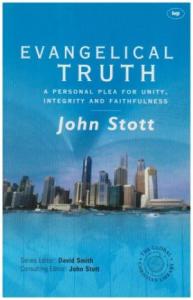
  • Evangelical Truth by John Stott

    evangelicaltruth stottJohn Stott and his ministry is well known and well respected throughout the world. He has written numerous books and articles, and up until his death in 2011 he was considered a worldwide Christian leader.

    In this little book of 149 pages Stott explains the essentials of the Christian faith and makes a strong plea for unity. Here, toward the end of his life, Stott continues to write with great insight, making you think about the primary and secondary issues within the Christian faith. There is constant debate between Christians, now more than ever it seems, over all sorts of theological and social issues. Stott believes these issues should be discussed, but at times there is a need to lessen the vigour and closed-handedness of these debates.

    Evangelical Truth has five chapters, including the introduction and conclusion. The three main chapters cover the following areas: the revelation of God, the cross of Christ, and the ministry of the Holy Spirit.

    In the introduction Stott gives a brief rundown of his definition of evangelicalism. He pitches this definition against that of fundamentalism and liberalism. Within this chapter he also gives information about evangelicalism has evolved and its main historical turning points within the church.

    The chapter on revelation, as expected, is based on the revelation of God through the bible. Stott speaks of general and specific revelation, progressive and personal revelation, inspiration, authorship, biblical authority. He touches on the debate between the sufficiency of scripture and also the inerrancy of scripture. Here Stott makes his stand against using the term ‘inerrancy’.

    Chapter three is essentially the gospel. It is the message of the cross well explained. He gives a helpful explanation of ‘justification by faith’, and grapples with what disciples and mission are. It is the shortest chapter in the book but also the most concise and straight-forward. It was good to hear the gospel again.

    A final chapter on the ministry of the Holy Spirit makes Evangelical Truth truly trinitarian. The topics of assurance, holiness, purity, community, mission, and hope are all covered. Stott is really telling the reading of how the Holy Spirit works; in the New Testament and his continuing work today. This is a good chapter and well explained.

    To conclude, Stott summarises his point and pleads with the reader to be united with Christian brothers and sisters around the globe. He calls for Christians to endure hardship and wants to be an encouraging voice within that. You can really see in the writing that Stott has a wealth of experience and knowledge of the gospel, is passionate about the things of God, and wants Christians around the world to be united under the gospel. He encourages all believers to lead with humility and to love one-another with Christian love.

    A great primer of the Christian faith. Get on it.

    John Stott, Evangelical Truth: A Personal Plea For Unity, Integrity and Faithfulness (149 pages; Leicester, UK: Inter-Varsity Press), 2003.

  • Power Through Prayer by EM Bounds

    EM Bounds is known as a prolific prayer-warrior, mainly because of his many and various books on the topic. While they were written many, many, years ago they are still greatly relevant for our soul today.

    “Power Through Prayer” is a book written particularly for ministers, that’s certainly the impression you get from reading it. Bounds encourages everyone, but particularly those who preach, to come back to prayer, to fight for prayer, and to do all things with and through prayer. Bounds stresses the power that comes through prayer, and through close communion with God in prayer you soul will be lifted high unto the heavens.

    Bounds tells tales and stories of people of the past who have spent many hours on their knees fighting for their congregation, the people they minister to. Throughout the book there are various quotes about prayer from famous churchmen in Christian history, including a special affection for David Brainerd, the young American preacher and Indian missionary of the 18th century. They are very inspiring and perfect for an Instquote if one could be bothered. In fact, much of the book is quotable as he wrestles the reader to the ground, urging them to take up a prayer ministry. There is constant encouragement to spend time in prayer, praying for the sermon, and the souls of men and women.

    An example of this would be:

    “What the Church needs to-day is not more machinery or better, not new organizations or more and novel methods, but men whom the Holy Ghost can use — men of prayer, men mighty in prayer. The Holy Ghost does not flow through methods, but through men. He does not come on machinery, but on men. He does not anoint plans, but men — men of prayer.”

    Even though the book is only 128 pages it is an inspirational book. It will shake you up and help you understand the power of prayer in the Christian life. I would highly recommend it to anyone who is wondering about prayer and its importance. It is an excellent book, and you can even download a free PDF of it here.

    E. M. Bounds, Power Through Prayer (128 pages; London, UK: Marshall, Morgan & Scott).

  • George Whitefield (Vol 1) by Arnold Dallimore

    This great volume comprehensively describes the life and times of George Whitefield.

    Starting with his early years right through to the age of 26, Arnold Dallimore describes the wanderings and impact of this young man. Using previous biographies, and the more important journals of the man himself, Dallimore outlines Whitefield’s contribution to the spiritual state of Britain and America during the 18th century.

    This book is brilliantly illustrated with stories of his time at home and at school. There is detailed analysis of his time at university, where he became a true convert of Christ and became firm in his understanding of the doctrines of grace.

    GeorgeWhitefieldv1and2

    His travels throughout Britain and America take up considerable pages, but these are very much the guts of his ministry. The book ends with Whitefield about to face more trials as he returns to England for the second time.

    As I’ve written previously, there are a number of things to take away from this work. His preaching ministry is a powerful manifestation of the Spirit, and his courage in the face of adversity is something to behold. He began preaching while in his teens, and soon began speaking to crowds upwards of 20-30,000 people. Such was the power of his preaching.  Furthermore, there is a sense of his overwhelming love for his fellow brethren, wanting to be united with the many ministers and other preachers.

    This is only book one of a two volume set, and there is much depth and content to be gleaned about the man. It’s worth the read.

    Arnold Dallimore, George Whitefield: The Life And Times Of The Great Evangelist Of The 18th Century Revival (vol. 1, 590 pages, London: Banner of Truth Trust), 1970.