• Judson The Baptist

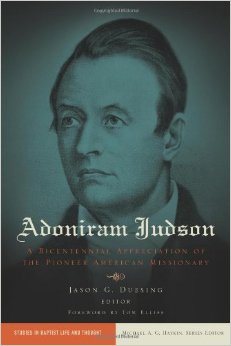
    I’m currently reading through Adoniram Judson – A Bicentennial Appreciation of The Pioneer American Missionary by Jason G. Duesling. It’s a terrific read, giving good historical context to Judson’s decision in becoming a missionary and outline of his work and family.

    He began his faith as a Congregationalist, coming from the house of a Congregationalist minister. But after working through the intricacies of being the first missionary with the denomination he became a Baptist while travelling from America to Burma. This certainly caused a bit of a stir at the time, as you could imagine.

    In the 1913 issue of the Foreign Mission Journal there is mention of the presentation of the Judson Centennial fundraising movement at the Southern Baptist Convention’s annual meeting. One statement recorded from the evening summarised the guidance Judson received from the Spirit and the Word.

    The mighty significance of the Judson spirit is not the fact that when a missionary is left alone with his Bible he becomes a Baptist, but the significant thing is that when a Baptist is left alone with his Bible he becomes a missionary.

    This is one of the great mission quotes, let alone one that inspires those who call themselves ‘Baptist’.

  • Adoniram Judson’s Courtship Proposal

    AAJudsonAnn Hasseltine asked Adoniram Judson to write to her father and ask for permission in order to begin a courtship with her, this is what he wrote in July, 1810:

    “I have now to ask, whether you can consent to part with your daughter early next Spring, to see her no more in this world; whether you can consent to her departure, and her subjection to the hardships and sufferings of missionary life; whether you can consent to her exposure to the dangers of the ocean; to the fatal influence of the climate of India; to every kind of want and distress; to degradation, insult, persecution, and perhaps a violent death. Can you consent to all this, for the sake of him who left his heavenly home and died for her and for you; for the sake of perishing immortal souls; for the sake of Zion, and the glory of God?”

    That is some proposition!

    Ann’s parents ended up letting her make the decision. And in her journal she writes:

    Jesus is faithful; his promises are previous. Were it not for these considerations, I should, with my present prospects., sink down in despair, especially as no female has, to my knowledge, ever left the shores of America to spend her life among the heathen; nor do I yet know that I shall have a single female companion. But God is my witness, that I have not dared to decline the offer that has been made me, though so many are ready to call it a “wild, romantic, undertaking”.

  • A DIY Discipleship Plan

    We are in the fortunate position of living in a Christian resource-rich period of time. No other generation has had such access to the teaching of the Bible and other resources that come with it. Only a few years ago it was impossible to hear any sermon other than the one you heard while attending your local church. Now, I can listen to one sermon on the way to work and another on the way home. That’s crazy.

    The amount of books, podcasts, music, articles and blog posts, devotionals, and different versions of the Bible give a plethora of options in helping us to understand and know God better. But, it can also cause a tremendous amount of confusion because there is so much choice.

    discipleship

    Therefore, I find it helpful to think about how I’m going to grow in my understanding of God and develop as a follower of Jesus by having a plan. In previous years I’ve attempted to read the Bible through in a year. There are many good plans to help with this and I find committing to reading four chapters a day the most consistent method. Having said this, I haven’t been overly successful lately.

    Because I enjoy learning, particularly through reading and listening, I’ve decided to approach my discipleship development in a different way for 2015. Rather than have broad goals of reading the Bible through in a year and praying regularly I’ve sought to make them a bit more specific.

    In structuring this plan I’ve broken my development into four areas; biblical theology, historical theology, systematic theology, and practical theology. Within these four areas I then have specific resources I’d like to read or listen to at different times throughout the year. See below as an example:

    Biblical Theology

    • Read the book of Jeremiah 5 times
    • Read a commentary on Jeremiah
    • Reach the book of Hebrews 5 times
    • Read a commentary on Hebrews

    Historical Theology

    Systematic Theology

    • Read 3-4 books on the topic of ‘Salvation’ (Do you have anything to recommend in this area?)

    Practical Theology

    There are many resources to read, watch, and listen to. There are conferences to go to and church to attend. There are small groups to join and other community activities to be part of. There is no doubt that discipleship is communal. I don’t want to negate this. But on a personal level I also want to continue to grow in my knowledge of God through his Word, what He’s done in history, through the teaching of others and then seek to apply it.

    It’s at least a plan, and I like plans, even if they don’t always get achieved the way I think they should be. So next year I’m going in with a plan to develop as a disciple. What about you?

  • My Top Books of 2014

    At the start of each year I set out to read, on average, a book a fortnight. By the end of the year I’ve usually done that. What can I say, I enjoy reading. It’s usually a mix of fiction (30%) and non-fiction (70%). The list of books I read don’t include the ones I dip into here and there but are the ones I read right through. If you’d like to see every book I read this year then head here, otherwise, below is a list of the top books I read, the ones I gave 5-stars to.

    books old

    One Day by David Nicholls

    I found this a great novel and it moved me in ways I didn’t suspect. I can understand why it won the 2010 Galaxy Book of the Year Award. It’s the story of two people who circle each other their whole lives and each chapter is written as if it’s a journal note from the same day each year. Worth a holiday read.

    You Lost Me. by David Kinnaman

    A detailed analysis of why Millennials/Gen Yers are leaving the church. This is an excellent read for anyone concerned about the future of the church and particularly if you are a Pastor or Youth Pastor. Kinnaman bases much of the book on research done by The Barna Group. Much of the information wasn’t too much of a surprise to me as this is my world but it was a good reminder to continue to think hard about engaging and growing young people in the faith.

    Calico Joe by John Grisham

    Just a classic piece of work by Grisham here. Not a long book but it will keep you reading.

    What’s Best Next by Matt Perman

    Can you believe that there is actually a theology of productivity? No, either could I until I read through Perman’s book. I’ve been following his blog for a few years now and love much of what he says. I found this volume really well structured to ensure solid theory and practical solutions. If you’d like to be more effective in life and work then read this book. Perman has got great thoughts on productivity and leadership and this book is well worth the time to read. It will take time to implement some of the suggestions he gives but when done I imagine a much easier way of life.

    The Pastor’s Kid by Barnabas Piper

    Such a good book. So good I had to review it. This book is for anyone in the church because it is helpful for Pastors, Pastor’s kids, and the general church member. It names everything a PK will go through and senses while in the church with their parent being a Pastor. It helps naming those things but also helps others understand what and why the PK is going through what they’re going through.

    A special mention must go to In My Place Condemned He Stood by JI Packer and Mark Dever. It’s mainly a collection of essays written by Packer and one by Dever. They are all based upon the penal substitutionary atonement of Christ, its meaning, purpose, and result. Each essay is comprehensive and will help grow your faith. Terrific read.

  • Remembering Missionaries This Christmas

    cross and christmasEvery week I receive numerous newsletters and emails from cross-cultural workers (or missionaries depending on your preference) telling me what they’ve been up to and what they’d like prayer for in the coming months. As you can imagine this time of year brings with it a certain theme – Christmas.

    Christmas isn’t an easy time for missionaries. The same can be said for many people back home too. But part of being a missionary means you’ve left your extended family to live and work in a place where you’re an outsider.

    You don’t know the language as well as the locals, you are away from the comforts you’ve been bought up with, you’re more than likely unable to worship in the capacity you’re used to for this festive season, and the big Christmas meal probably won’t include a large succulent turkey. Christmas can be a tough little period where you begin wishing you were back home.

    In among all the palaver that comes with celebrating a Western Christmas the main tinge of sadness comes from not being able to celebrate with others, particularly family. It is the relational aspect to Christmas that can be hardest, that can being with it this sense of disappointment.

    In the two years we were in the Middle East we felt that strongly. We lived within a school that had a few other expat teachers to celebrate Christmas with. It was a great time together and we did of course have a lot of fun. But once the food has been eaten and the afternoon slumber has come over you there is that time of reflection and wishing you could just hang with people you know.

    On the other hand there is a great opportunity for missionaries to share the good news of what God has done. Living in a different culture where Christmas isn’t thought of as anything more than a Christian holiday and a few days off work becomes a time where you can tell others about what it really means. That Christmas is actually the remembrance and celebration of God entering the world in human form, bringing hope and joy. And while this may be an assumed reason in the West, when living in a non-Western country the ability to talk about faith and religion is far greater. Striking up a conversation about why Christmas is important and what it means can come far more naturally in a foreign setting than in the Santa-obsessed, present-focused West.

    This Christmas is again, like every year, a good reminder to think of those who are away from family.

    I am making a conscious effort to pray for and drop a line to those who I know are serving in a missionary capacity. Perhaps you could too?

    A few things you could pray for could be:

    • Joy among the sadness of being away from family.
    • Opportunities to share the real meaning of Christmas with those they live and work with.
    • Time for reflection and recuperation from the year that has been.
    • A deeper sense of the love of God and the love of those back home.
  • Jonathan Edwards On The Nature Of Conversion

    Jonathan Edwards on conversion, in A Faithful Narrative of The Surprising Work of God:

    These gracious discoveries given, whence the first special comforts are derived, are in many respects very various. More frequently, Christ is distinctly made the object of the mind, in his all-sufficiency and willingness to save sinners; but some have their thoughts more especially fixed on God, in some of his sweet and glorious attributes manifested in the gospel, and shining forth in the face of Christ. Some view the all-sufficiency of the mercy and trace of God; some, chiefly the infinite power of God, and his ability to save them, and to do all things for them; and some look most at the truth and faithfulness of God. In some, the truth and certainty of the gospel in general is the first joyful discovery they have; in others, the certain truth of some particular promises; in some, the grace and sincerity of God in his invitations, very commonly in some particular invitation in the mind, and it now appears real to them that God does indeed invite them. Some are struck with the glory and wonderfulness of the dying love of Christ; and some with the sufficiency and preciousness of his blood, as offered to make an atonement for sin; and others with the value and glory of his obedience and righteousness. In some the excellency and loveliness of Christ, chiefly engages their thoughts; in some his divinity, that he is indeed the Son of the living Cod; and in others, the excellency of the way of salvation by Christ, and the suitableness of it to their necessities.

  • Education, Millennials and Missions

    millennials-graphic-600The post ‘Six Millennial Statistics Every Adult Should Know‘ was published a little over two weeks ago. I was sent a link for it through a colleague who also challenged a group of us to respond to one of the questions being posed and how it related to missions and missions engagement. As a side note, I reckon this article is worth consideration, as opposed to other Gen Y blog posts because it actually asks really good questions at the end of every point. In any case, I responded to the question through the group email in the following way. You’ll notice I’ve also included the paragraph and questions I was responding to.

    Well Educated

    School plays a larger role in this generation of young adults than any in American history. 23% have a Bachelor’s degree or higher, making them the most educated generation ever. Obviously, some have stayed in school due to a poor economy. (It just wasn’t a good time to launch a career). Others stayed in school because mom or dad pushed them to get that college degree and a “white collar” job instead of a “blue collar” job, and parents were all too happy to have them live at home during (and after) the process. So they’re well educated but may need to take a job they are over-qualified for at first. It also may mean they take a job where they must “pay their dues” in order to make progress. This is difficult.

    Question: How can we enable young adults to capitalize on their education and leverage it to take them where they’re most gifted to serve?

    My thoughts:

    Most of my “ministry career” has been doing youth and young adult ministry in the rich part of Melbourne. The majority of my kids were going to private schools or top public schools in the state. The importance of education is taught at an early age and takes away time from church. The pressure from the school and parents was enormous, so much so that many of the year 11-12’s were having mental health issues like anxiety and depression.

    The expectation is to continue this education into their university studies and then career. Western culture teaches them to continue studying and gain better and better results in order that they can do the exact same with their kids etc.

    We all really know this don’t we…?

    But, because they’re so educated it means they won’t begin to think about missions in a serious capacity until they’re almost out of their university degree. This has implications for us as the average age of someone jumping into missions and heading off long-term will continue to be pushed out to the 30s and 40s – once their education and career has been established.

    Because they’re so educated it means they will want to use what they’ve learnt in the future. It’s not often to have someone come and say they’d like to just give up what they studied and worked toward for something else. Well, unless they’ve been in the workforce for 10 years and its time for a career change or something. This has implications for us as those who wish to do missions will want to use their skills and education as the backbone to their missionary effort. This might mean people won’t fit into our organisation but on the other hand it will mean we get well-educated professionals when they do fit.

    Because they’re so educated they will be better able to understand the concepts and ideas that missiology and theology present to them. I don’t think any teaching is too deep for any Millennial, as long as its clear and answers the question of why. The implication for us is that there needs to be in-depth and rigorous training and development given throughout their “missionary career”.

    Because they’re so educated they will have a fair bit of financial debt. While Fee-Help and HECS is brilliant and in reality may not need to be paid off because they won’t earn enough it is still a debt they will be carrying. Depending on their personality they may wish to pay it off or live with it hanging over their head – like I do. This has implications for us because they may wish to pay this off as they serve and therefore have it included in their support budget. Also, if they’re required to go to theological college then that debt will be increased at a significant rate because of the private nature of theological schools.

    I think the tough question is how do we show that they will be using their education as part of their missionary efforts on the field?

    To suggest that they won’t be using any of their studies will simply drive people away. We need to take each person as they are and show them how they can be of great help using their skills and what they’ve learnt. Telling stories of workers who’ve gone over and found that their skills and education help them build relationships and teach others is important. And, I think it’s important to show people that their education is more than just a visa platform too.

    How would you respond? 

  • Inconvenient Evangelism

    A great little post from Leon Brown over at Reformation21:

    Sharing the gospel takes time, time we often do not believe we have. Sometimes we are so concerned with ensuring our plans are completed, we do not stop to consider that the Lord may have other ways he would like to utilize us. Sure, we know in theory God “establishes [our] steps,” but when the theory becomes a reality, it rattles our me-centered paradigm. That is one reason why some of us may not share the gospel very much, if at all. It is inconvenient, rattles our self-centered approached to life, and thwarts our plans.

    Read the whole thing here.

  • John Wesley On Love

    John Wesley, in his sermon On Love from 1 Corinthians 8:3, “Though I bestow all my goods to feed the poor, and give my body to be burned, and have not love, it profiteth me nothing”, articulates a love that must be rooted in a love for God for any of our works to be considered good. This is a good reminder of how we are to have a deep deep love for God grounding us in our love for others. An insight into the kind of love, and attitude of love, we should strive for when serving others.

    Though I should give all substance of my house to feed the poor, though I should do so upon mature choice and deliberation; though I should spend my life in dealing it out to them with my own hands, yea, and that from a principle of obedience; though I should suffer from the same view, not only reproach and shame, not only bonds and imprisonment, and all this by my own continued act and deed, not accepting deliverance; but, moreover, death itself; yea, death inflicted in a manner the most terrible to nature: yet all this, if I have not love, [“the love of God, and the love of all mankind shed abroad in my heart by the Holy Ghost given unto me”] it profiteth me nothing.

  • Better Together For Mission

    The title of this post is the title I have for the sermon I’m preaching this coming Sunday.

    It’s causing me issues.

    I’ve spent most of this morning writing and deleting words from my screen. I haven’t been able to put into words the things I need to say and so currently have very little to say.

    Part of this post is to enable me to write something that may actually trigger what I want to say come Sunday.

    Of course, I’m hoping to say what God wants me to say. As I do every time I preach. But that’s all well and good when the words flow, the passage makes sense, and the topic is an easy one.

    So far these have alluded me.

    When thinking about ‘Better Together For Mission’ there comes to mind the group or communal aspect of mission.

    Mission is not a solitary exercise between one individual to another, although it could be. But even when it seems to be this way there is usually prayers from church members or mission supporters that are being lifted up and heard by God, therefore having an impact upon the situation.

    In a local church context there are programs run by numerous people within the church, another example of community working together for mission.

    Where programs aren’t a big emphasis then the daily mission task of the average Christian is being encouraged weekly through the Sunday gathering with a reminder of what it is to be a believer during the week.

    The point is that mission is not individualistic, it is communal. And so the partnership between individuals, the church, and God is evident in each and every mission activity we do.

    But this still doesn’t resolve my problem.

    If mission is something that is part of the whole of life as a believer then mission is life. It isn’t some part of life, it is the driving force behind a purposeful life.

    The reality is this kind of focus and priority isn’t seen as regularly within the church and the Christian life as we’d like. Unfortunately it’s more like a bit part, something that comes to our minds only when we’ve been reminded that God has a mission for us here in the world.

    On one hand we could say that mission is a communal exercise, even if we find ourselves in the middle of nowhere, with a language we hardly understand, and a culture we find confusing. But it must be ingrained in us to think that mission is a natural part of living. A life focused on another mission – to earn heaps of money, to climb the corporate ladder, to write a Pulitzer prize – is one that doesn’t give God the priority. These things may come our way but they aren’t the driving force in life, they are second to the mission of follow Jesus. be more like him, and see others come to know him too.

    As I write these words my mind is cynical about what I’m writing. Is this the reality of the Bible? Is it simply simplistic to write this and how does this play out in life?

    I’m not sure right now and I’m not sure when I’ll be sure. Perhaps this speaks more of me than of what God’s mission is for the world.

    But if there is a focus on anything but Jesus then something is wrong. That I know for sure.

    Perhaps that’s the answer right there.

    We won’t be involved in what God is doing around the world, whether right next door to where we live or 4000km away, unless we have Jesus as the focus, priority, and central aspect to our whole life.

    If Jesus isn’t the centre of our life then his mission for us won’t be the centre of our thought.

    If Jesus isn’t the centre of our church then his mission won’t be the centre of our local ministry,

    If Jesus isn’t the centre then something else will be and we will lose out on being part of God’s mission.