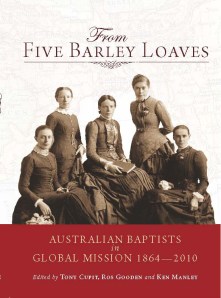
 This year Global Interaction, the Australian Baptist cross-cultural mission agency, celebrates 100 years since federation and 149 years of involvement in global mission. As part of these celebrations a book has been released highlighting the involvement of Australian Baptists in cross-cultural mission since 1860.
The first five Baptist missionaries sent from Australia were female. At their commissioning service the pastor, Silas Mead, preached from the text referring to Jesus feeding the five thousand in John 6. Drawing on this story Mead made reference to the five barley loaves supplied by the child, the implication being that the work these five women were about to undertake in Bengal would be one where they were few among many. It is from this beginning that the title of the book From Five Barley Loaves gets its name.
Ken Manley, Australian Baptist pastor, historian, and former Whitley College principal, was one of three main editors of this work. He has been kind enough to answer a few questions about the book and let us in on some of the significant points of his research and writing. I’d like to publicly thank Ken for agreeing to share his thoughts, it’s much appreciated.
1. What interested you in being involved in writing this book?
I was asked to act as a consultant to a small group from Global Interaction who were planning the project. There was no expectation or commitment that I would do any writing. I was quite supportive of the book for several reasons. When writing my history of Australian Baptists I had included one chapter on our foreign mission work and realised how inadequate this was. I knew there was a great need for a carefully researched history of the Mission. I also believed that the work of the Mission was the most unifying ministry of Australian Baptists nationally and wanted to see the full story told. My friend Gerald Ball had written a fine thesis on early Australian Baptist work in India and had been asked to write a major history of ABMS (as our mission was then called). I really wanted to help him and was sorry when his health meant that a much wider group of writers had to work on the history. Also, I had always been a supporter of the Mission and had served in minor ways across the years and so was delighted to be asked to help as an advisor. In the end I wrote the chapters on home leadership and mission policy as well as the conclusion.
2. In your mind, what were the most significant findings in researching the book?
This is hard to say in the sense that in broad terms the story was well known. As a group we shared a belief that mission history generally and our story in particular should itself have a strong missiological purpose. As we wrote the history we were constantly seized with the way in which the Mission was led by God and sustained especially in the most difficult times. The way in which various national groups responded to the gospel is itself inspiring and a reminder that all missionary work is in the deepest sense simply telling what God is doing in the world. The depth of the commitment to the work by such a wide range of people right across our churches was confirmed by the details of our research.
3. As Australian Baptists why is it important to know our mission history?
It is a major part of who we are as a people. We did not want to produce a naive devotional narrative that depicted missionary heroes as flawless saints. We wished to avoid any sense of triumphalism or promote a cultural imperialism. The growth of faith and mission among those people with whom the missionaries shared has been a significant and central part of our story, not as a justification or vindication of ‘our’ work but as testimony to the unfailing work of God in mission in the world. That God used ordinary people just like us is a call and challenge for us to serve in our day.
4. Was there anything that surprised you about our mission history? If so, what?
I am not sure that ‘surprised’ is the right word. In broad outline the story was known. Yet the very fact of bringing it all together was itself an inspiration. Here was ‘just’ another story about part of the global phenomenon that is Christian mission. Here was a tale about this small part of the Christian world family seeking to share the truths of the gospel to people of different cultures. Here was the story of both failures and successes, of a slow but steady growth in awareness of the challenges of cross-cultural mission and of experiments in outreach to different cultures in times of dramatic changes in the world. We believe that there is inspiration and challenge in the story but we have not felt it necessary to gloss over mistakes and struggles. A couple of the saddest parts to record were about differences and failures but that was necessary too.
5. How can we be encouraged in our faith through reading this book?
Archbishop Rowan Williams has written, ‘We are always likely to forget that Jesus is different from the Church, not the Church’s possession’. So with this Mission. We were once inspired with the vision of taking the gospel to the ‘lost heathen of the world’. We do not mock the motivation, the sincerity and the passion with which that mission was undertaken. But our Mission’s story affirms that Jesus was never the Mission’s possession to be given from an imagined superiority to the poor benighted people of distant foreign places. Today we clearly affirm that we are partners not propagandists with a vision to ‘empower communities to develop their own distinctive ways of following Jesus’.
Indeed, as the one eventually charged to write about the work of successive leaders, to analyse home support and reflect on the missiological policies of the Mission, I was deeply impressed with several aspects and found my own faith in missions increased. I was, for example, inspired by the way in which during successive periods dedicated workers grappled with challenging problems. Frank Marsh who led the Mission for 23 years summarised his term as a series of crises that ‘add up to a story of repeated deliverance and convincing evidence of Divine care’. His successors echoed this sentiment. I discovered a willingness to change, to follow fresh insights and to adopt compelling mission goals even if this involved risks of misunderstanding by supporters. Most especially, I came to understand more clearly the immense depths of support given by a myriad of loyal, mostly unknown Baptists, whose unfailing interest, incredible generosity, faithful prayers and sacrificial efforts seemed to grow in times of desperate need and which lay behind every advance on the fields. This is the story of such ordinary Baptists at home as well as the hundreds who served as missionaries in diverse locations.
6. And for those tossing up whether to read this history or not, what would you say to them?
It is a long book and you may choose to read it in chunks. It is great value! Every church should have a copy in the church library or available for all to read. The story in each country is found in separate chapters. Reading it will reward you as an individual believer and as a church you will be challenged to extend your commitment to global mission in our generation. Here is our story, not only from the past by right up to date. If you care about the spread of the gospel throughout our world today you will need to read and be challenged!
Any further comments?
One Anglican reader and historian of missions, Professor Stuart Piggin has written about our history: ‘A really quite astonishing record of an astonishing part of the church family which says to the rest of us, “Go and do thou likewise”’.