Tag: Church

  • 11 Things: Nothing Else Matters

    A while ago I wrote a post about what I wished I knew when entering youth ministry. This is part six of a series dedicated to elaborating each of those eleven points. You can read part onepart twopart threepart four, and part five here.


    When in the guts of week-to-week youth ministry it is unlikely that anyone cares about what you’ve achieved in the past. The only time your education, prior experience, and variety of training helps you is through the application and interview process. Once your name has gone to the church, an introductory A4 sheet of paper is handed out about who you are (and your family, if you have one), and the vote has been taken, it’s all over. All of that is forgotten.

    What matters most to those in your church is how you relate to people and whether you can look after the students.

    Seriously, get those two things right and generally people will be happy.

    However, for us as Youth Pastors, we have a sense of pride in our work. This is not the kind of arrogant pride, overconfidence, and belittling of others. No, this is a sense of achievement, being happy and satisfied in the work, education, and relationships we have in our life.

    If you’ve been in youth ministry longer than 5 years you should feel good about that. If you’ve completed a particular course, you should feel good about that. If you’ve travelled, you should feel good about that. If you’ve been through tough experiences and come out the other side, you should feel good about that. If you’ve taken the step to get married, I hope you’d feel good about that! Whatever your accomplishments and achievements are you should feel good about them. We are all unique and will bring those experiences into our youth ministry role at church.

    The issue is, no one will care more about this than you.

    I wished I knew that what I’d achieved in the past would only matter to me earlier than I did. At one stage I believed that the two-years in mission work would help me gain a position as Youth Pastor. I thought it would at least provide a good platform for leadership in the church. After all, I knew what I’d done, the experiences I’d had, and was confident in my own abilities. Yet, when in conversation with someone in leadership they simply dismissed this experience because it wasn’t youth ministry specific. Little did they know me, let alone the experiences I had, and how totally applicable and formative it was to youth ministry.

    Often we begin to believe that the experiences we’ve had in the past aren’t very influential or relevant to the role we play as Youth Pastors. This isn’t true.

    Everything we’ve done is really formative for us. Our experience in life and work all helps in the youth ministry role, helping us relate, care, and create as Youth Pastors. Whether it’s a course of study, travel, corporate work, gardening, or cleaning toilets as part of your entry-level McDonalds job, all of these help in forming us in youth ministry.

    All this being said, it comes down to the realisation that we can’t rest on these experiences. We can’t have our hope and identity in our past accomplishments, just as we can’t have our hope and identity in our role as Youth Pastor.

    While these things help form us, they aren’t known to others. Youth ministry volunteers, parents, the students don’t know your story like you do. When something comes up that they’re not happy with, that they challenge you on, that they disagree with you about, then none of your accomplishments matter. It’s not about status and achievements. What matters is how you’re going to deal with the situation you have in front of you. What matters is whether you’ve learnt from your experiences, and how you can leverage them in dealing with the challenges and joys you face in youth ministry now.

    The point is really about identity.

    Our identity is not in our position as Youth Pastor. It’s not in our accomplishments. It’s not about our ego.

    It’s in Christ (John 15:15; 2 Cor 5:17; Gal 2:20; Col 3:3).

    We serve him. His people. And try to get the ego out of the way.


    Questions for reflection:

    • Do you put too much weight in the achievements of the past?
    • Is your ego seeking to remind you of all the awesome things you’ve done?
    • How are you learning and growing to serve others in humility?
  • Podcast: After 9 – Episode 82

    I was interviewed about my journey in youth ministry on the After 9 podcast. It was really fun to do and I think it ended up alright. It went live today.

    “In this episode of After 9 Zac interviews Aussie blogger and youth pastor Jon Coombs. Hear the ministerial honesty from half a world away as…[Jon]…shares his heart about what it means to serve in youth ministry long term and what the simple gospel has to say about the power of God working in the lives of young people. If you were called to ministry young or have continued to serve for more than a decade, or have a dad as a pastor, this one is for you.”

    You can find it here.

  • 11 Things: The Grass Isn’t Greener

    We are constantly comparing ourselves to others.

    From our material goods to our leadership skills to our parenting, we are always comparing ourselves to others. There is something about our fallen humanness that leads us to measure our uniqueness with the uniqueness of others.

    This also happens in the church, and in youth ministry.

    img_6518
    We are enticed into dreaming about the bigger, and supposedly better, youth ministry down the road. Our mind drifts to consider what it would be like to be in a position at that church, or under this leader. What would it be like to have that role, live in that place, and have those facilities? For some reason we believe that the person leading that youth ministry or the role in that church will be better than the current position we find ourselves.

    I think this is natural.

    I hope it’s natural.

    I know it’s not helpful.

    Part of this thought is solidified by social media. Those glorious pictures of friends on holiday, travelling to exotic places, and experiencing amazing things compound our thought life. We tell ourselves that life is not like that, but we can’t help wonder whether our life is matching up to what we see around us. The same is true when we follow other youth group accounts, meet with other Youth Pastors, and hear of stories of what God is doing in other youth ministries. The pics portray a false reality that leads our thinking and dreaming into unhelpful areas. We begin to judge ourselves with the bigger church down the road, the one which has more money, better facilities, and the opportunity for seemingly more influence.

    Instead of praising God for the work he is doing we sit there comparing ourselves, turning the work of youth ministry into an exercise in self-centredness.

    But the truth is, the grass in not greener on the other side (or in another church).

    The issues, challenges, hard work, conflict, and all those frustrating and negative things we are dealing with now are still there in the ‘bigger and better’ church down the road. It might not look that way from the stories or the pictures or the conversations, but despite a change in place or position those pastoral and youth ministry related challenges will still be there.

    As I wrote in my original post, “It’s easy to let your mind drift to the church down the road and begin to think of how good it must be there. It’s not. It’s just not. They are having the same issues as you. They are having the same struggles. They are having the same problems. The same goes with going into a different ministry role or a role at a para-church organisation. The grass isn’t greener. It’s work. It’s hard.”

    So, instead of dreaming and spending time unhelpfully thinking about the church next door why not do some of the following things to help gain some perspective. What we do now, in the place and position we are currently in, is important. We are called to be faithful to it and work hard in the youth ministry we are involved in now.

    Abide In Him

    In John 15 Jesus talks of abiding in him. Jesus makes the connection between fruit and abiding in him. If we are to be fruitful we need to be faithful to Jesus. Through remaining in Christ, walking closely with him, and realigning our thinking with his, we will find ourselves in a better frame of mind about our current position.

    Pray

    Once we realise we are not living with Jesus as well as we should be we do need to admit that to him. Through prayer we can lift our thoughts to God and ask for forgiveness. We can then ask God to help us understand what he has for us now. While our life with Jesus is a major part of our drifting into unhelpful thinking it may also be tiredness, weariness, and demotivation for a period of time. Pray for the ministry and your rhythms in all of this.

    Vision Over Task

    With the never-ending to-do-list we can get stuck in the task. Remember the vision for youth ministry you have. Spend some time mapping out the broader vision for the youth ministry, and do some brainstorming about future ideas and possibilities. When we are stuck on task we can get bogged down. Lift your eyes to the heavens and dream about the big-hairy-audacious goals. It’s usually pretty inspirational.

    Write A List

    Have the list of everyone involved in the youth ministry at your church. Make specific comments on what you appreciate about them. Write them a note or a card referencing those specific appreciations.

    Look At Your Calendar

    Hopefully you have a calendar. Look over the last 3 months, writing down everything you’ve been involved in – the people you’ve seen, the meetings you’ve attended, the teaching you’ve presented, the events you’ve been to. Everything. Look at how much you’ve accomplished.

    Call A Friend

    Either a mentor or a close ministry friend. Give them a call. Verbally vomit on them about how you’re feeling and the frustration you’re going though. Tell them about the unhelpful thinking. Let them help you process what’s happening right now. Let them slap you around (metaphorically, of course).

    It’s often not admitted, but we know it’s there. Perhaps it’s time to let go of the belief that it’s better somewhere else. God has us where we are for a reason, we are to be faithful to him in that.

    And remember, the grass isn’t greener.


    A while ago I wrote a post about what I wished I knew when entering youth ministry. This is part five of a series dedicated to elaborating each of those eleven points. You can read part onepart twopart three, and part four here.

  • 11 Things: Friends For The Journey And Friends For The Road

    If there is one thing Pilgrim’s Progress makes clear it is that you need friends to help carry you and be there for you. Christian faces trials and challenges to faith numerous times as he seeks the Celestial City. It is Jesus who carries him through, but the means by which this carrying occurs is through the friends he has along the way.

    Friends are important. We know this ourselves. Socialisation and relationships are something we learn from a young age, or hopefully learn at least. The need for relationship and friendship and companionship is vital to living. This is why we begin making friends in playgroup and kindergarten, seek to be included when we’re in high school, find community in hanging out with university friends or work colleagues on a Friday night, and why recent widows or widowers marry again soon after the passing of their spouse.

    Relationship drives much of what we do. 

    In youth ministry we are surrounded by people, but this doesn’t mean we have close friends. In fact, it is probably less likely for us to feel like we have solid friendships with others because we may only be at a church for a short period of time before moving on to another congregation. This is not to say that we don’t care about those people we cared for previously. Due to a new role and a new church, new relationships need to be made.

    Another point to consider is that sometimes our friend card can be full. If we’ve had some really close friends from high school and that’s continued for a number of years, picked up a few more through church and other areas of life, then our social and relational needs may be met. When we get to a new church we may not need to be friends with people because of the friends we already carry. This is not always the case but worth recognising as a reality.

    With this said there are two types of friendships we might come across in youth ministry. The first I call friends for the journey, and the second I call friends for the road.

    Friends For The Journey

    The word ‘journey’ has got to be the most overused Christianese I have heard. Ever. It’s probably lessened in recent time, overtaken but that word ‘space’. However, it is good to use the word to describe this situation.

    Friends for the journey are those friends who are only around for a short period of time but they are with you through your ministry tenure at your church.

    For example, this could be a member in the congregation or in the small group you connect with really well. They are genuine friends with you and you with them. The relationship grows and grows but when you leave then the relationship pretty much stops. There is the recognition that this relationship was only for a certain period of time because of the situation you find yourself in. It could well be that you rarely speak to a former colleague after leaving for another ministry placement. That’s OK. It’s going to happen. But while you were there it was a great friendship. When you meet up again it’ll be as if no time has passed at all. But, don’t be surprised if the friendship moves on and new friends are made from both sides when this occurs.

    Friends For The Road

    These friends are those friends who you’ll be 83 years-old with and still kicking around like you’re 23. These are the friends who stick with you, you may not see much of each other during certain seasons in life, they may not even go to church or be Christian. But, the relationship and friendship was formed years ago and over time it is just natural to continue that friendship. They know more about you than most other people will ever know, and they can speak into your life or come along and support you at anytime. You could pick up the phone, call them, and they’d take it.

    This kind of friendship is needed in youth ministry as they will be there when there are challenges and tough times. They will be there in the joys and fun of the ministry. They will also see you grow and mature and become the pastor and leader you are. These are great friendships and are important to have as you lead and minister to others.

    Friends and relationships are important in every sphere of life. Sadly, there are many who don’t have friends. But in ministry it is important to have people who walk with you closely for a period of time and then there are people who are needed over the long-term, those lifelong friends.

    Do you have such friends? Is it time to give someone a call or shoot them a text? 


    A while ago I wrote a post about what I wished I knew when entering youth ministry. This is part four of a series dedicated to elaborating each of those eleven points. You can read part onepart two, and part three here.

  • 11 Things: Church Health > Youth Ministry

    Would it surprise you that there are churches out there that are unhealthy? That there are churches full of sinners, led by sinners, where the health of the church is compromised?

    I’d hate to burst your bubble but it’s true.

    There are churches that aren’t as healthy as they should be or could be. This is a shame, of course, because a healthy church can do wonders for the glory of Christ and the people who go to it. Unfortunately, not all churches are perfect. But, as the saying goes, if you find the perfect church make sure you go somewhere else as you’ll be the one to stuff it up. 😉

    I open referring to unhealthy churches because the reality is that the state of the youth ministry you lead or are part of (as a student, volunteer, or parent) is only as healthy as the overall church.

    It is important to reflect a little on this idea of health. There are a number of ways to think about it. Is the church healthy theologically? Is the church healthy in its structures and processes? Is the church healthy in its interpersonal relationships? Is the church healthy in its leadership? There are different angles to explore this issue of a healthy church. Nevertheless, if there is some part of the church that is unhealthy then it will, consciously or not, affect the whole church. When I get a cold my main issues are the throat and sinuses but it affects the way my whole body operates. It’s the same with the church.

    For you as a Youth Pastor, or someone involved in youth ministry, this could look different. This unhealthiness could show up in different ways.

    For some churches there is a clear disparity between the youth ministry and the rest of the church. The youth and young adults have their own things going on and the adults have other programs happening and never the twain shall meet. This is sad. It means there isn’t any inter-generational interaction and growth occurring, resulting in the ‘silo effect’. When people of generations aren’t able to get to know each other it is easy to forget “we’re all one in Christ Jesus” and that our church is a local expression of the body of Christ, from child through to octogenarian.

    Other churches may have a great Youth Pastor, have a terrific leadership group, run an awesome program, build solid relationships with parents and students, and see people coming to Christ. However, if things at the top of the church leadership structure aren’t great then things will go awry. The health of the leadership of the church is vital in providing a sustainable base for the youth ministry to grow and thrive. In Baptistland, where I find myself residing, there is always the temptation of church leaders to seek power and control and the status of being on the ‘diaconate’ or ‘council’. If the point of being on such a group isn’t service, and a looking out for the whole of the church and its ministries, then it will soon collapse.

    So, what are some ways those in youth ministry do despite un-health?

    • Pray for the church. Pray for the whole church, for its pastors, for its leaders, for its volunteers, and for its health.
    • Encourage membership. In the Baptist tradition the base of power is held with its members. Therefore, encourage those who meet the membership requirements of your church to become members. This enables those within the youth and young adult ministry to have a more formal voice in the church’s decision-making process.
    • Be aware of what is going on in the wider life of the church. The worst thing is to become a person or ministry that is disconnected to the whole church. Be someone, or a ministry, that seeks strong relationships with others in the church. In doing so you may find yourself recognising that you’re part of a bigger picture.

    A while ago I wrote a post about what I wished I knew when entering youth ministry. This is part three of a series dedicated to elaborating each of those eleven points. You can read part one and part two here.

  • Being Pastor To A Pastor’s Kid

    I’m a Pastor’s kid.

    I’ve also been the Youth Pastor to the Senior Pastor’s kids.

    It’s a weird situation.

    I recently wrote about the Senior Pastor-Youth Pastor relationship. Off the back of this a mate of mine suggested I write more specifically about dealing with a dynamic many Youth Pastors face – You’re the Youth Pastor of the Senior Pastor’s kids.

    img_6075

    On one hand you want to to lead the youth ministry in a way that you believe is appropriate. A way that is contextual to young people while also coming under the vision, mission and values of your church. Under normal circumstances this wouldn’t be a problem.

    But on the other hand, the Senior Pastor, the one you as Youth Pastor report to, has children in the youth ministry. And while they trust you and your leadership; they have an added desire to see their children come to faith under your ministry. This is not to say their children are any more important than another parent’s child, not at all. It just happens to be that your ‘direct manager’ is also a parent.

    It becomes an interesting dance.

    And so, it’s worth thinking through this particular topic from four perspectives.

    First, the Senior Pastor perspective.

    Their desire is for their children to come to know and follow Jesus. The Pastor, with their spouse, has sensed a call to the ministry. They have invested time, money, and energy into the local church. They continue to teach and counsel the members of the congregation. But, their children are special to them. They are their children! They love them, want the best for them, and over the years have been teaching them the ways of the Lord in the family context.

    Like any other parent you deal with as a Youth Pastor the Senior Pastor and their spouse is no different. They have a strong desire in seeing their child come to faith in Jesus, raised well in the context of their local church, included in the church family in a way that is meaningful, and have them grow in faith.

    Second, the local church perspective.

    To the congregation, the children of the Senior Pastor reflect their Pastor. Depending on the context this could be a small thing or it could be quite a big thing. Either way, there is some form of reflection.

    For some reason most churches believe they own the children of the Pastor and consider them one of their own. They have unsaid and unintentional expectations on how the Senior Pastor’s kids are to behave, what they should be doing, what they believe, and how much biblical knowledge they should have. Whether it is during a church service or while they’re at youth group, the church is watching them.

    The church loves these children though. They give them extra servings at church lunches, a gift at Christmas, or something special for their birthday. This doesn’t come to every child in the congregation, some things are specifically for the Pastor’s kid.

    In one’s most skeptical moments there is the thought that this special attention given to the Pastor’s children is solely because their parent is the key leader of the church. Most of the time this is out of love and care and concern. But, at other times this could be a way for certain members to get back at their Pastor, an attempt to bring some form of turmoil to the Pastor’s family or ministry. This is not to say that the small minority causing these issues are prevalent in every church. It’s something to be aware of.

    There are expectations coming from the congregation regarding the Pastor and his family. They are often unsaid. But at the end of the day it will cause grief, not just as a parent, if the Pastor’s kid goes off the rails. It will cause the Pastor to wonder whether they are worthy of the position they are in, and this may even be voiced by some in the congregation.

    Depending on what season of life the child is in will depend on how the church reacts to certain actions, beliefs and behaviours of said child. Considering we’re talking about those youth ministry years you can imagine the things going on here.

    Third, the Youth Pastor perspective.

    The Youth Pastor is in an interesting position. They are seeking to disciple the Senior Pastor’s children. They don’t believe they should be doing anything different for this child despite the parent being their boss. But, this is a fine balance, as they want the best for this kid, like all the others in the youth ministry.

    The Youth Pastor is employed by the church and sits under the Senior Pastor. At times, whether in a Pastoral Team meeting or at a church event, the Senior Pastor will have two hats – that of parent and that of Pastor. To know which is on at which time could lead to confusion and misunderstanding if not careful.

    It is also worth pointing out that the Youth Pastor may be lulled into unhealthy thinking; believing that if the Senior Pastor’s child is doing alright then they might have an ease of pressure from their superior.

    At the end of the day it is worth having some clear guidelines about how to approach this. Some of the following suggestions might be helpful:

    1. Have a conversation with the Senior Pastor about dealing with their children. Just open up the conversation and see what comes of it. Often it is in having the conversation that a greater understanding of the issue can be seen. There needs to be awareness from both the Youth Pastor and Senior Pastor that this topic can be a minefield and lead to conflict.
    2. Suggest that the Senior Pastor isn’t the parent that brings parenting questions to the Youth Pastor. Have a clear guideline that means the spouse of the Senior Pastor raises issues or concerns to the Youth Pastor.
    3. Work out boundaries on how much or how little to share about the Pastor’s kid. Often Youth Pastors will know stuff about the child that the Senior Pastor won’t even know.
    4. Have an advocate from outside the church come and speak to the Senior Pastor on your behalf or with you. This could be a denominational leader or simply another Pastor who you trust will mediate fairly.

    Fourth, the Pastor’s kid perspective.

    It’s not often we end up thinking how things might look from the Pastor’s kid perspective. As a Youth Pastor we obviously want to be aware of their needs, and the challenges they are facing in any particular season. But, who really thinks about the perspective of the Pastor’s kid? Here’s a little of what they’re thinking while they traverse church life as they go through their teen years.

    • They are aware that everyone in the church is looking at them; their beliefs, attitudes, and behaviours.
    • They are aware that their parent is the key leader of the church and that his leadership is something God has ordained.
    • They are aware that they didn’t ask for this role of Pastor’s kid. They had no say in it, it just is.
    • They are aware that their coming to faith or turning from the faith has an impact on their family. Anything from parental disappointment to job loss.
    • They are aware that the Youth Pastor doesn’t want to show them any more special treatment than they do to others. This means it might actually be harder for them to integrate or feel comfortable in the community.
    • They are aware that the Youth Pastor is under the leadership of their parent and so can play this off if they were inclined to do so.
    • They are aware that what they say about the Youth Pastor at home might have an impact on the Youth Pastor’s relationship with their parents.
    • They are aware that they are expected to be at youth events and enjoy the youth ministry that their church has.

    This can be a thorny issue for Youth Pastor’s. It is worth thinking about, at least at some level.

    A terrific resource about Pastor’s kids is Barnabas Piper’s book ‘The Pastor’s Kid’. It would be useful for all Pastors and church members to read. If you’re a Youth Pastor and you haven’t thought too much about the Pastor’s kid then I’d encourage you to read this. I have written a review of the book here.

  • 11 Things: The Senior Pastor-Youth Pastor Relationship

    A while ago I wrote a post about what I wished I knew when entering youth ministry. This is part two of a series dedicated to elaborating each of those eleven points. You can read part one here.


    As a Youth Pastor I’ve spent time under three Senior Pastors. I’ve always felt I’ve had a good relationship with them. I know I had the support of them throughout my time with them, and I also feel I supported them well, no matter the circumstances. It may well be the loyalty instinct I have within me, but I have resolved from very early on to back my Senior Pastor to the hilt.

    The Senior Pastor-Youth Pastor dynamic is an interesting one. It is not often talked about in public. I’ve never been to a workshop about how to relate to my Senior Pastor or been provided with much training in how to navigate this relationship. If such a workshop was ever offered at a youth ministry conference I suspect it would be highly attended.

    img_6035
    I say this because I believe the main reason Youth Pastors leave churches is because they don’t have a good working relationship with their superior. I don’t have any empirical evidence for this statement, but anecdotally I’ve observed the main reason for Youth Pastors moving on is breakdown in relationship with the Senior Pastor.

    I spent six months in a denominational role a couple of years ago caring for Youth Pastors who were having a tough time. The topic of conversation, whenever I met with them, was their relationship with the Senior. Sometimes it was simply wanting to get things off their chest and once that was done there was a sense of freedom. Other times the relationship had broken down to the extent that the Youth Pastor decided to leave.

    This is not to say the Senior Pastor is at fault. Not at all. This is not to say that all Youth Pastors leave because of this. Not at all.

    But.

    If the relationship between the Senior Pastor and Youth Pastor is not great then it is hard to provide a healthy ministry for the church.

    With this being said, what are some questions worth asking surrounding this topic? How can this working relationship improve for the betterment of the church?

    First, the expectations about the Senior Pastor-Youth Pastor relationship need to be set at the time of advertising the position.

    A clear understanding between Senior and Youth Pastor about how they will work together is worth talking through as early as possible. It is one thing for the Youth Pastor to tick the boxes in terms of competency and character, another thing in regard to chemistry.

    Being able to talk through the way the church see the position operating gives helpful insight into the working relationship. One role might be for the Youth Pastor to fulfil a set of tasks and “look after the young people”. Another role might include more oversight and leadership and therefore wider conversations with the Senior Pastor would be required.

    Questions worth asking at an interview might include:

    1. How often do you expect to meet up with me as the Youth Pastor?
    2. What kind of information about the ministries I lead as Youth Pastor do you require?
    3. Do you see this Youth Pastor role as one that is mainly about fulfilling tasks or is there an element of growth to it?
    4. What kind of availability do you have (as Senior Pastor) if I would like to talk to you (as Youth Pastor)?

    Second, is there a growing relationship that includes the Youth Pastor being seen as an actual ‘Pastor’?

    For many years it has been common for Youth Pastors to be seen as lowly staff workers for the church. They are really just paid ministry leaders who are ‘looking after the young people’ and not really a significant voice in the life of the church. If this is the first ministry role for the Youth Pastor and they haven’t got many runs on the board then this might be a fair way of operating, as long as the training and development is also happening alongside. But for a Youth Pastor who has been in ministry for a while it might be time to explore areas where they can continue to help grow the church. This could be in pastoral care to parents and families, developing small groups, or having more teaching responsibilities. The point is, when the position is advertised and the relationship with the Senior is defined, does the Youth Pastor actually become a Pastor in the church or are they more a Youth Director or Worker?

    Third, regular check-ins and one-on-ones between Senior Pastor and Youth Pastor are vital.

    If I didn’t meet with my Senior Pastors I wouldn’t have developed as quickly nor would I have felt respected. Surely, a working relationship means meeting regularly with fellow pastoral team members, no matter what size the church is. In the majority case, where it is a Senior Pastor and Youth Pastor on staff, then this seems even more vital. Putting the principles of leadership and management aside, I don’t actually know how a working relationship can work when the Senior Pastor and Youth Pastor don’t meet up, talk about the church and its members, check-in with how each other are going, and learn, develop and grow together. I don’t have a category for this, it seems so basic. Yet, I hear numerous times a year of Senior and Youth Pastors never meeting except on a Sunday morning or at a whole church event. Such a shame.

    If there was one thing a Senior Pastor could schedule in to help the relationship it would be a regular one-on-one meet up with their Youth Pastor. If there was one thing a Youth Pastor could seek to encourage their Senior Pastor to do, it would be to meet up with them. This isn’t to add an extra to-do item, this is an opportunity for growth, development, and passing on the faith and ministry. This is an opportunity for discipleship.

    I know we now live in a different era. I know that Senior Pastors of the past would operate as the sole pastor of a church. They would have a church of 200-300 people and the pastoral team would consist only of them. But times have changed, there’s more emphasis on team ministry, and the current generation of Youth Pastors coming through are crying out for mentoring, coaching, discipleship (whatever you call it) in ministry. They want to be led, and they want to follow. They want to talk about, observe and experience a variety of opportunities that will help them grow as people and as pastors.

    The greatest opportunity for a Senior Pastor to have influence is through their Youth Pastor.

    Fourth, is there mutual respect between the Senior and Youth Pastor?

    Respect and trust within the pastoral team would seem obvious. This does develop over time, but can also be damaged along the way. This relationship doesn’t mean everyone needs to be best buddies but it should have trust and respect within it.

    Ways to foster this mutual respect and trust would be to:

    • Meet regularly.
    • Take an interest in each others lives, not just about the ministry.
    • Speak positively of the other, in public meetings and private conversations with church members.
    • Share openly about the struggles and challenges of life, faith and ministry to one-another.
    • Speak clearly and directly when any disagreements arise (in private).

    Fifth, understand the line of authority in the Senior Pastor-Youth Pastor relationship.

    At the end of the day the Senior Pastor is the main leader of the local church. They have more responsibility placed on their shoulders than anyone else in the church. They not only have pastoral oversight but at the end of the day they are the boss or manager, whichever sounds nicer for you.

    As a Youth Pastor I don’t know half of what is coming across the desk of my Senior Pastor. I don’t know the issues he is dealing with most weeks. I know the main things he has responsibility for and what he is up to but whatever it is it’s a lot more than what I have to deal with. This doesn’t minimise any of the issues, problems, or challenges I have as a Youth Pastor. But, one of those particular tasks as a Senior Pastor is pastoral team management, which includes me as Youth Pastor. But as a Youth Pastor I need to recognise that I don’t have overall responsibility for the church. I have responsibility for part of the church and am committed to the ministry, but even that is under the supervision and leadership of the Senior Pastor.

    I hope this has been helpful for you. What kind of relationship do you have with your Senior Pastor? 

  • Growing Young – Final Reflections

    This is post nine in a series of reflections on the book Growing Young: Six Essential Strategies To Help Young People Discover And Love Your Church. For an introduction to the series please read part one and continue reading the reflections in part two, three , fourfivesixseven, and eight.


    Over three months ago I started a series of reflections on the book ‘Growing Young: Six Essential Strategies To Help Young People Discover And Love Your Church’. The sentences have been underlined, the pages have been marked, and the book has now been read. Each reflection worked through each chapter, giving thought to the main research and learnings from the Fuller Youth Institute team. Much has been learnt and there continues to be much to learn from this work.

    This final post about Growing Young seeks to evaluate the book and the research as a whole. While each chapter has its own learnings it is valuable to end this series with a broader scope, looking at what to take away and what to leave behind.

    gy_book_straight
    From the outset it is important to say that this book needs to be read for what it is. It is a book summarising research on what keeps ‘young people’ at churches. Despite the title’s byline it isn’t seeking to push a particular youth ministry philosophy. Furthermore, the research cuts across denominational and theological lines because it is summarising the results of said research.

    At the same time, because of the way this research has been put together it can come across pragmatic in nature. The main point of each chapter implies what churches should focus on, implication being that overtime a church may well ‘grow young’. For example, in the chapter ‘Unlocking Keychain Leadership’ the main idea is to equip and grow young people to be leaders in key areas of responsibility. In ‘Fuel a Warm Community’ the emphasis is to be a church that is genuinely caring of students in every principle and program. In the chapter ‘Prioritising Young People (and Families) Everywhere’ the key idea is is to look at the structures and systems within the church to help facilitate integrated ministry and partnering with parents. The inference being that by doing these things your church is more likely to ‘grow young’.

    However, the research findings doesn’t mean that a church should begin implementing a certain structure, program, or idea for a select period of time. No, this book is really talking about cultural change. This cultural change is focussed on growing young as a church and the principles behind it are based on the solid research from the FYI. To implement this kind of cultural change will take many years to implement and be a painful process for many congregations.

    Another way this book is pragmatic is at the end of each chapter. Helpfully, the authors have included some reflection questions and ideas at the end of each section for reflection and application. By doing his the book becomes a help in encouraging churches to grow young.

    In one sense Growing Young doesn’t promote a particular ministry philosophy but the way it is written means that there is a ‘system’ that can be formulated through it.

    I have written extensively about the strengths of the book and each chapter in my earlier reflections. So it is worth asking how this book could have been more helpful, particularly for those of us in youth and young adult ministry.

    First, I’d say, and say this very gently, that when reading a book like this those of us in youth ministry can be prone to affirming everything without sifting it through the lens of the Bible. Of course, there is the assumption that everyone who reads this is a professing believer. Yet, as I’ve pondered this research further I’ve come away thinking ‘so what?’

    Of course, we want more young people in churches. We want young people to be involved in the things we do at church. We want young people to meet Jesus and know that they can have a relationship with him. We want young people to grasp the Gospel and realise that God is God and we are not. We want young people to understand that God is a personal God whom we worship, enjoy, and follow.

    The danger with a book like this is that we can take the ideas, insights, and inspirations and attempt to make the church younger without making it more faithful.

    I can walk away from this book thinking that my youth and young adult ministry can get bigger and more influential within the church by implementing these things. Instead I want my youth and young adult ministries to know Jesus more and grow in faith and godliness. Why can’t we use the Bible as the ‘strategy’ rather than seeking a temporary solution that seems to fit with the cultural milieu?

    This is not to say culture is unimportant. I’m not saying that. We are living in a culture which requires a certain cultural response. But, if we believe that it is the Word of God that speaks, and that through that speaking God creates, and that through that creation young people’s hearts are opened to the Good News of what Jesus has done, then this becomes a central cog in the youth ministry wheel. Off this cog are the systems and processes and ideas that this book talks about.

    So how does this research affect me as a Youth and Young Adults Pastor going forward?

    • This book has provided excellent food for thought.
    • It has given a framework to assess the youth and young adult ministry I currently lead.
    • The emphasis continues to be on the long-term, not on short-term fixes.
    • The research provides data regarding youth ministries and churches.
    • It continues to affirm the much needed work of youth ministry within churches.

    Finally, before this post gets far too long, this is an excellent resource for any youth leader, parent, church leader or Pastor in any church. For those who’ve been in the youth ministry world with a discipleship and mission mindset there won’t be too many surprises, but the framing of these things is excellent. I’d encourage you to read the book and talk with someone on the leadership team at your church about it.

    Further Resources:

    The NYMC Podcast = Episode 15 + 16 – This two-part podcast delves into each chapter of Growing Young and discusses the research at length.

    Book review of Growing Young by Seth Stewart

    Carey Nieuwhof Leadership Podcast (106): Kara Powell On How Many Average Churches Are Actually Reaching Millennials

    Book reflection by Trevin Wax


    Here are the links to the series of reflections on the book:

    1. Growing Young
    2. Growing Young – Keychain Leadership
    3. Growing Young – Empathise With Today’s Young People
    4. Growing Young – Take Jesus’ Message Seriously
    5. Growing Young – Fuel A Warm Community
    6. Growing Young – Prioritise Young People (And Families) Everywhere
    7. Growing Young – Be The Best Neighbours
    8. Growing Young – Growing Young In Your Context
    9. Growing Young – Final Reflections
  • Para-Church Triage In Youth Ministry

    It could be the regular emails sent by various para-church organisations. It could be actual snail mail arriving through the church office. It could be the phone calls from representatives seeking your ear.

    In church ministry there is the constant demand from people in Christian organisations around the country who would love to ‘partner’ with you. They email, post, call or seek coffee with you regularly enough that a whole day of your week could be filled with meeting people para-church organisations.

    So, what do you do?

    On one hand, it seems rude to palm people off and not hear what they have to say about their organisation and what they’re doing. On the other, there is only a certain amount of time, money, and space you can give to various organisations.

    How do you prioritise which organisations you will closely ‘partner’ with?

    I’ve come to see the answer to this question as para-church triage.

    If there is some form of health crisis and you need to go to hospital for help you usually head straight to the emergency department. If you’ve ever been to the emergency department you’ll know that the first person you see is the ‘triage nurse’. The triage nurse is someone who takes your details, assesses your condition, and then places you in the appropriate spot in the queue to see the doctor. This assessment and placement is known as triage. The nurse is evaluating where you should be placed on the priority list, whether you’ll be seen quickly or whether you’ll need to sit a while. If the triage nurse is making the right assessments someone with a drug overdose should be seen quickly while you wait with your basketball-induced sprained ankle.

    It’s the same with para-church triage.

    As a youth pastor, or any type of pastor I suspect, you need to do a little triage. That is, you need to decide where in the priority queue the various para-church organisations are placed. Some organisations might be at the front of that metaphorical queue and have a strong relationship with you, others might find themselves having to wait a while or work on the relationship, and then there are others who probably need to move queues.

    What kind of system is useful in order to perform this triage?

    I’ve come up with a framework that helps me think through what to prioritise. I understand that it will have flaws, but it might be helpful for some.

    Para-Church Triage Framework

    Priority 1: A relationship of openness, trust, and engagement

    • The organisation already has an ongoing relationship with the church.
    • The organisation is given financial support through the annual church budget.
    • The organisation employs members of the church.
    • The organisation is aligned theologically with the church.
    • The organisation can helpfully contribute to the vision and mission of the church.

    Priority 2: A relationship that is cautiously open

    • The organisation is known to you and you affirm their work.
    • The organisation has connection with people who attend the church.
    • The organisation has been recommended to you by people you respect.
    • The organisation helps train and develop disciples through people, events, and resources.
    • The organisation reaches out, wanting to improve its partnership with the church.

    Priority 3: A relationship of little or no connection

    • The organisation is not known to you and there is no relationship with them.
    • The organisation doesn’t fit with the vision and mission of the church.
    • The organisation doesn’t align theologically or philosophically.
    • The organisation pushes for financial support over relationship.

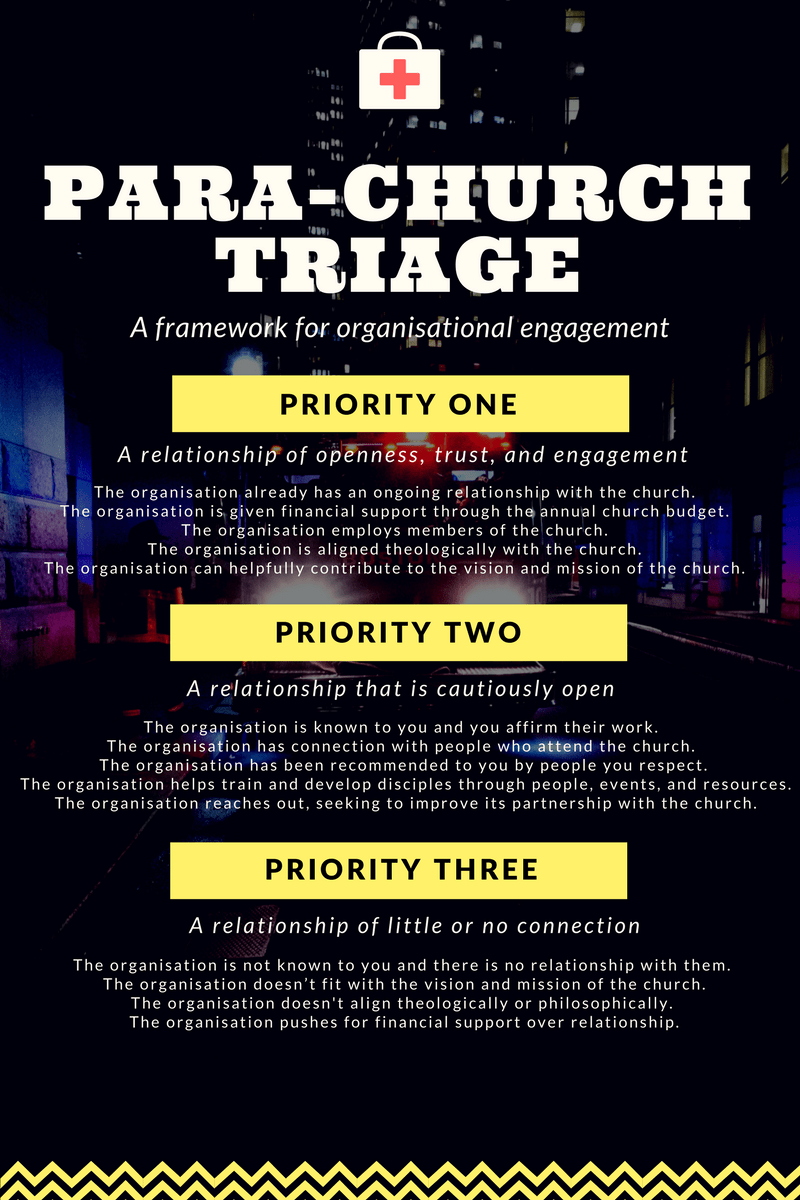
    That’s the framework, and one that I hope helps you think through this issue. It’s not an issue that’s overly appealing so I’ve created a graphic to go with this to make it that little bit more sexy.

    para-church-triage-graphic

  • Baptism and The Baggy Green

    The Australian baggy green is a significant symbol in our nation’s sporting landscape, and some would argue our Australian culture-at-large. The baggy green is held up as a symbol of sporting greatness and success, and is the embodiment of Australian cricket values and expectations.

    When a player is selected for the Australian test team they become part of a select number of people to ever do so. Upon being selected they are presented with a baggy green cap.

    mitchell-johnson-baggy-green
    Photograph: Ryan Pierse/Getty Images

    In years past this cap was picked up when the player received their kit bag for the upcoming tour. Some players were given a number of caps throughout their career and many of the ‘greats’ have long ago lost or given theirs away. But in recent time, from the mid-90s, each debutant is physically presented with their baggy green by a former Australian test great. On the morning of their first test, just after the warm-up, this player is told of the significance of the cap and what it represents. He is surrounded by the others in the team, who congratulate him on becoming an Australian test cricketer. They watch him put it on and welcome him into the fold. As cricket journalist and historian Gideon Haigh comments ‘the baggy green means a lot to the current generation of players – they are constantly being told how important it is and how great they are’.

    This baggy green is a symbol of what it means to play cricket for Australia. It is a symbol of elite performance and cricket excellence. But more than that, it is a symbol of joining the other 450 players who have played test match cricket for Australia.

    In a similar way baptism is a significant symbol of the Christian church.

    Baptism has played an important part in the history of the Christian church. Prior to the birth of Jesus baptism was practised by the various Jewish sects as an act of cleansing, for ritual purity. Jesus’ cousin, John the Baptist, led people in the practice of baptism ‘for repentance of sins’. And, Jesus was baptised himself, in order to fulfil all righteousness and share in this act with those who were to follow him in faith.

    Throughout the New Testament the followers of Jesus have continued in this tradition and symbol of baptism. After Jesus was resurrected, and before he ascended to the Father, Jesus said to his disciples, “All authority in heaven and on earth has been given to me. Go therefore and make disciples of all nations, baptising them in the name of the Father and of the Son and of the Holy Spirit, teaching them to observe all that I have commanded you. And behold, I am with you always, to the end of the age.”

    And from this time on baptism has been a symbol and rite of passage that takes place as one puts their faith in Jesus, follows him, and seeks to obey his commands.

    But what’s this got to do with the baggy green?

    First, like the baggy green baptism is a significant symbol and rite in the Christian church.

    Since the resurrection of our Lord Jesus baptism has been performed as a symbol of entrance into the Christian community. It is through baptism that Christians were recognised as believers of the Way. When we are baptised today we not only join a local body of believers, but also join with the millions who’ve gone before us in recognising Jesus as Lord and Saviour.

    Just as the baggy green is a symbol of an Australian test cricketer, a marker of their entrance into the team. So too, baptism is a symbol of a follower of Jesus, a marker in their life and faith.

    Second, like the baggy green baptism has meaning and significance.

    Through the act of baptism itself we acknowledge what Christ has done for us. When we are baptised, like many before us, we acknowledge the work of God in our lives and the reality of what Christ has done.

    Those who have been baptised do so because through his death on a cross Jesus has paid the punishment for their sin. Through his resurrection Jesus has enabled true life, and a relationship with God. And by faith, those baptised acknowledge Jesus as Lord and seek to trust and obey his commands.

    Going down into the water and coming up again is an imitation of this truth. It is a symbol of leaving behind the ways of the past and committing to a life of following Jesus.

    Just as the baggy green derives its meaning from the players of the past, the values and expectations of what it is to be an Australian test player. Baptism derives its meaning from the person and work of Jesus, who died and rose again in order for us to know God.

    Third, like the baggy green baptism is a natural part of being a Christian.

    It would be odd for a player to be presented with his baggy green and then to put it in his pocket or stick it in his kit bag for safe keeping. The baggy green is handed over and is expected to be worn. To not do so would be odd.

    In committing our lives to Christ and putting our trust in what he has done it is only natural to be baptised. To not do so would be odd. The New Testament doesn’t have a category for one who is a disciple of Jesus and not baptised.

    Those who do go public with their faith are following a rite of passage into the Christian community from ages past until now. In front of a local church congregation they acknowledge Jesus as Lord and simply follow him in obedience.

    Just as the baggy green is to be worn and acknowledges the cricketer as a test player. Followers of Jesus are to be baptised, publicly declaring that they are following in the way of Jesus and his commands.