Tag: Discipleship

  • Bible Reading In The New Year

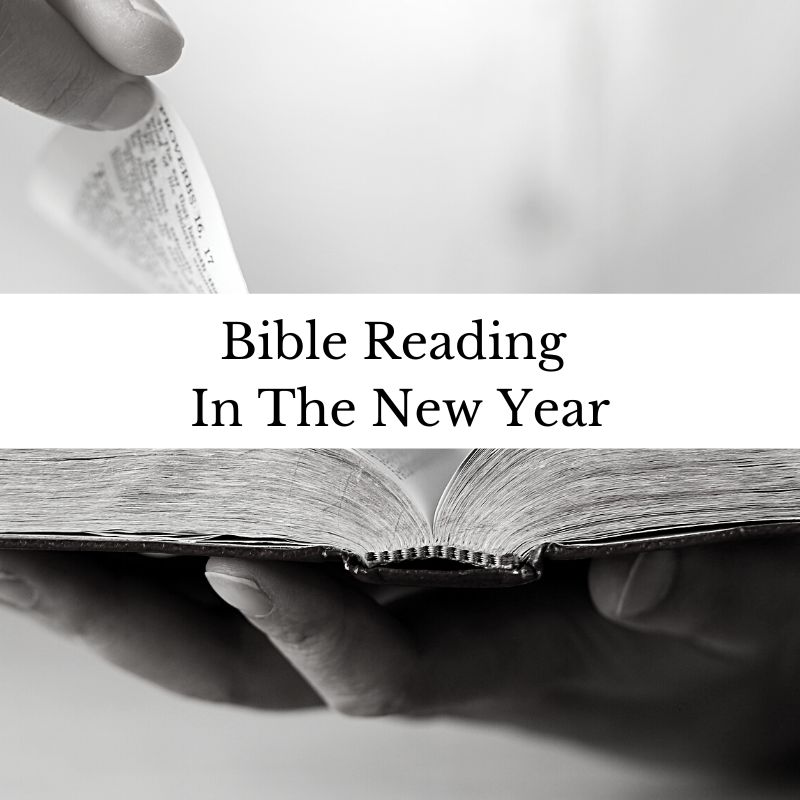
    For many years I had the goal of reading the Bible from cover-to-cover in a calendar year. I reckon I’ve completed that goal once in the last 15 years. My routine from January first was to start at Genesis 1:1 and make my way through at least 4 chapters per day. Yet, by late January I’d be stuck in Exodus reading about the plagues, the Red Sea, and the journey into the wilderness and already finding myself too far behind to catch up. 

    Perhaps this is a familiar experience for you as well.

    As one who comes from a tradition where the regular reading of the Bible is engrained from a young age, being unable to do this can trigger some sort of guilt trip. Thankfully, this need not be the case and my legalistic view of Bible reading has changed somewhat. This is not to say that my view of God’s Word has changed, only the perceived necessity to read through the entire Bible each year. 

    As I seek to worship God in the everyday I seek to engage with God’s Word in various ways and at various times throughout the day. This may involve reading a select passage of scripture, listening to worship music focussing on the words of scripture, or reading a portion of a Christian book that leads me to contemplate the ways of God more deeply. 

    The sidebar to this that I can’t help but make is that God’s Word is not on even par with a worship song or a Christian book. No other book or words written in human history is “…God-breathed and useful for teaching, rebuking, correcting and training in righteousness, so that the servant of God may be thoroughly equipped for every good work” (2 Timothy 3:16-17). It’s got to be said. 

    But still, perhaps you are like me and require some structure, some idea of what you’d like to do. In growing as a disciple, in our experience, knowledge, and follow-ship of Jesus it’s still good to have a plan or approach to scripture reading. As a regular practice of our faith, and as the year is now underway, I wonder whether a way to approach this might be to think small, think regular, and think expectantly. 

    Think Small

    Everyone has different capacities as to what they can achieve in a day or a week or a year. Often we might be surprised at how much we can accomplish when we are consistent in doing little things throughout the year. 

    I’d encourage you not to think about reading the whole Bible as one complete project for the year. Radical, I know. But instead, think about it in little chunks. Think about reading one Proverb a day and repeat it every month. Think about working through a gospel one chapter at a time and digesting it properly. Or think even smaller, contemplate 1-2 verses of Paul’s letters. Or perhaps limit yourself to 5 minutes a day for January with the goal of increasing it a minute each month. 

     It is the little done over time that produces a significant amount. You’ll be surprised at how much of God’s Word you will end up reading if you think small. 

    Think Regular

    Thinking small leads to thinking regularly. Doing the small means approaching the reading of the Bible as a consistent discipline. 

    Perhaps reading everyday is not a possibility for you, that’s OK. How do weekdays suit? How does committing to a Saturday and Sunday schedule sound? I’m not sure what’s best for you, but it is in your hands as to when and how regularly your Bible reading might be. 

    At the moment I’m probably hitting 4-5 days per week of significant reading whereby I’m seeking to connect with God and grow in him. Outside of this I am in the unique situation where I’m given the opportunity to dip into God’s Word in various ways – sharing with others, preparation for sermons, and in faith conversations with church and community members. Nevertheless, what I’ve found helpful is to have a committed time of reading that’s in the calendar or on the to-do list (and prayer is always helpful alongside this). 

    Think Expectantly

    The final idea in approaching Bible reading for this year is to read expectantly. 

    How often Bible reading can become a duty rather than a delight because we come to God’s Word not expecting to hear from him! Not expecting him to change our hearts and minds, not to conform and have our mind renewed (Romans 12:2-3). 

    Often we will find connections, greater knowledge of God and his ways, and be willing to hear from God when we come to his Word expectantly. Sure, sometimes Bible reading is hard and difficult and doesn’t make sense to where we find ourselves, yet God has revealed himself through his Word and continues to make himself known by it. It’s why part of our discipleship is to go to God’s Word and hear what he has to say to us. 

    I’d encourage you to have a go, to think small, to think regularly, and think expectantly as you approach the reading of God’s Word this year. 

  • By Faith – A Future Hope

    Hebrews 11 is one of those chapters in the Bible that is packed with so much that it takes numerous readings to grasp its various teachings. It’s the chapter where the writer outlines all those significant biblical characters of the past, and describes briefly how they lived by faith, trusting and obeying God throughout their lifetime.

    For me, stepping into Hebrews 11 is like walking into a museum. A museum with a long dimly lit corridor, with dark floorboards, and square-paned windows letting the light in. And as you walk down this corridor there are old paintings hanging on the walls. And along each side of the corridor there are white marble busts of significant leaders of history and important dignitaries sitting on top of pillars.

    This is what I think of when I read Hebrews 11.

    All these people from the Old Testament in painting or statue form, highlighting their status among the saints of the past. And with each of these saints we get a small glimpse into what they are commended for; what they have done to earn such a reputation to be written about hundreds of years after they have died.

    To extend this museum illustration further, I can imagine that next to each painting or statue there sits a little plaque and as you wander down the corridor you can walk up to each of those plaque’s and read how they lived by faith. Next to each item there is a little inscription starting with “By faith…” and flowing into their individual commendation of how they lived by faith.

    By faith Abel…
    By faith Enoch…
    By faith Noah…
    By faith Abraham…
    By faith Sarah…

    And as we work our way through this chapter we come to an editor’s sidebar. Like one of those big signs at a museum that gives you a broader explanation of what’s going on, there in the middle of this corridor stands as sign with v13-16 on it.

    “All these people were still living by faith when they died. They did not receive the things promised; they only saw them and welcomed them from a distance, admitting that they were foreigners and strangers on earth. People who say such things show that they are looking for a country of their own. If they had been thinking of the country they had left, they would have had opportunity to return. Instead, they were longing for a better country—a heavenly one. Therefore God is not ashamed to be called their God, for he has prepared a city for them.”

    These words describe how all these people we read of in Hebrews 11 died knowing there was something better for them. They lived on earth as exiles, as people who were in the world but not of it. While the land was plentiful and the descendants numerous God had promised something better. This earth and life was a prototype of something greater. They knew there was something more to come.

    This is why the writer can say in v16, “…they desire a better country, that is, a heavenly one. Therefore, God is not ashamed to be called their God, for he has prepared for them a city.”

    And this resonates with the words of Revelation 21:1-5,

    “Then I saw “a new heaven and a new earth,” for the first heaven and the first earth had passed away, and there was no longer any sea. I saw the Holy City, the new Jerusalem, coming down out of heaven from God, prepared as a bride beautifully dressed for her husband. And I heard a loud voice from the throne saying, “Look! God’s dwelling place is now among the people, and he will dwell with them. They will be his people, and God himself will be with them and be their God. ‘He will wipe every tear from their eyes. There will be no more death’ or mourning or crying or pain, for the old order of things has passed away.”

    He who was seated on the throne said, “I am making everything new!”

    We know we live in a world that is broken. People are broken, governments are broken, organisations are broken. This results in a world where bad stuff happens, stuff that is not fair for the individual and the collective.

    But here in v13-16 we are told of the future hope we can have as believers.

    As followers of Jesus we recognise the reality of a broken world. A world broken by sin but a world being prepared for restoration and renewal through the coming again of Jesus Christ. For through Christ there is the promise of forgiveness for our own sin and shame. Through Christ there is the promise of being able to live by faith in relationship with God. Through Christ there is the promise of the restoration of the world. Through Christ is the promise of life-everlasting in the renewed creation of God.

    In the same way as the Old Testament saints live by faith for what is to come, so too we live in the world as people who know there is greater to come (despite how bad it may look at times) as God prepares us for the restoration of all things.

    I’m a big fan of CS Lewis’ Chronicles of Narnia series. I really enjoy reading the whole collection every so often, and at the end of the final book, The Last Battle, there is a depiction of heaven as the various characters and animals make their way to a renewed land. Lewis writes,

    It is as hard to explain how this sunlit land was different from the old Narnia as it would be to tell you how the fruits of that country taste. Perhaps you will get some idea of it if you think like this. You may have been in a room in which there was a window that looked out on a lovely bay of the sea or a green valley that wound away among mountains. And in the wall of that room opposite to the window there may have been a looking-glass. And as you turned away from the window you suddenly caught sight of that sea or that valley, all over again, in the looking glass. And the sea in the mirror, or the valley in the mirror, were in one sense just the same as the real ones: yet at the same time there were somehow different — deeper, more wonderful, more like places in a story: in a story you have never heard but very much want to know.

    The difference between the old Narnia and the new Narnia was like that. The new one was a deeper country: every rock and flower and blade of grass looked as if it meant more. I can’t describe it any better than that: if ever you get there you will know what I mean.

    It was the Unicorn who summed up what everyone was feeling. He stamped his right fore-hoof on the ground and neighed, and then he cried:

    “I have come home at last! This is my real country! I belong here. This is the land I have been looking for all my life, though I never knew it till now. The reason why we loved the old Narnia is that it sometimes looked a little like this. Bree-hee-hee! Come further up, come further in!” (p154-155)

    A vivid piece of writing, but also a great reminder that we do indeed live, by faith, looking forward to the Holy City, a better country, a heavenly one.

  • Published: Practicing Thankfulness

    A couple of months ago I had a book review of Practicing Thankfulness: Cultivating a Thankful Heart In All Circumstances by Sam Crabtree published on The Gospel Coalition (AU) website.

    Ironically I read this while Melbourne was in its fourth lockdown, of which we’ve never really come out. So I will confess I wasn’t that impressed with the beginning of the book but as I read it more I found it did do something within me. It reminded me that there is reason for thankfulness and not simply being a grump for the situations we find ourselves in. It requires a mindset change, an attitudinal change.

    As I say in the final few paragraphs of the review:

    “So if you would like your heart to opened and exposed—perhaps even have a metal rake run over it—this book will do you a world of good.

    I will confess I didn’t like every part of it. I felt the tone lacked a certain pastoral quality, and that it was overly firm in some places where a bit more grey and grace would have been helpful. For example, Crabtree seems to write off all complaining and frustration as being ungrateful for what God has given us. He doesn’t give room for complaint and lament like many of the Psalms we read, and almost suggests we need to ignore these types of feelings, tell them to shut up, and move on. Further, there was some discussion about topics that seemed unnecessary and forced in relation to the main themes. These make moments in this book seem simplistic and reductionistic at times.”

    You can read the full review here.

  • Published: Asking The Why – What Is My Calling?

    I’ve written regularly about calling, and how to think through it.

    Recently, I was interviewed by the YMI podcast “Asking The Why”. It was a fun conversation, and hopefully helpful too. Here’s how it’s described:

    “What career path should I go down? Which relationship should I enter in to? Where should I live?

    For many of us followers of Jesus, these questions can depend on what we feel God is calling us to do with our lives. In church language today, the term calling usually refers to a Christian discovering a specific job, ministry role, or use of gifts and talents that is out there for them. But for many of us who feel like we haven’t found that special “calling”, we can sometimes feel like we are outside the will of God or failing as a follower of Christ. So how then can each of us find out what the call of God is for our lives?”

    You can also view the video here:

  • Is Mission Optional For Discipleship?

    OK, let’s be clear from the outset.

    To be a disciple is to be a student of a teacher.

    To be a disciple of Jesus is to learn from Him.

    This learning and growing process is known as discipleship.

    I imagine for the majority of those who call themselves disciples of Jesus, discipleship involves some or all of the following – meeting with other believers, reading the Bible regularly, praying, going to church, meeting with a mentor, doing a short-course on an aspect of the Christian faith, listening to podcasting preachers, reading Christian books, talking about spiritual things with Christian friends, being involved in a small group, volunteering in a ministry at church and maybe even using Christian buzz words like ‘journey’, ‘organic’, ‘missional’ and ‘emerging’.

    Most of these are excellent. They’re great and important. They help us grow in our faith. They allow us to gain a better understanding of the nature of God and the power and presence of Jesus. They help to build real and authentic (OK… another buzz word) community and inspire us into a deeper faith.

    Yet, when I look at the discipleship ‘journey’ that Jesus took with 12 young guys, I wonder if we’re missing something in the discipleship package we’re sold today. Yes they prayed together, ate together, were part of a mentoring relationship and listened to cracker sermons (from Jesus Himself!). But all of this happened within the context of a much larger picture. There was a purpose that led to something greater than their own faith development: the faith of others. AKA Mission.

    Is Mission Optional For Discipleship_

    From the outset Jesus equipped, prepared, challenged and released His followers into mission.

    It was mission-focused discipleship.

    A discipleship that was geared more towards the needs of others than their own. It was a kind of discipleship that required them to be active and to work out their faith in the daily grind. It was this kind of discipleship that grew some uneducated country fishermen into ‘missionaries’ committed to spreading the Good News to people who hadn’t heard it. Mission was not an added, optional, “Would you like fries with that?”’ extra. Rather, it was completely integrated into their discipleship. Just like your veggie patch needs light, food and water to survive, our discipleship is nurtured, fed and grown by engagement with others in mission.

    Discipleship is the vital activity of believers around the world. In fact, it’s the model of mission Jesus has given us from the start. The Great Commission in Matthew 28:19-20 emphasises the making of disciples as the primary activity for believers. Jesus Himself showed us the way as He led His disciples, while in Acts and throughout the rest of the New Testament believers continued to grow their faith in all the different places and cultures they lived in.

    I wonder what part mission plays in your understanding and experience of discipleship? It may mean joining a new sporting team or club or being more intentional with your time, resources and language at uni, work or mother’s group or engaging with other cultures to see where God is already working and how you might be able to join Him.

    If the job that Jesus left us with is really about being disciples who make disciples, then it applies whether we are here in Australia or in a far corner of the world. If we follow Jesus’ model of discipleship, then no matter the number of books we read, sermons we listen to or mentoring sessions we slot into our week, something will always be missing if it isn’t wrapped up in mission. And while this can seem impossibly daunting, even simple things like starting a soccer match or joining a Tai Chi class can be used by God not only to make more disciples but to help deepen our own experience as disciples as well.


    Originally published in Resonate (ed. 20), a publication of Global Interaction