Tag: Faith

  • 11 Things: Life With Jesus

    A while ago I wrote a post about what I wished I knew when entering youth ministry. This is the beginning of a series dedicated to elaborating each of those eleven points. Enjoy.


    Some would like to think that being surrounded by the programs, activities, people, books, studies, services, teaching, and social engagements that being a Youth Pastor brings means that life with Jesus would be easy.

    Some would like to think that because of the all encompassing nature of being a Youth Pastor, rubbing shoulders with the things and people of God, then life with Jesus would be a breeze. That it would be a constant joy to be involved in so many so called ‘spiritual things’ that a closeness with God would naturally occur.

    Some would like to think that a relationship with God would be so easy to sustain through the conversations, events, and teaching opportunities each week. After all, there isn’t the monotony of the 9-5 existence (is that a thing anymore?) and so connecting with God during the day will occur without too much effort.

    Um.

    Wrong.

    Perhaps at one time I would’ve thought it’d be easier to maintain a great relationship with the Lord while doing ministry too. Nothing seems to be further from the truth.

    It’s hard.

    Youth Pastors, Young Adult Pastors, Student Pastors, they aren’t good at telling people this. They aren’t good at telling people they struggle with faith sometimes. They aren’t good at telling people they lead that they struggle to read the Bible. That they find it hard to bring teaching to life for the students they disciple. They find it hard to confess that the passage they prepared for small group this week was the only part of the Bible they’ve read this week. They find it hard to admit that their prayer life only happens at church things, five minutes before their next meeting or event.

    There is the constant pull to be using our time for what seems to be ‘active ministry’. For many Youth Pastors the actual programs and events of the church take up the allocated time allowance they’re paid for. Outside of this there needs to be time found to do adequate preparation, planning, administration, and hopefully time to counsel people as well. The pressure can seem overwhelming, as there seems little time to take stock, reflect, and breath.

    Oh, and in all of this connect and commune with God.

    Every Youth Pastor knows that connecting and communing with God is their main priority. The difference is in its application. Every Christian knows the need to commune with God regularly. The difference is in its application.

    Youth Pastors are no different to anyone else in seeking to walk with God closely in their life. The difference is that because they are surrounded by issues of faith and spirituality each week one would think life with Jesus would be easier.

    I suspect we’ve all heard of the date night for couples. This is usually a dedicated week night for the couple to spend time on their own and without any distractions. They may go out, they may stay in. While the date night is great it would also be wrong to believe that this is the only connection for the week. No relationship is sustained because of a two-hour period one night a week. It’s an added extra. It’s a more intentional time, but not one that takes the place of regularly plodding with each other while doing dishes, checking in at the end of the day, or driving to various engagements.

    It’s the same when we consider our relationship with Jesus. At times in our walk with Jesus we might be prone to thinking that we simply need to have a date night with Jesus. That is, simply spend a couple hours one night each week and this will bring some sort of sustainable relationship. Unfortunately this is not the case. As those who seek to help lead others in the faith we should be striving to walk with Jesus each and every day.

    The priority is there but the application can be lacking. And it’s in the application that makes the difference.

    For Youth Pastors it is simply a must to structure our time and day to help our relationship with Jesus. Out of this we can then disciple and lead others in the faith.

    Depending on the season I’ve attempted to do a variety of things to help sustain my faith and life with Jesus. Here are a few suggestions, in particular order, if you care to read them.

    1. Have a quarterly ‘Read & Reflect Day’

    This is a whole day dedicated to reading scripture, praying, journaling, and spending time in silence. During this day I usually take time to run through the calendar of the last three months, writing down everything I’ve achieved. I then turn to the coming three months, writing 3-5 specific goals to aim for.

    2. Meet up regularly with someone older in ministry

    I’ve generally tried to meet up with people who I respect and who I believe I can learn from. I’ve gone directly to them asking for an hour or so of their time and bring specific topics of discussion to the meeting. Some will call this mentoring, I’d prefer to stick with discipling. If this occurs once every eight weeks or so then that’s great.

    3. Structure my Bible reading

    I don’t understand people simply opening up their Bible’s and reading whatever they land on. I at least have a plan and seek to work through a book, at least one chapter at a time. For deeper study a commentary alongside this is helpful.

    4. Write people’s name on a prayer list

    Just grab a piece of paper, write a name that comes to mind, note down a little something about their life you can pray for. Then actually dedicate a set amount of time to praying for that list of people.

    5. Set a phone alarm as a reminder to pray

    One thing I really appreciate about observing other Christian traditions, and even Islam, is their commitment to praying at set times of the day. Setting your alarm at certain times in the day will help you to stop and remember to pray. If this is done over a period of time a certain rhythm begins to form.

    6. Listen to different podcasts

    Listening to sermons all the time can get a bit much, but I’ve found listening to a variety of different podcasts can help in life, faith, and ministry. I have podcasts that are for fun and enjoyment, for learning and education, for news and culture, and for faith and ministry.

    7. Listen to music

    I know some people really enjoy listening to worship music and find themselves refreshed in doing so. Search Spotify for the ‘Hymns for Hipsters’ playlist. You won’t need anything else.

    8. Write in a journal

    Writing your prayers or thoughts down in a notebook might sound wussy to you. It’s not. All the hipster pastors do it. But the key here is to understand that by writing these prayers and thoughts down will allow you to slow down. In doing this you can take time to pray and gain a clarity of thought you wouldn’t otherwise.

    9. Read old, dead authors

    Read Spurgeon – He’s fun. Read Calvin. Read Luther. Read Sibbes. Read Edwards. Read Augustine. Read Wesley. Read Whitefield. Read Lloyd-Jones. Read Stott. Read Carey. Read Taylor. Read Barth. Read Bonhoeffer. Read Lewis. Read Owen. Read Aquinas. Read Jay. Read Paton. Read Simeon. Read Gregory. Read their sermons, their writings, or both.

  • Growing Young – Prioritize Young People (and Families) Everywhere

    This is post six in a series of reflections on the book Growing Young: Six Essential Strategies To Help Young People Discover And Love Your Church. For an introduction to the series please read part one and continue reading the reflections in part two, three , four and five.


    A church that confines the involvement of young people to their youth group won’t be a church that young people or emerging adults hang around too long. The whole church needs to be a place where young people and their families can participate.

    This chapter in Growing Young makes the case for churches to focus on young people and their families in everything they do. Whether it be the Sunday service, the children’s ministry, the working bee, the missions team, or the cleaning roster. In every area of church life the question to be asked is: How can young people participate? 

    yja2so4srtmdlfrskd5t_moulin-fisk

    This is not just a superficial or patronising question. Well, it’s not meant to be. It’s a question that needs to be asked by churches and ministry leaders not so more young people come to the program or event but so that young people have active involvement in leading and shaping it.

    This question becomes a church culture question: How is the church thinking about the participation of young people and families in the life of the church? 

    “How do churches that grow young make youth and emerging adults a greater priority? When they think about budget, strategy, worship planning, programming, community life, theology, and all other aspects of church life, they think about young people. They intentionally pay attention.”

    One of the most significant comments in this chapter is about the role of parents in a young person’s faith. It has been and continues to be found that “…parents still carry the most important weight in their kids’ faith development.”

    This begs the question: What are we as Pastors and churches doing to encourage the parents to discuss faith within the home? 

    Only three days ago I was in a conversation about how churches have a big focus on children’s and youth ministries, as well as a support focus with older people, but those going through the middle season of life, the parents and adults, are basically left to there lonesome.

    “Research continues to affirm that the best predictor of a young person’s faith is the faith of their parents. That means the role of ministry leaders who care about kids also must include the care, equipping, and formation of parents and families…According to pastoral leaders, when parents are intentional about faith building outside of church, overall faith maturity and vibrancy within the congregation rises even more.”

    It’s a no brainer for those in children’s, youth and family ministry to begin focusing more on the parents than the kids themselves. Continue to work and have programs in these areas but begin the culture shift through encouraging and engaging parents in their role as faith-builders.

    So what could this look like in the life of a youth ministry?

    • Send an email or message that talks about what aspect of faith the youth ministry is focussing on at the moment.
    • Give parents a few questions to help them initiate faith conversations in the home.
    • Suggest a reading plan for the family to do together.
    • Run an afternoon tea where all the parents are in the room and they get to chat and find support with others in the same situation.
    • Start talking about how you are a church or ministry that partners with parents.

    In regard to the other parts of this chapter, seeking to prioritise young people and families in the church. It might be a good time to review the ministry structure and evaluate where young people are involved and where they are not and what needs to be changed.

    I have to say that this mind-shift is something that can take a bit of time. It is a cultural shift for a church focussed on a programmatic approach to children’s and youth ministry with little engagement of parents.


    Here are the links to the series of reflections on the book:

    1. Growing Young
    2. Growing Young – Keychain Leadership
    3. Growing Young – Empathise With Today’s Young People
    4. Growing Young – Take Jesus’ Message Seriously
    5. Growing Young – Fuel A Warm Community
    6. Growing Young – Prioritise Young People (And Families) Everywhere
    7. Growing Young – Be The Best Neighbours
    8. Growing Young – Growing Young In Your Context
    9. Growing Young – Final Reflections
  • A Radically Ordinary Faith

    There is much written about the radical nature of following Jesus.

    The call to come and follow Him.

    The call to take up your cross.

    The call to be a radical disciple.

    Whatever way you put it Christianity can be portrayed as some type of hyper-enthusiastic, always active, and amazingly awesome life.

    And then you have to clean the dishes currently lying in the sink, change the babies nappy, make your bed, or put the rubbish out.

    That’s not amazing.

    That’s mundane.

    That’s ordinary.

    A Radically Ordinary Faith

    And what do you do with a verse like 1 Thessalonians 4:11, “…make it your ambition to lead a quiet life: You should mind your own business and work with your hands, just as we told you…”?

    Sounds pretty ordinary to me.

    There can be a tendency to believe we’re not ‘radical’ enough in our faith,  that we’re not doing enough radical stuff with our lives. The implication of this is that we’re not being obedient. We’re not living up to the kind of discipleship required of us as followers of Jesus.

    But when we think this way we begin to diminish the life God has given us.

    If God has created us, made us who we are, and has us in the place we currently find ourselves in, then perhaps we can trust that our faith is ‘radical’ enough.

    This isn’t to be used as an excuse for laziness, a reason to neglect serving others, and avoiding any form of growth in our faith. But, our faith must be something that relates to and be relevant to our daily lives.

    I always find it inspiring to hear of the adventures and opportunities missionaries have as they serve God overseas. It’s inspiring to see people get involved in missions, church planting, and other evangelism initiatives. Every now and then I get an email from a university worker working with international students. The stories that are shared are quite incredible, hearing of the way people are attracted to hearing more about faith and understanding the Bible for themselves. Some of these stories are very encouraging.

    And so it’s inspiring to see the work people are doing, and even more exciting to see people become interested in knowing more about Jesus. But I’m not sure they’d tell you they’re being radical in their faith because of the work they’re doing, and neither will a missionary or a pastor. The work is often very ordinary.

    And so what does a radical faith look like for freshly minted teaching graduate who is in the middle of a long first year, struggling to find time to read their Bible because the nightly preparation takes so long. Or the plumber who has been dealing with crap all day, trying to spend time with the family among the household chores. Or the mum who looks after the children, who is waiting for her partner to arrive home from work in order to help her out.

    What does ‘radical’ faith mean for them?

    It may be me in my most cynical moments, where I totally turn deaf to this call to be radical, but I’m not sure whether telling people to be more radical is helpful. To me, it adds another burden, another layer of guilt, where I end up feeling my faith isn’t good enough and I need to do more. I see the need to make the call for people to be more radical in their faith, many of us aren’t. But at the same time, what does it mean for my faith to be relevant in the mundane?

    What do you think?

  • Evangelical Truth by John Stott

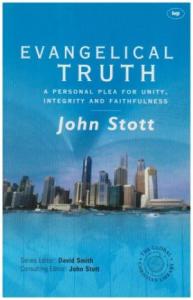
    evangelicaltruth stottJohn Stott and his ministry is well known and well respected throughout the world. He has written numerous books and articles, and up until his death in 2011 he was considered a worldwide Christian leader.

    In this little book of 149 pages Stott explains the essentials of the Christian faith and makes a strong plea for unity. Here, toward the end of his life, Stott continues to write with great insight, making you think about the primary and secondary issues within the Christian faith. There is constant debate between Christians, now more than ever it seems, over all sorts of theological and social issues. Stott believes these issues should be discussed, but at times there is a need to lessen the vigour and closed-handedness of these debates.

    Evangelical Truth has five chapters, including the introduction and conclusion. The three main chapters cover the following areas: the revelation of God, the cross of Christ, and the ministry of the Holy Spirit.

    In the introduction Stott gives a brief rundown of his definition of evangelicalism. He pitches this definition against that of fundamentalism and liberalism. Within this chapter he also gives information about evangelicalism has evolved and its main historical turning points within the church.

    The chapter on revelation, as expected, is based on the revelation of God through the bible. Stott speaks of general and specific revelation, progressive and personal revelation, inspiration, authorship, biblical authority. He touches on the debate between the sufficiency of scripture and also the inerrancy of scripture. Here Stott makes his stand against using the term ‘inerrancy’.

    Chapter three is essentially the gospel. It is the message of the cross well explained. He gives a helpful explanation of ‘justification by faith’, and grapples with what disciples and mission are. It is the shortest chapter in the book but also the most concise and straight-forward. It was good to hear the gospel again.

    A final chapter on the ministry of the Holy Spirit makes Evangelical Truth truly trinitarian. The topics of assurance, holiness, purity, community, mission, and hope are all covered. Stott is really telling the reading of how the Holy Spirit works; in the New Testament and his continuing work today. This is a good chapter and well explained.

    To conclude, Stott summarises his point and pleads with the reader to be united with Christian brothers and sisters around the globe. He calls for Christians to endure hardship and wants to be an encouraging voice within that. You can really see in the writing that Stott has a wealth of experience and knowledge of the gospel, is passionate about the things of God, and wants Christians around the world to be united under the gospel. He encourages all believers to lead with humility and to love one-another with Christian love.

    A great primer of the Christian faith. Get on it.

    John Stott, Evangelical Truth: A Personal Plea For Unity, Integrity and Faithfulness (149 pages; Leicester, UK: Inter-Varsity Press), 2003.