Tag: Jesus

  • King Jesus: The Leper

    King Jesus: The Leper

    I had a skin condition for many years.

    I was told it was leprosy. 

    All over my body, all over my skin, were sores and disease and discolouring. You could see it on my arms, on my face, on my body and my legs. My skin had bumps and big wart-like growths. My fingers were distorted, and some of my toes had disappeared. I had lost feeling in them long before that. 

    In speaking to others, no one remembers a time when I didn’t have this disease. I don’t even remember when I had clean skin. 

    Because of this disease I was an outsider. I’d been outcast from the community a long time ago. I was separated from everyone; my friends, my family, my neighbours. When people saw me they would walk by me. They didn’t deign to look at me, let alone interact. If anything they might insult me as one not worthy of life. All of this would remind me of my position in life. 

    People who knew me and my family would blame me for this condition. It was like I’d done something wrong, or something my parents had done wrong in those early years. 

    And so I would just shuffle from place to place. I would sit alone. I would eat alone. No one would reach out to me, no one would talk to me, no one would come close. 

    There was no cure for this condition. There was no ointment that could help my sores. There was no medicine to help the skin. I didn’t even have a place to go to wash and get clean. 

    When others would go to worship at the synagogue I was unable to go. I wasn’t allowed. I couldn’t worship God like others, and instead sat wondering whether there was a God. 

    I was forever unclean. 

    But then I heard of this man called Jesus. 

    Jesus came to the village. The word on the street was that he was one who could heal. He had healed others before and it made me wonder if this Jesus could heal me too.   

    I took courage. He found out where he was and approached Jesus. I knelt before him and asked, “If you are willing, you can make me clean.” I said this with real belief, real openness, and honesty.

    Jesus looked down upon me and had compassion for me. Everyone could tell, you saw it in his eyes. Others around thought Jesus was indignant and annoyed for being interrupted, but that wasn’t the case. Jesus had real pity on me. 

    And suddenly, for the first time in who knows how long, I felt the touch of another human being. Jesus reached out, not concerned about his own uncleanliness, and took a risk and said he was willing to make me clean. 

    You wouldn’t believe it, but this is what happened. Right away I was clean and healed and the disease was gone. I couldn’t believe it. No one could believe it. My skin changed, the growths were gone, I didn’t scratch or itch. Even my fingers and toes were all back and in working order. 

    I was so happy. I was smiling and laughing and full of joy. 

    Jesus not only cleaned me on the outside, radically changing my life, but he also made me clean with God. 

    This Jesus made me clean and whole. 

    I thought my greatest problem was my skin. I thought that if the sores disappeared, the isolation ended, that I could just walk back into town then everything would be right again. This is what happened but it’s only part of the story. What I came to realise was that my greatest problem wasn’t my skin, it was my separation. Not just from people but from God. 

    When Jesus reached out and made me clean he did more than restore my body. He restored me to worship. He restored me to a relationship. He restored me to God.


    King Jesus: A Series in Mark’s Gospel
    Part 1: King Jesus: The Beginning of The Good News
    Part 2: King Jesus: The Messenger
    Part 3: King Jesus: The Love of God the Father
    Part 4: King Jesus: The Kingdom of God
    Part 5: King Jesus: The Calling of The Ordinary
    Part 6: King Jesus: Place and Purpose
    Part 7: King Jesus: The Authority Behind The Words
    Part 8: King Jesus: The Power of Jesus
    Part 9: King Jesus: The Leper
    Part 10: King Jesus: The Paralytic

    Part 11: King Jesus: Restoration From Chaos

  • King Jesus: The Power of Jesus

    King Jesus: The Power of Jesus

    I am yet to have been interrupted so abruptly like Jesus was when teaching here in Mark 1:21-29, and I hope I never will be! But in this passage a man with an unclean spirit disrupts the service in the synagogue with a loud cry and shouts,

    “What do you want with us, Jesus of Nazareth? Have you come to destroy us? I know who you are — the Holy One of God!” (Mark 1:24)

    The Confession

    Aside from what might have been a rude and surprising interruption, as it would be in any setting such as this, this was a particularly telling event in the early ministry of Jesus. The religious leaders and the crowds are amazed by Jesus but haven’t quite worked out who he is. This unclean spirit, however, knows exactly who he is dealing with. It names Jesus’ hometown. It names Jesus’ identity. There is no confusion in the spiritual realm about who Jesus is or the extent of his authority

    Immediately Jesus shuts this down. He says, “Be quiet! Come out of him.” And it does. This is not because of embarrassment but more for the sake of keeping things quiet until his time to announce his full self reaches its proper time. 

    This isn’t the last time in Mark’s gospel that Jesus encounters and casts out an impure or demonic spirit; there are five instances in Mark alone. What it tells us is that King Jesus rules and reigns over all that is spiritual. There is no power in the heavenly or earthly realms that is outside his authority.

    The Reality of Spiritual Warfare

    I don’t take the view that behind every illness or every struggle with sin there’s a demon lurking. You might know people who see evil under every rock, or every challenging circumstance needs to be exorcised. That’s not the picture Mark is painting. But Paul, in his letter to the Ephesians recognises the reality of the spiritual realm when he says, “our struggle is not against flesh and blood, but against the rulers, against the authorities, against the powers of this dark world.” (Ephesians 6:12)

    Satan is real. The evil one’s fingerprints are visible in the brokenness of our world, in the pull of temptation, and in the pattern of suffering and deception that run through our human experience. The New Testament is honest about the measure of power he holds and it is the reality of our earthly existence.

    However, as we read in the first chapter of Ephesians, the battle has been won!

    “God exerted his power when he raised Christ from the dead and seated him at his right hand in the heavenly realms, far above all rule and authority, power and dominion, and every name that is invoked.” (Ephesians 1:20-21)

    This battle is not won because evil doesn’t still push and prod, but because through the death and resurrection of Jesus, the enemy has been decisively defeated. The prince of this world will be driven out (John 12:31). The cross is God’s power on full display.

    As 1 Corinthians 1:18 puts it: “the message of the cross is foolishness to those who are perishing, but to us who are being saved it is the power of God.”

    Authority You Can Trust

    The power of God is clearly here at the beginning of Jesus’ ministry. It’s on display in our world, as the Lord calls people to himself, and those whose hearts are drawn to the light. And, it is on display through the cross on which he died. 

    Be assured of the authority of Jesus in your life and in our world, no matter the chaos. 


    King Jesus: A Series in Mark’s Gospel
    Part 1: King Jesus: The Beginning of The Good News
    Part 2: King Jesus: The Messenger
    Part 3: King Jesus: The Love of God the Father
    Part 4: King Jesus: The Kingdom of God
    Part 5: King Jesus: The Calling of The Ordinary
    Part 6: King Jesus: Place and Purpose
    Part 7: King Jesus: The Authority Behind The Words
    Part 8: King Jesus: The Power of Jesus
    Part 9: King Jesus: The Leper
    Part 10: King Jesus: The Paralytic
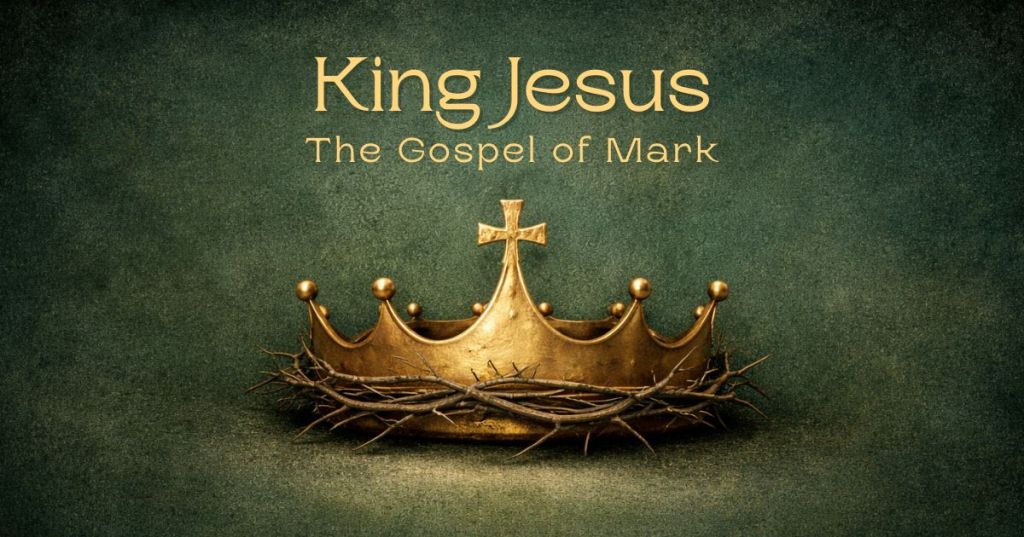
    Part 11: King Jesus: Restoration From Chaos

  • King Jesus: The Authority Behind The Words

    King Jesus: The Authority Behind The Words

    Have you ever been in a room when someone speaks and the atmosphere simply changes?

    Not because they were loud or theatrical, but because there was something behind the words. Weight. Clarity. An authority you couldn’t quite put your finger on but couldn’t ignore either.

    Jesus the Teacher

    In one of his early ministry moments Jesus is given the opportunity to teach in the local synagogue (Mark 1:21-39). And while we’re not told what he taught, we’re told how it landed on his audience.

    “The people were amazed at his teaching, because he taught them as one who had authority, not as the teachers of the law.” (Mark 1:22)

    Now these teachers of the law were learned men. They had spent their lives studying the scriptures and traditions of Israel. Their teaching method, however, was to essentially quote authorities, past rabbis and respected interpretations. They may have dealt with the text of scripture a little, but they grounded their own authority on the teaching of others. It’s built on the stilts of others.

    Jesus doesn’t do this when he teaches. He doesn’t borrow authority from others. Instead, he teaches as someone who had firsthand experience, he teaches as someone who knew what he was teaching.

    Preaching with Power

    There is something recognisable for those of us who have sat under preaching that carries a particular anointing of the Spirit. The message lands right where you are. It speaks exactly to what you need this week. It reveals more of the scriptures to you in a compelling way. It is a sermon that grabs your attention more than usual. This is the Word of God speaking through a person as they preach. This is the Holy Spirit working through the Word of God.

    Like an archer with an arrow, the Word of God pierces the heart and soul. And it is Jesus who teaches with this kind of presence and authority.


    King Jesus: A Series in Mark’s Gospel
    Part 1: King Jesus: The Beginning of The Good News
    Part 2: King Jesus: The Messenger
    Part 3: King Jesus: The Love of God the Father
    Part 4: King Jesus: The Kingdom of God
    Part 5: King Jesus: The Calling of The Ordinary
    Part 6: King Jesus: Place and Purpose
    Part 7: King Jesus: The Authority Behind The Words

  • The Scandal of Grace

    The Scandal of Grace

    Scandals are usually thought of in negative terms like the sports star who is caught out or the celebrity news on the gossip pages. It’s negative, possibly something immoral to the world, and breaks the internet for a day or two. 

    In preaching through the book of Jonah recently I’ve continued to have it pressed home to me just how scandalous the grace of God is. God’s free gift of salvation through Jesus Christ offered to all who receive it is a scandal. Scandalous. It sounds odd to hear as we never name it as such, but it really is. 

    In Jonah 4 we find the prophet outside the city of Nineveh, sitting at a lookout point, watching and hoping that God will bring fire and sulphur down on this city like he did on Sodom and Gomorrah. Jonah has just preached his short, reluctant sermon to the Ninevites, seen an entire city turn from its evil ways, and watched God relent from the judgement they deserved.

    But Jonah is furious. He’s so angry. You’d think he’d be happy, after all, he is a missionary! 

    He says to God in verse 2, 

    “I knew that you are a gracious and compassionate God, slow to anger and abounding in love, a God who relents from sending calamity.”

    Jonah knows exactly who God is. He knows his character and he has experienced the breadth and depth of that tender mercy of God himself. He was rescued from drowning, delivered from the belly of a fish, and given a second chance when he had run as far as he could in the opposite direction. God showed grace to Jonah, and ironically, when that same grace is extended to Nineveh he cannot bear it. 

    It’s a reaction we might understand ourselves. The Ninevites weren’t just a bunch of foreigners Jonah happened to dislike. These were the Nazis, the al-Qaeda, the ISIS of the ancient world. The Assyrians were vicious, brutal, and violent. They had God’s people in their sights and everyone knew it. Within a generation they would conquer the northern tribes of Israel (2 Kings 17:6). Jonah knew what these people were capable of and he seemed to know what was coming.

    Yet, God showed them grace anyway.

    This is the scandal.

    This event and the story of Jonah asks a question of us, it turns the mirror toward us and asks, “How far does our love and grace really extend?”

    Perhaps as an illustration we might think of that Navy Seal team who was brought together to take out Osama bin Laden all those years ago. Let’s imagine that instead of this team the US President sent a crack evangelist team to convert him. And in so doing they didn’t kill him, but they reached him with the good news of Jesus. Let’s say he repented, placed his faith in Jesus, and became part of God’s family. 

    How are you going to respond to that? 

    If you feel a twinge of discomfort, anger even, while reading that then you know exactly how Jonah felt sitting outside Nineveh.  

    The scandal of grace is that God’s compassion and mercy is open to the most ghastly serial killer, the most despised paedophile, the rapist, the war criminal, the dictator, the murderer. If I’m honest, there’s a part of me that is angry at God right now, just like Jonah. It’s not fair. It doesn’t feel fair to respond to such evil and wrongdoing with grace. It’s outrageous. My human understanding struggles to believe this.

    Alongside this scandal of grace we also need to hold onto something. God is not letting anyone off the hook. He is not being unjust. In fact, in order to even offer this grace, God provided his Son Jesus Christ as the one who absorbed the full force of the justice and judgement that is rightfully deserved by all who have sinned, all who have done evil, all who have broken God’s law and God’s ways (Isaiah 53:5; Romans 5:8). Every murderer and rapist, every liar and adulterer, every person consumed by anger or greed or pride — the judgement they deserve was placed on Jesus where God dealt with evil fully and finally at the cross.

    It is at the cross where the grace is offered and it is at the cross where it remains. This isn’t cheap grace. It’s not grace that ignores wrongdoing. But it is costly, blood-bought grace that has dealt with sin at its epicentre and is now extended by invitation to all people everywhere.

    This is why we call it amazing grace. This is why I’m calling it scandalous grace. 

    God’s final question to Jonah, “Should I not have concern for this great city?”, is a question that exposes the limits we place on grace. It exposes the idols we carry in our hearts. It is that attitude of silently deciding others don’t deserve it. 

    In Luke 15 Jesus tells a story along similar lines. A father opens his arms and offers grace to a son who has wasted everything. Standing outside the celebration, unwilling to go in, is the elder brother who has been faithful and dutiful all his life. And there he stands furious that grace has been shown to someone who in his view simply doesn’t deserve it. The father comes out to him and says: everything I have is yours, but one who was lost has been found. 

    Like the book of Jonah, the parable of the Prodigal Son ends without answer. The scandal of grace toward the Ninevites and the younger brother is the same grace that God gifts us and is ours to receive. His arms are wide open. 

    The mirror has turned toward us, and the question remains, “How far does our love and grace really extend?”


    More Than: A Series in Jonah
    Part 1: More Than A Mission You Can Refuse
    Part 2: More Than Running Away
    Part 3: More Than A Prayer
    Part 4: More Than A Second Chance
    Part 5: More Than Anger
    Related: The Scandal of Grace

  • King Jesus: Place and Purpose

    King Jesus: Place and Purpose

    There must have been something deeply compelling about Jesus.

    When he calls his first disciples in Mark 1:16-20 his authority is already evident. We’re not told these disciples spent time thinking about whether they should follow, or talked to Jesus about what following him would mean, or negotiated terms and conditions. They simply left their nets and followed him.

    Mark 1:17-18 is what Jesus says to Simon (Peter) and his brother Andrew, the first two disciples:

    17 “Come, follow me,” Jesus said, “and I will send you out to fish for people.” 18 At once they left their nets and followed him.

    Evidently the call of Jesus is not easily ignored.

    His call to follow him is powerful and with a purpose.

    Jesus doesn’t invite these guys for a short stroll along the shoreline and back again. You know, one of those walks you might have on a hot summers evening while walking the dog and talking to your spouse. Instead, Jesus is calling them to place him over their work, their family business, their security, their future plans, and whatever they’re thinking about to come and follow him. Jesus is calling for total allegiance. He’s calling them to follow him with their whole lives, their whole selves.

    Dietrich Bonhoeffer once wrote, “When Christ calls a man [or woman], he bids him come and die.” In this he means that discipleship involves dying to self and living for Christ. Just as Jesus himself says later in Mark, that whoever wants to follow him must deny themselves, take up their cross, and follow (Mark 8:34–35).

    This call is life changing (as we’ve discussed previously).

    But it also comes with a purpose.

    Jesus tells them they will become fishers of people. (or fishers of ‘men’ in the humanity sense if you would prefer).

    They are drawn into mission. They are to participate in gathering others into the kingdom through the good news and calling them to repent and believe.

    This purpose still stands. It is still our purpose as followers of Jesus too.

    As followers of Jesus we are not only saved into his kingdom, but we are also sent into his mission. In our own settings, relationships, and practices we are part of his work in drawing people to himself.

    Where might Jesus be calling you to follow him more fully? Remember, he’s asking for your whole heart, your whole self. We are to place him at number one.

    What part of life might need to be more fully under his lead and into his purposes for the world?


    King Jesus: A Series in Mark’s Gospel
    Part 1: King Jesus: The Beginning of The Good News
    Part 2: King Jesus: The Messenger
    Part 3: King Jesus: The Love of God the Father
    Part 4: King Jesus: The Kingdom of God
    Part 5: King Jesus: The Calling of The Ordinary
    Part 6: King Jesus: Place and Purpose