Tag: Jesus

  • Day 7 – You Are Saved

    “For you are saved by grace through faith, and this is not from yourselves; it is God’s gift—not from works, so that no one can boast.” (Ephesians 2:8-9)

    We’ve been looking at the guts of the Christian faith over the past week and now come to this idea of ‘being saved’. I don’t tend to use the term ‘saved’ when talking about my identity and faith. I know it’s often used in movies and shows that depict Christianity and churches. It is a term used by a generation that were all about having people ‘saved’ at big faith rallies and events. And occasionally, you may still hear it in conversation between Christians when they are talking about people, ‘whether they are saved or not’. It’s just a good old Christianese word.

    To say that ‘you are saved’ is to say that you have salvation. As Christians, we believe we have attained salvation because of what God has done for us on the cross.

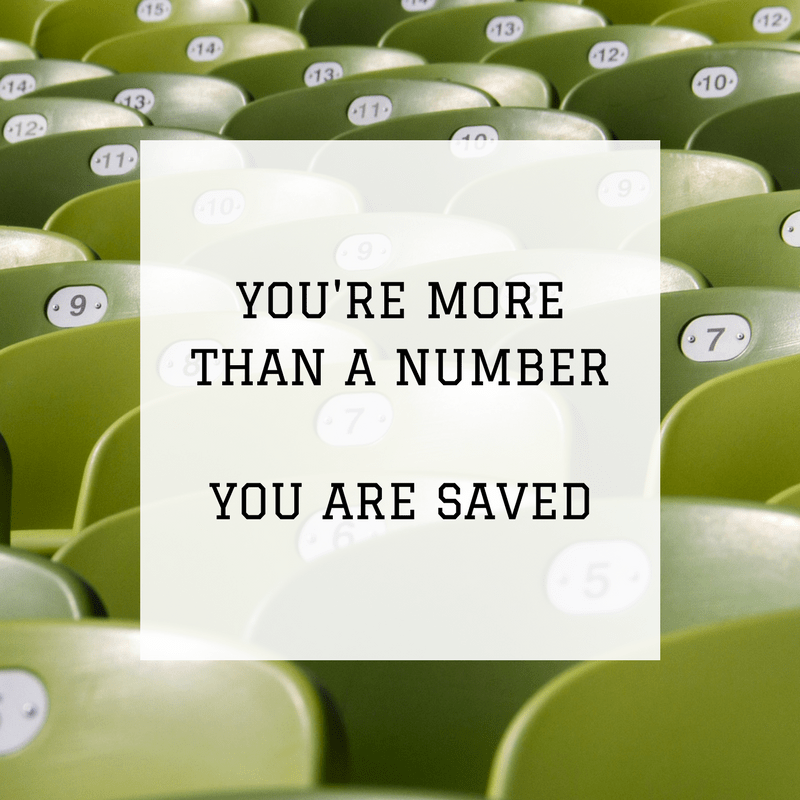
    You're More Than A Number - You Are Saved

    The dictionary defines salvation as, “the act of saving or protecting from harm, risk, loss, destruction”. And when we seek to define it in faith terms, it means that we are saved or protected from the judgment and consequence that we are under due to sin. Some might even go as far as saying that we have been saved from a particular place, hell.

    I imagine we can all relate to what it means to be saved or protected from harm.

    I remember a cousin of mine struggling to swim in a pool when we were kids. After she’d slipped off the step she found herself in a panic, thrashing around in the water. One of the adults around, my mum I think, saw what was happening and quickly grabbed her by the hair and yanked her up.

    We would say she’d been saved from harm wouldn’t we?

    I wonder if you can think of a time when you were saved from harm? Perhaps it was crossing the road without looking. Perhaps it was while you were climbing a tree. Perhaps it was swimming yourself.

    Throughout the storyline of the bible we read of the constant effort people go to in order to attain salvation. To be saved.

    Once Adam and Eve disobeyed God’s instruction to not eat of the tree there has been a need to find salvation. The initial judgement they faced was being booted out of Eden, their disobedience had physical consequences. However, there were further costs for them, further costs which had eternal consequences. In order to find salvation many people throughout the Old Testament seek to make good their bad by providing sacrifices and avoiding mistakes and errors in their life. They don’t want to face the judgment and wrath God has toward their sin and so go to extraordinary lengths to avoid actions that disobey God.

    It’s like knowing the curfew your parents have placed on you for the party. There will be consequences if you disobey. We get that right. But, to make this even more legalistic, like the people of the Old Testament, we would make sure we are home well before the curfew to avoid any sort of possibility of being late. We might even leave 30 minutes earlier so we know we’re back home in good time. (Probably not realistic I know, but I hope you get the idea).

    Some people continue to operate this way when they think about Christianity.

    But, Christianity is not about law and legalism, it is about faith and freedom.

    To be saved, to find salvation, is something that we are given by God. God, in his wonderful grace, has given us salvation. He has saved us from his own judgment and wrath through his Son Jesus.

    Just as we have explored the forgiveness that comes through Jesus and the cross. Just as we have explored being bought back to God through Jesus and the cross. Just as we have explored the love God has for us through Jesus and the cross. So too, we find another aspect of our faith is centred around being saved from judgment and wrath through Jesus and the cross.

    Here we can say that Jesus saves.

    Here we can say that we are saved.

    Praise God.

    FOR REFLECTION

    • Can you remember a time where someone saved you from harm or injury?
    • What picture do you have of God’s wrath and judgment? It’s not often we think on this, mainly because it’s not a particularly appealing thought.
    • Do you recognise the need to be saved from God’s judgment and see how Jesus achieves this?

    This is part of a devotional series called You’re More Than A Number. To understand the purpose of these posts then please read the series introduction. If you’d like these delivered to your inbox, please sign up to follow this blog or my FB page.

    1. You Are Created
    2. You Are Sinful
    3. You Are Forgiven
    4. You Are Called
    5. You Are Redeemed
    6. You Are Loved
  • Day 6 – You Are Loved

    “God’s love was revealed among us in this way: God sent his one and only Son into the world so that we might live through him. Love consists in this: not that we loved God, but that he loved us and sent his Son to be the atoning sacrifice for our sins.” (1 John 4:9-10)

    In recent weeks Ed Sheeran has released another single. A few weeks ago he stated publicly that he wished to write his greatest love song, and with ‘Perfect’ he seems to have done that. It is the song that thousands of couples will now dance to on their wedding day. Here are some of the lyrics:

    I found a love for me
    Darling just dive right in
    And follow my lead
    Well I found a girl beautiful and sweet 
    I never knew you were the someone waiting for me
    ‘Cause we were just kids when we fell in love
    Not knowing what it was
    I will not give you up this time

    But darling, just kiss me slow, your heart is all I own
    And in your eyes you’re holding mine
    Baby, I’m dancing in the dark with you between my arms
    Barefoot on the grass, listening to our favourite song
    When you said you looked a mess, I whispered underneath my breath
    But you heard it, darling, you look perfect tonight

    In writing this song Eddie expresses his deep love for his girl. In doing so he gives us word pictures about how he loves her so.

    What a way to express love! What a way to express what someone means to you!

    You're More Than A Number - You Are Loved

    I wonder how you express love?

    I wonder how you express the love you have for others – for your family, friends, pets, things you do, things you have?

    The passage at the top of this post isn’t talking about romantic love like Ed Sheeran is. Nevertheless, it describes the love God has for us.

    It describes the love God has for us as sacrificial love.

    The writer points out that God has shown his love for us through the sending of his one and only son as an atoning sacrifice for our sin.

    The way God has shown his love for us is through Jesus. The way God has shown his love for us is through the cross.

    It is a cross-bound, life-sacrificing love.

    God has such strong affection for us, he cherishes us so much, that he is willing to die for us.

    This is a love that is deeply personal and a love that is of commitment and faithfulness to us. This love, this affection for us, is displayed for us through the action of sacrifice. He loves us so much that he sent his one and only Son to be an atoning sacrifice for us. He loves us so much that he sent himself, in human form, to take our place on that cross.

    This sacrificial love is the love that God has for us.

    As one commentator has written, the term ‘atoning sacrifice’ is a phrase to “…emphasise that God sent Jesus Christ to be the atoning sacrifice to remove the guilt we have incurred because of our sins so that we might have eternal life. This is the great expression of God’s love, and on this basis the author can say God is love.”

    Due to our sin, both the sin we do as action and the sinful nature we find ourselves battling against as fallen creatures, we are in need of a saviour. Because of our sin we find that our hearts and minds are a mess. As we seek to deal with our own selfishness and brokenness and pain on our own we continue to place ourselves as king or queen over our own lives.

    We become lovers of self, rather than lovers of God.

    And so, we find God loving us through sending his one and only Son in order for our lives to be transformed. Transformed into life-giving, self-sacrificing, love-promoting hearts. Sin is forgiven, our hearts are changed, and we begin to be changed into creatures perfected by his love. All from him loving us first.

    Ironically, Ed Sheeran’s song gets this. You may not remember but he sings,

    Baby, I’m dancing in the dark with you between my arms
    Barefoot on the grass, listening to our favourite song
    When you said you looked a mess, I whispered underneath my breath
    But you heard it, darling, you look perfect tonight

    Did you see it? Do you get it?

    When you said you looked a mess, I whispered underneath my breath
    But you heard it, darling, you look perfect tonight

    Through God’s sacrificing love for us, through God expressing his love for us through the cross, we find that we are transformed from people who are messy to people perfected by love.

    It is through this truth that we can know that we are indeed loved.

    FOR REFLECTION

    • Do you know the love God has for you today?
    • What is your impression of God’s expressing his love for you through sacrifice?
    • How will you hold onto this truth as you do what you do today?

    This is part of a devotional series called You’re More Than A Number. To understand the purpose of these posts then please read the series introduction. If you’d like these delivered to your inbox, please sign up to follow this blog or my FB page.

    1. You Are Created
    2. You Are Sinful
    3. You Are Forgiven
    4. You Are Called
    5. You Are Redeemed
  • Day 5 – You Are Redeemed

    “For even the Son of Man did not come to be served, but to serve, and to give his life as a ransom for many.” (Mark 10:45)

    The world, and its people, cry out in pain.

    One particular aspect of this pain is the sex trafficking industry, which sees millions of young boys and girls trapped in a cycle of slavery. This kind of slavery confronts each of us as we think of those who have no hope and are continually used and abused for the pleasure of others.

    The statistics are horrendous.

    Equality Now reports that the trafficking of women and children for sexual exploitation is the fastest growing criminal enterprise in the world. It is a lucrative industry, making nearly $100 billion per year. Nearly 21 million adults and children are bought and sold worldwide into commercial sexual slavery, and around 2 million children are exploited each year in the sex trade. 54% of sex trafficking victims are trafficked for sexual exploitation, and women and girls make up 96% of victims.

    As I say, the statistics are horrendous.

    You're More Than A Number - You Are Redeemed.png

    I know of a number of organisations working specifically to help people – men, women and children – out of this slavery, providing them with opportunity to flee such exploitation. This high-risk work threatens the lives of those sex trafficked and those working in the organisations. However, stories do emerge of people escaping such hell and beginning the road to some sort of recovery.

    One of these stories I heard while visiting the headquarters of such an organisation. A young girl, aged 14, was purchased for a price, believing she would be used for pleasure once again. When taken to the hotel room those who purchased time with her didn’t seek the usual pleasure of such buyers. Instead, they offered her a way out, a chance to leave, and decisive moment to start life over again. Obviously, a little suspect about what was going on the girl was not convinced until legitimate authorities were brought into the room to confirm this opportunity. In taking this chance the girl was then taken to a care home for former sex trafficked girls. Here she began to take steps to rebuild her life, hoping one day to be back with her family and former community.

    This short story of the life of this girl provides a good illustration of what it means to be redeemed.

    Redemption is the act of being purchased, of being bought back.

    The act of redemption occurred when Jesus died on the cross.

    A transaction took place whereby we were bought back to God through the death of Jesus Christ.

    In the New Testament we are told by Jesus himself that he came into the world to redeem us. In Mark 10:45 Jesus said to his disciples, “For even the Son of Man did not come to be served, but to serve, and to give his life as a ransom for many.”

    That is a powerful statement.

    Jesus came to redeem us. He came to redeem me. He came to redeem you.

    He came to rescue us from our sin and bring us into his holy family.

    Some many ask, but what do we need to be redeemed for.

    In Ephesians 1:7, another book of the New Testament, “In him [Jesus] we have redemption through his blood, the forgiveness of our trespasses, according to the riches of his grace.”

    It is understood that God has redeemed us through Jesus and the cross because of our sin (or ‘trespasses’ as this verse reads). As we’ve touched on previously, sin is something that separates us from God. It is something that we are bound to, that we are slaves of, that we are held captive by. Sin dominates our lives and tricks us into thinking we are free when we aren’t. However, true freedom is found through knowing God. And because God loves us so much, wants us to know him, and be in relationship with him, then he comes to rescue us from such slavery. God goes to the point of redeeming us through sending himself in the form of Jesus, to die for us in order that we can be with him.

    Because of this act we find ourselves redeemed.

    We find that we have been bought back by God.

    There’s a really old hymn that speaks to this theme called ‘Jesus Paid It All’. It’s final two verses speak of the fact that we are redeemed.

    “When from my dying bed
    My ransomed soul shall rise,
    ‘Jesus died my soul to save,’
    Shall rend the vaulted skies.

    And when before the throne
    I stand in Him complete,
    I’ll lay my trophies down,
    All down at Jesus’ feet.”

    What comfort, what joy, what hope.

    FOR REFLECTION:

    • How do you react to hearing people are still bound in slavery today? Is it something you can pray for now?
    • How do you react to hearing that Jesus has redeemed you? Write a short paragraph for yourself about what that means to you.

    This is part of a devotional series called You’re More Than A Number. To understand the purpose of these posts then please read the series introduction. If you’d like these delivered to your inbox, please sign up to follow this blog or my FB page.

    1. You Are Created
    2. You Are Sinful
    3. You Are Forgiven
    4. You Are Called
  • Day 4 – You Are Called

    “But we ought to thank God always for you, brothers and sisters loved by the Lord, because from the beginning God has chosen you for salvation through sanctification by the Spirit and through belief in the truth. He called you to this through our gospel, so that you might obtain the glory of our Lord Jesus Christ.” (2 Thessalonians 2:13-14)

    Purpose.

    We strive to know our purpose.

    Why were we created? What are we here for? What is our purpose right now?

    As we reach VCE we can’t help but wonder and contemplate this topic of purpose.

    Parents, teachers, principals, career advisors, and others begin to demand we make decisions that will apparently, “lead us down our career path for the rest of our lives”. When we choose subjects, refine our skills in certain pursuits, and reflect on things we like and things we don’t, we start trying to work out this thing called purpose.

    You're More Than A Number - You Are Called

    I’m not sure about you but I found it hard to decide what subjects I should be doing when going through VCE. I didn’t know what I wanted to do or what might help me in five years time. Five years time! That’s a fair while away!

    As time to decide these things came closer it all began to get overwhelming. The more pressure applied, the more indecisive I felt. I mean, it was hard enough to decide what subject to choose the following year, let alone what university course I’d like to do or work I wanted to undertake post-study. Give me a break. Why all this pressure on decision-making, purpose, and career?

    But the way the game of life works right now, and has done for a number of years, is that we are to be educated for a long period of time, expected to get a job immediately post-study, make some money, buy some things, continue making money to pay for those said things, and then retire and read a good book. The underlying effect of this is that we are told there is one path to trod. One particular destiny in life. One particular purpose.

    Throughout the bible we see plenty of people called to various roles. Some are called to lead, some are called to submit, some are called to life on the road, some are called to ransack cities, some are called to be kings, some are called to speak into other people’s lives on behalf of God.

    There are plenty of people who have been called to particular things in particular places for a particular purpose.

    We are also called.

    And first and foremost, we are called by God to himself.

    That is, God woos us and calls us to come and know him.

    To come and worship him.

    To come and love him.

    We are called to come and follow.

    Jesus, when beginning his work here on earth, called twelve men to follow him. The phrase “follow me” should be self-evident, it is Jesus calling people to follow him. A life of following what he does and what he teaches.

    If we describe ourselves as Christians – people who believe Jesus is the Son of God, who has died and risen for the forgiveness of sin and where true life can be realised – then we are called to follow him.

    A question for you at this point would be, are you following him?

    In regard to purpose, at its most base level it is simply to follow Jesus.

    He is our guide, our leader, our captain, our coach.

    Any worthwhile captain or coach is one who inspires, motives, encourages, disciples, and leads people to a better place, to a place that changes and transforms them for the better.

    Jesus is that captain.

    Jesus is that coach.

    FOR REFLECTION

    • Is purpose something you’ve been thinking about in recent months or years? How do you react to such thoughts?
    • What or who do you think you are following right now?
    • Are you following Jesus? Would you like to?

    This is part of a devotional series called You’re More Than A Number. To understand the purpose of these posts then please read the series introduction. If you’d like these delivered to your inbox, please sign up to follow this blog or my FB page.

    Day 1 – You Are Created

    Day 2 – You Are Sinful

    Day 3 – You Are Forgiven

  • Day 3 – You Are Forgiven

    “This is the message we have heard from him and declare to you: God is light, and there is absolutely no darkness in him. If we say, “We have fellowship with him,” and yet we walk in darkness, we are lying and are not practicing the truth. If we walk in the light as he himself is in the light, we have fellowship with one another, and the blood of Jesus his Son cleanses us from all sin.” (1 John 1:5-7)

    Yesterday we looked at the idea of sin.

    It wasn’t pleasant.

    You're More Than A Number - You Are Forgiven

    Sin impacts each and every facet of our life. All pain, brokenness, selfishness, and hurt can be tracked back to it. And, more than impacting our life, it also effects our ability to have a relationship with God.

    I’m not sure about you, but I’m constantly making mistakes. I make mistakes in how I think, in how I act, in how I make decisions, and in the decisions I make. It might be the way I communicate with my wife. It might be the way I treat my young daughter. It might be the attitude I have toward another person. It could be as little as taking the wrong way to a friend’s house, which means I’m late for dinner. I make mistakes. I suspect you do too.

    When it comes to mistakes and exams the idea becomes clearer. Mistakes in exams can cost final marks. A mistake in the answer to the physics question can have damaging results for the final answer. A mistake in the Chinese language exam has consequences. And a mistake in the music performance exam will be costly too. The idea of mistakes and making them in tests and exams is something we can get our head around.

    Thankfully life is not a test. Thankfully it’s not an exam.

    But this idea of mistakes helps us understand our need for forgiveness. Because of sin and our sinful-selfish-selves we are unable to have a relationship with God. Our sin has consequences, costly consequences, on our ability to know God. Our sin means we have made mistakes that destroy any chance of us being able to relate, know, and commune with God. As today’s passage says, “God is light, and there is absolutely no darkness in him.”

    Thankfully God has dealt with our mistakes. Thankfully God has dealt with our sin.

    To do so God sent his one and only Son, Jesus, to provide forgiveness for us. In the final verse of today’s passage there is mention of being cleansed of all sin. Instead of being held to account for our mistakes and errors for our sin, God has provided a way for them to be wiped clean. It’s like he sees our final exam paper with all our mistakes on it and says, “Not to worry, I’ve forgiven you for all the mistakes here, you have full marks”. Because of the life, death, and resurrection of Jesus we find ourselves forgiven of all our mistakes, of all our sin.

    How unbelievable is that!?

    Because of this we can say that we are forgiven!

    You are forgiven!

    I doubt that you’ll have an exam marker who gets your test paper, looks over it, sees all the mistakes you’ve made, and declares it 100%. It’d be nice. It’d help. But I don’t suspect that’ll happen.

    But God doesn’t do that with an exam. God does that with our life!

    He declares us 100%. He declares us perfect. Even though he knows we have made mistakes and sinned each and every day of our life. He sees this and declares us clean of it all because of what Jesus has done on the cross.

    What an amazing gift.

    What an amazing God!

    Through this forgiveness we can have confidence in coming to God. We can come to him and worship him for his grace, love, and kindness to us. But even more, we can simply come to him and know him. We can know God in a true and real sense because we have been forgiven. Through his act of forgiveness I am no longer separated from God, there is no longer a barrier between us, he is no longer a distant and abstract figure. He is God and he is knowable. My sin and my sinful nature no longer stop me from being able to have a relationship with God, and everything stupid, silly, and wrong I’ve ever done has been wiped from my record. I find myself forgiven.

    What an amazing concept.

    What an amazing reality!

    FOR REFLECTION

    • What are some of those mistakes you’ve made that stop you from knowing God?
    • How does this idea of forgiveness impact your life?
    • What is your reaction to understanding that you have been forgiven and can know God?

    This is part of a devotional series called You’re More Than A Number. To understand the purpose of these posts then please read the series introduction. If you’d like these delivered to your inbox, please sign up to follow this blog or my FB page.

    Day 1 – You Are Created

    Day 2 – You Are Sinful

  • Melito of Sardis On The Incarnation

    Preaching 1 John 3:19-4:6 this past Sunday meant I touched upon the doctrine of the incarnation. In referring to the early defenders of this doctrine I quoted Melito of Sardis. He died toward the end of the second century and wrote about the incarnation this way:

    “Though he [the Son of God] was incorporeal, he formed for himself a body like ours. He appeared as one of the sheep, yet he remained the Shepherd. He was esteemed a servant, yet he did not renounce being a Son. He was carried about in the womb of Mary, yet he was clothed in the nature of his Father. He walked on the earth, yet he filled heaven. He appeared as an infant, yet he did not discard his eternal nature. He was invested with a body, but it did not limit his divinity. He was esteemed poor, yet he was not divested of his riches. He needed nourishment because he was man, yet he did not cease to nourish the entire world because he is God. He put on the likeness of a servant, yet it did not impair the likeness of his Father. He was everything by his unchangeable nature. He was standing before Pilate, and at the same time he was sitting with his Father. He was nailed on a tree, yet he was the Lord of all things.”

    – Gregg Allison, Historical Theology, 367

  • You’re More Than A Number – The Series

    Canterbury Baptist Church is situated in the heart of Melbourne’s private schools. Within two kilometres of the church there are six private schools, two public schools, and a number of primary schools. The suburb has one of the highest university entrance rates within the country, and is one of the wealthiest areas in Melbourne. It produces the leaders of tomorrow, in any industry you can think of. Students are well-educated, well-resourced, and driven.

    But there’s a problem.

    You're More Than A Number - The Series

    Expectations on students in this area is astronomical. Expectations come from parents, who have paid plenty of money for their child’s education. Expectations come from teachers and schools, who expect a certain level of achievement for their organisation. And then there is the students own expectations, the results needed for their university course, the ATAR score to match their peers, and a false understanding that their final marks dictate the next 40-50 years.

    But this problem isn’t just limited to wealthy areas of Melbourne.

    It occurs in every part of the state and country.

    Expectations placed on students in their final years of high school has seen many deal with high levels of stress, an increase in anxiety, and even depression. The amount of VCE students with health concerns, mental illness, breakdowns, and other physical symptoms causes concern for friends, family, schools, and society.

    In Victoria, all students, at the end of year 12, are ranked against each other. This is known as the Australia Tertiary Entrance Rank (ATAR), where each student is ranked against another from 99.95 down to below 20. In essence, each student is competing against their fellow classmates to see who will achieve a higher score.

    By the time a student is 17 years old they have been taught that their results are the most important thing in their life. And while we’d like to think that everyone is simply trying their best, the pressure and expectations from the system tells otherwise.

    The underlying assumption taught to our students is that their final score defines their intrinsic and extrinsic worth. In other words, their identity is wrapped up in what they achieve in their final two years of their schooling.

    So, for a number of years it has been my desire to write a devotional series for VCE students that speaks to the heart of their identity. Often we define ourselves, often we allow others to define us. In the bible we see it is God who defines who we are.

    Identity is at the heart of what it means to be a Christian. It is central to how we understand ourselves in light of being Spirit-filled followers of Jesus.

    It is my hope this series will help you as a student, or anyone who reads these posts, to understand God and who he has created you to be. I hope to shift your mind to consider how God truly sees you, rather than what others and our wider culture forces upon you. Rather than simply being a number ranked among your peers, you are a unique individual made to glorify God. You are indeed more than a number.


    I will kick the series off on Wednesday 1st November, a few hours before all students undertake the English exam. From there daily reflections (I hope!) can be delivered directly to your email (see below) or you can find them through my FB page.


    Enter your email address to subscribe to this blog and receive notifications of new posts by email.


    Here’s the list of the various posts for this devotional series:

    1. You Are Created
    2. You Are Sinful
    3. You Are Forgiven
    4. You Are Called
    5. You Are Redeemed
    6. You Are Loved
    7. You Are Saved
    8. You Are Free
    9. You Are Chosen
    10. You Are A Child of God
    11. You Are A Slave
    12. You Are Made For Good Works
    13. You Are A Follower
    14. You Are Relational
  • Disappearing Church by Mark Sayers

    I’m not even a fanboy but it seems I have found myself reading everything Mark Sayers has written. OK, not ‘Vertical Self’, but ssshhhhh. Anyway, his books make me think and for that reason alone I find them useful.

    disappearchurch

    Over a month ago I finished reading his book, ‘Disappearing Church’. And perhaps it’s because he writes as someone living in the Eastern suburbs of Melbourne, or because I need a simplified version of various cultural and philosophical ideas, I find myself wrestling with his ideas. My understanding of what Sayers says in this book is that the church needs to be less concerned about being culturally relevant, and build greater resilience and understanding in the Gospel and who it (the church) is. This is in order for believers to be able to live as a minority in today’s secular world, being and producing resilient lifelong disciples of Jesus.

    Early on Sayers states his aim for the book,

    “This book will argue that we cannot solely rely on the contemporary, Western church’s favoured strategy of cultural relevance, in which Christianity and the church is made “relevant” to secular Western culture. Instead we need to rediscover gospel resilience. To walk the countercultural narrow path in which we die to self and re-throne God in our lives as the supreme authority…Living with gospel resilience in the corrosive soil of Western culture requires a posture of living as a creative minority. Throughout history God has replenished cultures, through the witness of minorities of believers who hold true to their beliefs while blessing the surrounding culture. It is to this position we must return.” (Mark Sayers, Disappearing Church, 12)

    The book is broken into two parts.

    The first is similar to his other books where he examines culture. In Disappearing Church Sayers focusses on dissecting what a post-Christian culture looks like. He makes the case for how Gnosticism and the self has become central to Western thinking. He also writes at length about how the church of the past few decades has been seeking to stay relevant to culture. This effort has resulted in the poor effort of liberalism, millennials leaving the church in droves, and sustained modern criticism of the Christian worldview in society.

    In part two Sayers pivots to show what a resilient faith looks like. This resilience is rooted in a deep faith centred in the Word and prayer. A fair amount of time is spent on acknowledging that we live in such an individualistic society and self-centred world that what Jesus calls for is in direct opposition to this. The aspects of grace given to believers, and the call of God to deny yourself in love and sacrificing for others are two examples of a counter-culture faith. This leads to an understanding that God is not a bit player in life, but the centre of it all. To follow Jesus means He is made central to every aspect of life. He becomes the heartbeat of life and makes life relevant to us. Therefore, in acknowledging the grace of God we are to subordinate ourselves under his Lordship. Essentially the biblical call of following and obeying. As he writes,

    “To be shaped by grace in a culture of self, the most countercultural act one can commit in the third culture is to break its only taboo: too commit self-disobedience. To acknowledge that authority does not lie with us, that we ultimately have no autonomy. To admit that we are broken, that we are rebellious against God and His rule. To admit that Christ is ruler. To abandon our rule and to collapse into His arms of grace. To dig deep roots into His love. We don’t just need resilience; we need gospel resilience.” (Mark Sayers, Disappearing Church, 76)

    This is an excellent book and I don’t think I can do it justice in 700 words. I appreciated the ideas, of which there are plenty. Of all of Sayer’s books I have found this most helpful. I believe he helps the church navigate a post-Christian culture and live as deeply rooted, faithful, followers of Jesus. In essence, he is calling people back to the historical faith, to be diligent and disciplined in seeking after God through the Word and prayer. Jesus is to be relevant in private and in public, the centre of individual faith and their church communities.

    I would highly recommend the read.

  • Assurance In Uncertain Times

    In times of uncertainty stress levels rise, anxiety increases, and the ability to make wise decisions can decrease. We live in a time of uncertainty, both locally and globally. There are many depressing stories on the news and in our social media feeds that continue to promote fear, instability, and uncertainty. With these things at the forefront of our minds we can feel the tension rise within us.

    At our church we’ve recently begun a series, “Assurance In Uncertain Times”, working through the Letter of 1 John. This is a letter written in the first-century to a group of people living in uncertain times. Given the current climate we find ourselves in it becomes a relevant and fresh voice for us.

    Assurance In Uncertain TimesOutside the believing community we find a distinct lack of confidence in the church, rightly or wrongly. There are continual critical voices, and in many ways this is to be expected. It’s happened for many years and will continue to happen for many years to come. But right now the coming couple of months will be a telling time for the Christian witness here in Australia.

    Inside the church an erosion of our faith and core convictions can also occur. A variety of idea and theologies, all deemed to be accepted in this post-everything age, means we live along a continuum of confusion. On one end we find the denial of Jesus’ divinity and humanity, the rejection of the atonement, and the casting aside of the resurrection. On the other end we find some form of moral over-reach where behaviour trumps belief. Law is placed over grace, and fear over love, which provides an open door for a distorted Christianity.

    And so living a life of faith can get confusing. Assurance can be eroded and confidence can be diminished.

    You may not be someone of faith, or you may have had a faith for a while now, nevertheless as we journey through life a sense of assurance is something we find ourselves searching for. This search for assurance, for confidence in our self, in what we believe to be true, is part of life’s quest. There are many areas and activities where this can be discovered, but for the Christian this is most clearly found in the love of Jesus. 1 John 3:16 reads, “This is how we know what love is: Jesus Christ laid down his life for us. And we ought to lay down our lives for our brothers and sisters.”

    Being assured of a God that loves us is a tremendous thing. With this knowledge we find a solution to our lack of assurance. We find confidence in knowing God loves us because his Son Jesus gave his life so we could find true life in God. As a result we seek to live lives that are humble and service-orientated toward others—families, neighbours, and community. Through the inward knowledge of the love of God comes the outward expression of love to others.

    In uncertain times, where we aren’t assured of what is true, fear becomes one of the main drivers of our decision-making. The fear of the future, the fear of our children’s education, the fear of unemployment, the fear of family breakdown, the fear of relationship struggle all unhinges our assurance. Thankfully, through scripture, and particularly through the Letter of 1 John, this lack of assurance is overcome by the love God has for us, and in turn, our love for others.

  • Hudson Taylor On Love

    “One thing, and one thing only, will carry men through all, and make and keep them successful; the love of Christ constraining and sustaining them is the only power. Not our love to Christ, nor, perhaps, even Christ’s love to us personally; rather His love to poor ruined sinners in us. Many waters will not quench that love, nor floods drown it. Pray that this love may be in us…”

    This is Hudson Taylor, as quoted in ‘By Love Compelled‘ by Marshall Broomhall, p12-13.