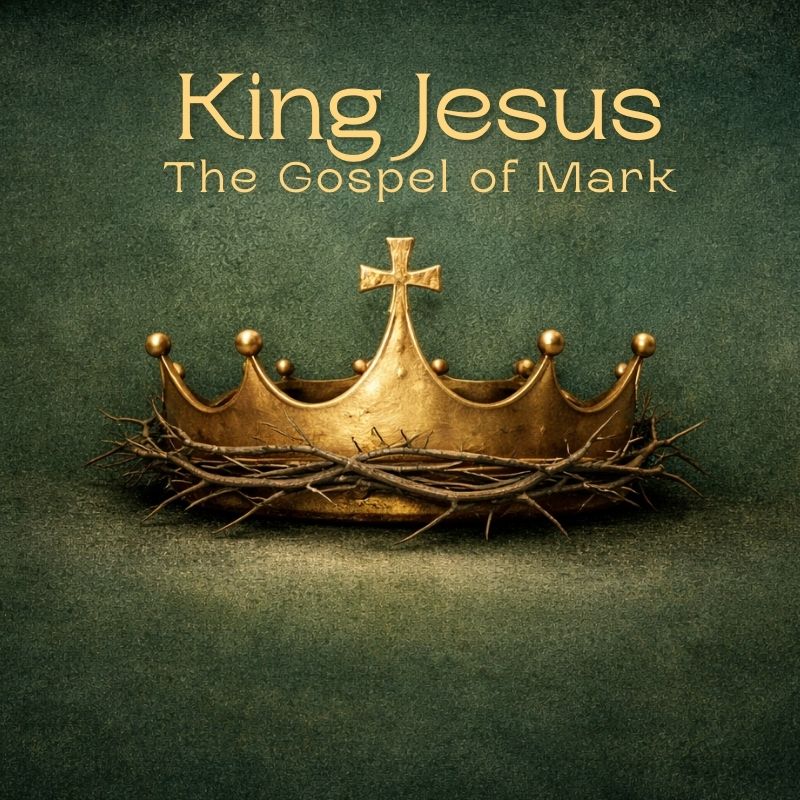
Tag: God

  • King Jesus: The Beginning of The Good News

    Do you like a good action movie?

    A James Bond film, Mission Impossible, or one of the Bourne movies? The kind where things are moving from the opening scene and the story carries real momentum.

    If one of the gospels were turned into action flick, Mark would be the script. It moves quickly, has lots of movement, and gets straight to the point. There is no warmup, no stretching beforehand, no long preamble. It is like the starter’s gun at the beginning of a race and we are off.

    Mark begins like this:

    “The beginning of the good news about Jesus the Messiah, the Son of God.” (Mark 1:1)

    That single line acts as both introduction and purpose statement. It tells us what the whole book is about before anything else is said. Like the opening line of a great novel, it draws us in. Except this isn’t fiction. This is the announcement of a real person and the purpose for which he came.

    Mark doesn’t include genealogies, birth stories, or any post-resurrection events. His focus is clear and deliberate. He wants to announce and show that Jesus is the Messiah and the Son of God. The book is centred on who Jesus is, what he does, and what it means to follow him.

    The word gospel (euangelion in the Greek) means good news. In the first century, good news would be publicly proclaimed when there was a military victory or a royal announcement. You can picture the town crier calling out the news of the day in the streets. In that sense, Mark is like a paper boy standing on the corner calling out the headline,

    “Good news. Jesus Christ, the Messiah, the Son of God has arrived.”

    But this good news is greater than a victory in battle or the birthday of an emperor. This is the announcement of God’s King and the fulfilment of long-awaited expectation and hope.

    The good news is not merely an event. It is a person. Jesus himself.

    Notice the titles Mark gives him. Messiah. Christ. Son of God. These are not polite honourifics. They are identity claims. They tell us that Jesus is not simply another religious teacher or prophet. He is uniquely connected with God and shares in God’s own identity.

    From the first sentence, Mark wants us to know who stands at the centre of this story. Everything else in the book hangs from this opening declaration.

  • Christmas 2025: Jesus

    Jesus – Luke 2:41–52

    We have citrus trees along the side of our house. Four years ago we planted them. They are still in the juvenile stage, growing taller and taller each season. It’s a slow process and will take another few years before they produce any fruit.

    Before Jesus preaches and begins His ministry of healing, teaching, miracles, and calling followers, we read of Him doing something very ordinary – learning. Here we get that picture of a student, asking questions, listening, and sitting among teachers. Even Jesus, the Son of God, takes part in that slow work of growth before going about producing anything.

    It’s quite a simple story. Jesus doesn’t perform any wonders or reveal Himself to others. What He is doing is growing in wisdom, stature, and favour with God and the people (v52). This is a time of formation for Jesus. And if Jesus required it, then perhaps we too might need to do the same.

    Growth doesn’t happen overnight, it’s often gradual, unnoticed, and uncomfortable. Yet God uses these seasons to shape us, to humble us, and provide us with wisdom and patience for the road ahead. Luke’s inclusion of this story reminds us that we are being formed through those unseen and ordinary years.

    It’s like learning a new musical instrument, having to practice and practice and practice when no one is looking. It’s like moving through adolescence, discovering who we are, what our purpose is, and where we belong. As someone once said, growth is like outgrowing old shoes; it’s awkward, slightly painful, but necessary.

    We often want instant results, instant transformation, but discipleship takes time.

    Ask God to highlight one area where He wants you to grow this season. Is it patience, courage, compassion, humility, wisdom, rest? Something else perhaps? Take one small step this week in that direction.

    Where might God be inviting you to lean into slow, steady growth this Christmas?


    This devotional series runs alongside our Songs for the Saviour sermon series this Christmas. It explores the four ‘songs’ of Luke’s Gospel, which in their historical Latin form are known as the Magnificat, Benedictus, Gloria in Excelsis, and Nunc Dimittis.

  • The Tender Mercy of God

    In the month leading up to Christmas Day I think I have been present and shared something of the Christmas story at six ‘extra’ end of year events. We all know it’s a busy time, with plenty of different activities in church, school, and other community groups we’re involved in. For me, this has probably been my most active Christmas in some time, possibly ever. And as you can imagine, I’m wanting to share the great news of Jesus’ birth, but also do so in a way that isn’t stale. I want it to be attractive and meaningful for the hearers, and also for me personally as the speaker. At some of these events I can share the same message with a tweak or two, but by the time you’ve done that 2-3 times I feel within myself that it’s time to change it up. 

    That’s why, at our Community Kitchen Christmas meal the other evening, I decided to share for five minutes on the phrase, “the tender mercy of God”, which comes from Luke 1:78.

    It’s such a great phrase. It’s beautiful really. And it is part of the Christmas story, tucked away in Zechariah’s song. 

    After months of silence, and the birth of his son John, Zechariah breaks into praise. His words look back and acknowledge God’s faithfulness (Luke 1:68-75), and then turn toward the future and the coming of Jesus, which lead him to say those words, “the tender mercy of God”. 

    Tender mercy. 

    This is not forceful power. 

    This is not harsh correction. 

    This is not distant authority. 

    This is tender mercy. 

    Zechariah’s song helps us understand what kind of God we are dealing with, and what kind of salvation He is bringing into the world through Jesus. 

    John, Zechariah’s son, was not to be the central character of the story. He would be the one who prepared the way. Like the opening act at a concert who warms up the crowd and gets them ready for the main artist or band, his role was important but not ultimate. He would point beyond himself to Jesus. 

    And what was he preparing people for? 

    Not a political revolution. 

    Not economic rescue.

    Not national independence. 

    John was preparing people for salvation through the forgiveness of sins. A salvation that flows from God’s tender mercy. 

    If we’re honest, we often look outward for our own salvation. We want to be saved from difficult circumstances, whether it’s pressure at work, financial stress, health challenges, and broken relationships. And God cares about all those things. 

    But Christmas reminds us that God’s deeper work for us is inward. 

    God comes to deal with the things we carry beneath the surface. Guilt. Shame. Regret. Fear. The quiet sense that things aren’t right inside of us. 

    And He doesn’t come aggressively or forcefully, He comes gently and tenderly. 

    God doesn’t approach us with a raised voice, or come to shame and humiliate. He isn’t impatient or hurried or fed up and disappointed. 

    God meets us in our brokenness with closeness. 

    He draws near. 

    Perhaps you’ve had a similar experience to me when on Christmas Day you celebrate a meal with all the special cutlery and utensils. I’m sure you know what I’m talking about. Out comes the special plates, the special bowls, the fine glassware, and the more expensive cutlery. There are decorations that only come out once a year, perhaps there are some precious ornaments displayed around the room too. And within this celebration there are kids around, excited and happy and joyful. 

    Now, imagine that one of them accidentally knocks a glass off the table. It shatters on the floor and its contents stain the carpet. The room is suddenly quiet. The child freezes. They’re waiting. 

    What are they waiting for? Most likely a parent or family member to get cross out of the stress, pressure, and frustration that a Christmas Day meal can bring. 

    But tender mercy is not snapping in frustration. 

    Tender mercy is not shaming or scolding. 

    Tender mercy is kneeling down, wrapping them in a hug, and saying, “It’s OK. No worries. I’ll sort it out.”

    This, Zechariah tells us, is what God is like. 

    Because of God’s tender mercy, Jesus comes into the world. 

    Because of God’s tender mercy, forgiveness is possible.

    Because of God’s tender mercy, light shines into dark places.

    And because of God’s tender mercy, God guides people into a path of peace.

    It isn’t about having life neatly organised. It isn’t about pretending things are fine. It isn’t about performing spiritual competence. It is about a God who draws near, who sees us as we are, and who chooses compassion over condemnation.

    Wherever this season finds you; tired, hopeful, grieving, uncertain, or desperately trying to hold things together, the message of Christmas remains the same.

    God’s mercy is tender.

    And it is for you.

  • Book Review: Spurgeon’s Sorrows – Realistic Hope for Those Who Suffer from Depression

    Would it surprise you to learn that one of the greatest preachers in Christian history, the so-called ‘Prince of Preachers’, struggled with depression throughout his life and ministry? 

    Charles Haddon Spurgeon, pastor of the Metropolitan Tabernacle in 19th-century London, preached to thousands weekly, wrote extensively, and continues to shape preachers today. Yet behind the sermons, quotes, and books was a man who often walked through deep fog and valleys of darkness.

    I have known for many years that Spurgeon battled various health concerns, and at least a little depression, but I hadn’t realised how pervasive it actually was. In reading Spurgeon’s Sorrows by Zack Eswine I gained a better picture of the man but also the depths to which his depression and anxiety impacted his life. The other surprising thing about this was how public and how often he spoke about it. This short little volume (just over 100 pages) really opens the reality of mental illness not just for believers but also for pastors. I know it’s not talked about often, if at all, and this book is so helpful and insightful for all saints and sufferers. 

    Our churches are full of people who are going through depression, anxiety, and all ranges of mental illness. We may not see it while interacting with them on a Sunday morning, but they sit there, often silently, battling the melancholy of the mind. Older people carrying the weight of loneliness, middle-aged adults questioning their position in life, young people navigating their identity and uncertain future. They may not look depressed but are sure to be there in the pews. 

    As Christians it is important to talk about this. The Psalms do. So does Job. So does Elijah. So does Paul. And so does Spurgeon. One reason I found this book helpful was the normalising of this conversation without reducing it to Christian cliches or simplistic solutions.

    To give you an idea of the depth of Spurgeon’s struggle he once said, 

    “The mind can descend far lower than the body, for in it there are bottomless pits. The flesh can bear only a certain number of wounds and no more, but the soul can bleed in ten thousand ways, and die over and over again each hour.”

    He knew the darkness that makes it hard to pray, to preach, to feel anything at all. That numbness that comes over us when walking through an unending fog. He writes about this kind of depression as something that comes uninvited and stays longer than is welcome. And yet, in all of this, he saw no contradiction between faith and depression. He writes elsewhere, “Depression of spirit is no index of declining grace”. 

    This is encouraging for us as believers. It’s comforting to hear this from someone who has lived faithfully under the weight of this burden. How often are we prone to think such a thought or such a condition may disqualify us of our belief? But it is not so!

    We walk with Christ in the valleys and on the mountaintops and everywhere in between. 

    Eswine writes with care and warmth. He doesn’t overreach. He lets Spurgeon speak and then offers reflections that feel more like a conversation. 

    In one part of the book Eswine lists various helps that Spurgeon would undertake to help him recover from these periods of flatness, which again was really helpful. But he goes on to talk about how, 

    “The melancholy life thrives when it runs marathons instead of sprints, or when it sprints often, only to rest often. You needn’t try to do “the most things” in “the fastest ways” anymore. To resist this is to have seasons of rest and nature forced upon us by breakdown.”

    This is helpful for all of us who find ourselves running too fast and living on the edge of our limits. Whether it’s burnout, exhaustion, or anxiety, there is the invitation to slow down and let go of that performance mentality. 

    At times Spurgeon himself described what it was like when the overwhelm was upon him.In a sermon called The Christian’s Heaviness and Rejoicing he preached these words:

    “I was lying upon my couch during this last week, and my spirits were sunken so low that I could weep by the hour like a child, and yet I knew not what I wept for…”

    How about that!? How raw. How open. How vulnerable and honest. It’s not the kind of thing we would hear out of a 21st-century preacher would we?

    The book, thankfully, doesn’t offer neat answers, tied up firmly like a shoelace. It doesn’t promise that darkness will lift, but what it does do is point to Christ. It points to Christ to declare that He is the one who truly understands what we may be going through. 

    I would recommend this book to anyone, it’s a must read. It’s five stars. If you’re a pastor it will do your own soul a truckload of good, and also help you walk with those who suffer from mental illness themselves. If you’re someone who experiences depression, or are in it now, then this book gives you a helpful and faithful voice to that which you struggle with. And if you walk with those who do walk the road of mental illness then this book might help you understand it a little more. 

    To close I can’t but leave you with one of my favourite quotes from Spurgeon about suffering and depression. While speaking about God providing all our needs from Philippians 4:19 he preaches,

    “Then comes our need in suffering, for many of us are called to take our turn in the Lord’s prison camp. Here we need patience under pain and hope under depression of spirit. Who is sufficient for furnace-work? Our God will supply us with those choice Graces and consolations which shall strengthen us to glorify His name even in the fires! He will either make the burden lighter, or the back stronger—He will diminish the need, or increase the supply.”

    Amazing. 

    How great that the Lord our God is with us through the troughs of life and will indeed supply us with everything we need. 

  • Pull Up A Pew

    Pull Up A Pew

    I’ve been toying around with poetry lately, both as a fun little exercise and something to learn and improve my writing.

    I wrote the following after reflecting on Matthew 14:23, where Jesus, even after all the ministry and miracles, withdraws alone to pray. I suspect many of us live in the tension of hurry and stillness, this is a kind of prayer from that place. An invitation to slow down and respond out of the rest in his presence.

    Pull Up A Pew

    Driven, my heart beats fast and faster
    Hurried, from one to the next
    The urgent crowds out my time and place
    To sit, be still, and seek your face. 

    The mind, it races on and on
    Thinking, what I ought to do
    So much, so many, so few pursue
    But here you call, pull up a pew.

    You stopped and went with task after task
    Up the mountain, where in the Father you bask
    Teach me your ways, for I forget
    Instead I find I just project.

    I want to stop and pray my Lord
    To find the rest you promise so
    To leave the work in your hands
    As you lead me to the silent lands.

    After dismissing the crowds, he went up on the mountain by himself to pray. Well into the night, he was there alone. – Matthew 14:23